
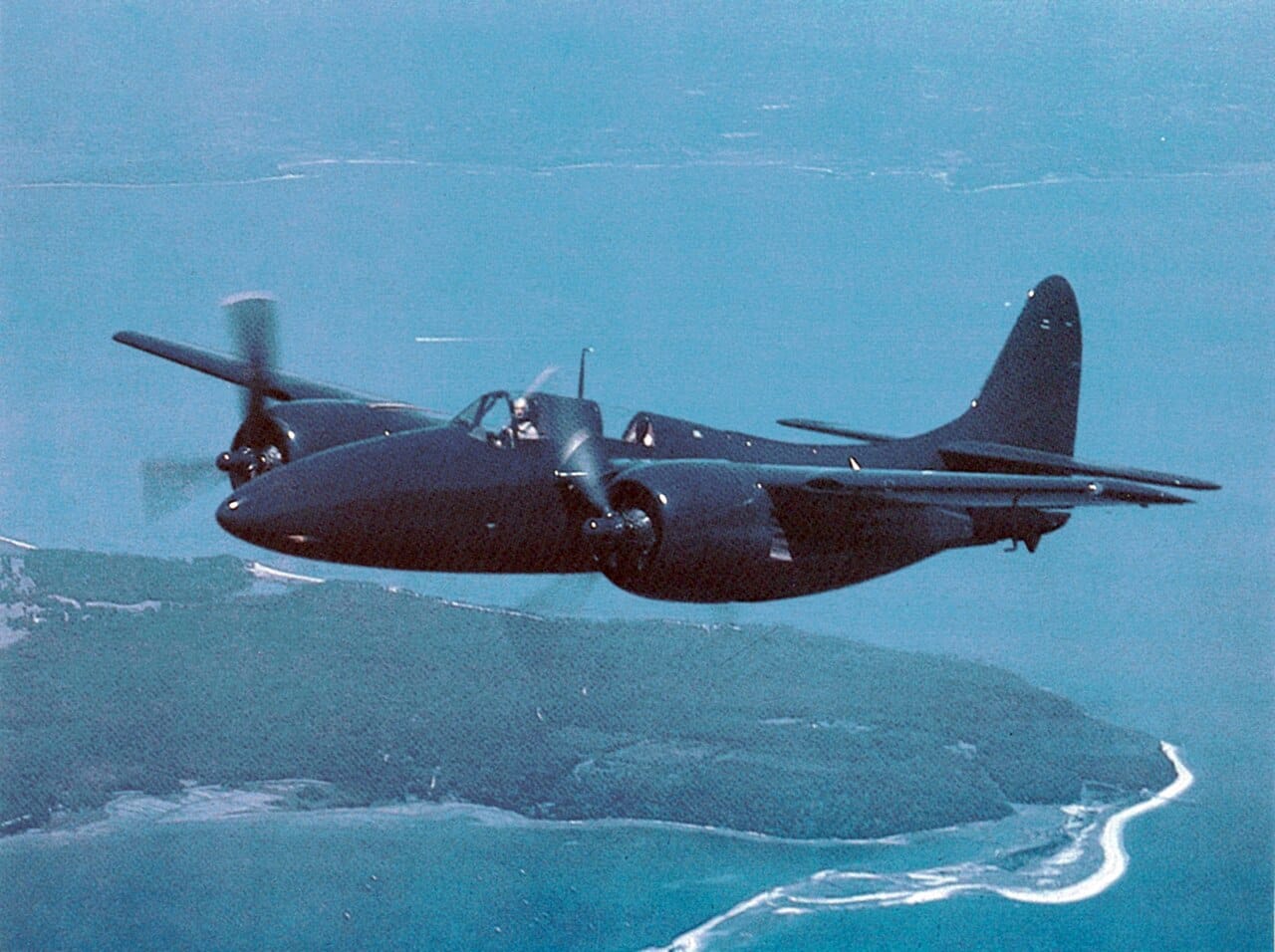
Grumman set out to build the finest carrier fighter of the Second World War: a twin-engine brute that could outrun and outgun anything in the sky and haul a bomber’s worth of ordnance off a flight deck. It succeeded. The Tigercat was blisteringly fast, savagely armed, and beautiful. It also arrived just in time to miss the entire war.
What followed was one of aviation’s stranger careers — a superb fighter that never got the fight it was designed for, was rejected by the very carriers it was built for, and ended its days dropping fire retardant on burning hillsides.
Datos rápidos
- Aeronave: Grumman F7F Tigercat
- Tipo: twin-engine heavy fighter (USN/USMC)
- Motores: 2 × Pratt & Whitney R-2800 Double Wasp, 2,100 hp each
- Velocidad máxima: 460 mph — 71 mph faster than the F6F Hellcat
- Armament: 4 × 20 mm cannon and 4 × .50 cal, plus bombs, rockets or a torpedo
- Construido: around 364, from 1943; retired 1954
The cat that was almost a Tomcat
Grumman named its fighters after cats — Wildcat, Hellcat, Bearcat — and this one was first called the Tomcat. The Navy’s Bureau of Aeronautics balked: “tomcatting around” carried overtones unbecoming of officers and gentlemen. So the Tomcat became the Tigercat, and the name was shelved for thirty years until a very different Grumman twin, the F-14 Tomcat, claimed it.
The design grew out of a June 1941 Navy request for a large twin-engine fighter to fly from the big new Midway-class carriers. Grumman’s goal was blunt: build something that outperformed and outgunned every fighter alive.
A documentary on the Tigercat, the last of Grumman’s wartime cats.
Fast, mean — and too big for the boat
On paper and in the air, the Tigercat delivered. It topped 460 mph, some 71 mph faster than the Hellcat at sea level, and packed four 20 mm cannon and four heavy machine guns. But all that speed and firepower came wrapped in a big, heavy airframe, and the aircraft flunked its carrier trials: it was unstable on one engine, its tailhook gave trouble, and a wing failed on a heavy landing aboard USS Shangri-La. Worse, its smooth nose threatened to slide straight over the deck’s crash barrier and decapitate the pilot.
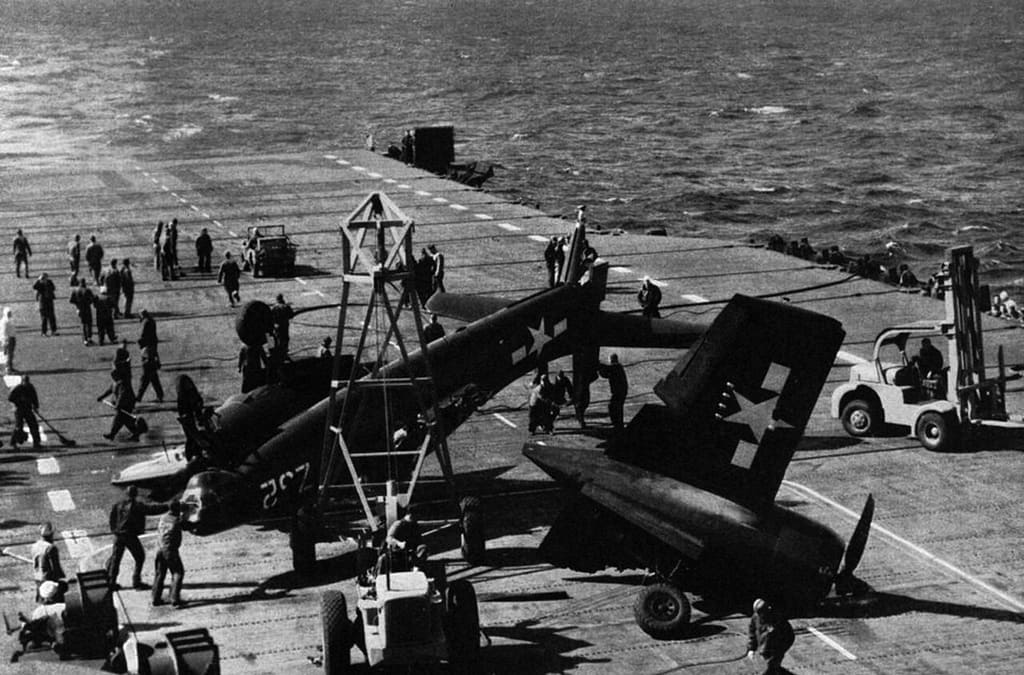
Only about a dozen specially strengthened F7F-4N models ever qualified for carrier work. The rest were handed to the Marines to fly from dry land, mostly as radar-equipped night fighters.
Love and hate in the same cockpit
That praise came at the end of a memorable dressing-down. Grumman’s project pilot, Corwin “Corky” Meyer, recalled walking Trapnell out to the aircraft and mentioning that he’d run the Tigercat programme. Trapnell promptly reeled off a list of the aircraft’s sins — over-cooling engines, poor stability, dangerous single-engine handling — and delivered a verdict Meyer never forgot.
And yet, Meyer noted, Trapnell chose to fly the Tigercat whenever he could — for its power, its visibility, its roll rate and its range. He hated its flaws and loved the aeroplane anyway. It was that kind of machine.
A surviving Tigercat put through an aerobatic display — the sound of two Double Wasps at full song.
A war it missed, and a second life
Reconnaissance Tigercats reached Okinawa only in the war’s final weeks, photographing the beaches of Kyushu for an invasion of Japan that never came. The type saw skirmishes in China’s civil war, then found its only real combat in Korea, where Marine night fighters flew interdiction and close air support — and shot down two ancient Polikarpov Po-2 biplanes, the “Bedcheck Charlie” night hecklers. Those two kills were the Tigercat’s entire combat scoreboard.
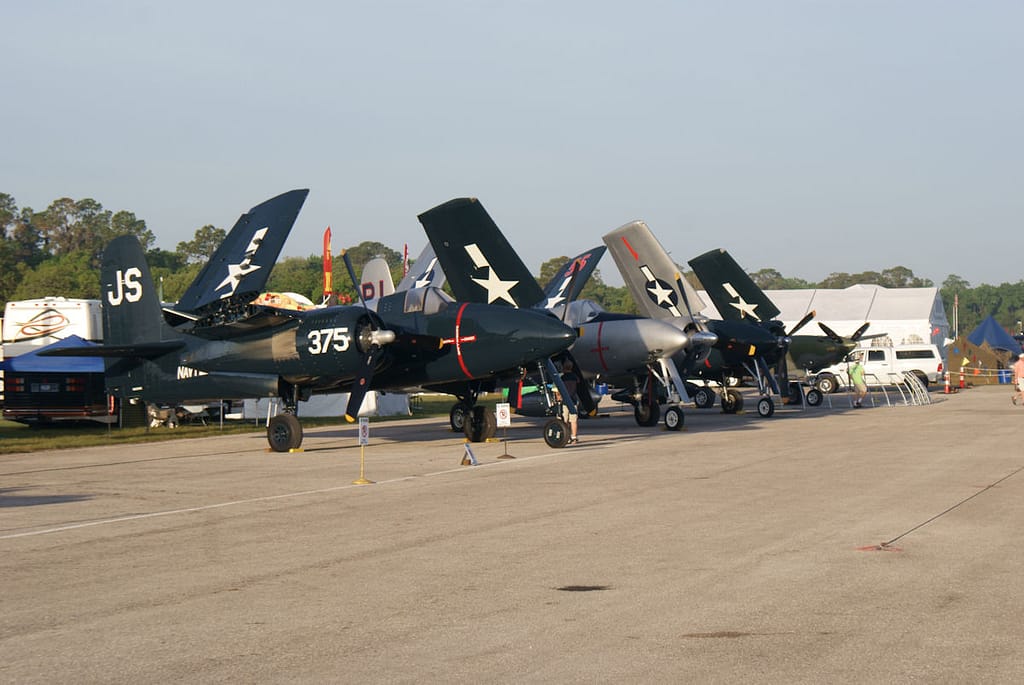
Retired from the military, the survivors traded cannon for chemical tanks and spent the 1960s to 1980s as fast, agile fire-bombers. A few still fly the warbird circuit today — and in 1996 a Tigercat even shared a display with its name-inheritor, the F-14 Tomcat, closing the circle on Grumman’s great cats. The Tigercat never got the war it deserved. It remains, all the same, one of the finest fighters almost nobody got to fight in.
A closer look at the Tigercat and its history.
Sources: Grumman F7F Tigercat (Wikipedia); Corwin H. Meyer, “F7F Tigercat: The Untold Story,” Flight Journal (2002); The Aviation Geek Club; Jane’s Fighting Aircraft of World War II.
0 Comentarios