
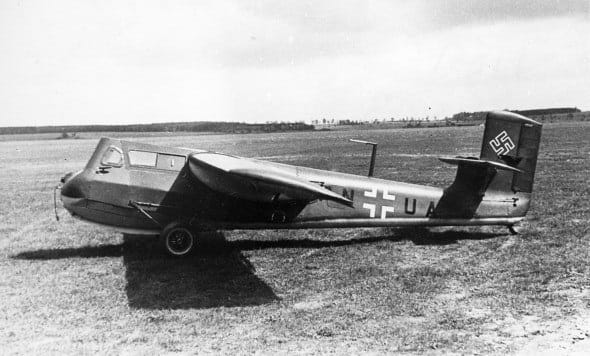
By 1943 the arithmetic over Germany had turned against the Luftwaffe. American daylight bomber streams — the tight, mutually-defending boxes of B-17s and B-24s — were arriving in numbers that piston fighters could not blunt fast enough. Blohm & Voss offered an answer that inverted almost every assumption of fighter design: an interceptor with no engine at all.
The concept was disciplined rather than desperate. Remove the powerplant and you remove weight, cost, fuel, and a large part of the airframe an enemy gunner can aim at. What remained was a tiny, cheap, wooden glider that could be towed to altitude by a single-engined fighter, released above the bomber box, and dived down through it. Speed came from gravity, not horsepower.
- Type: single-seat armoured glider fighter, no engine fitted
- Designer: Dr. Ing. Richard Vogt, chief designer at Blohm & Voss
- Armament: two 30 mm MK 108 cannon in wing-root pods, 35 rounds per gun
- First flight: 6 May 1944; 17 flights flown in total
- Built: six prototypes of roughly 20 ordered; programme cancelled 13 August 1944
- Combat use: none — the survivors were destroyed in a B-24 raid on Wenzendorf on 6 October 1944
The logic of leaving the engine behind
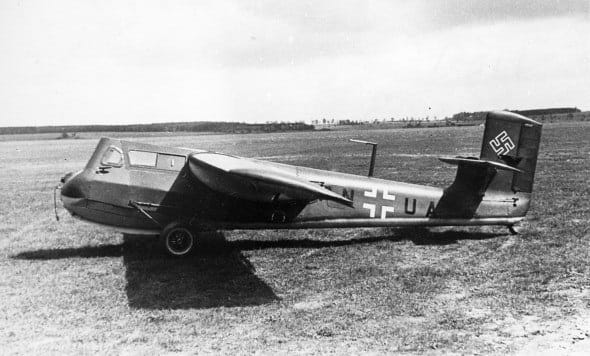
A glider fighter only makes sense if it is genuinely hard to hit and hard to destroy. The BV 40 pursued both. To shrink its frontal cross-section, the pilot did not sit — he lay prone, flat on his stomach, chin forward over the guns. A centrifuge study had suggested the prone position raised a pilot’s g-tolerance, useful for a machine expected to dive and pull hard through a formation.
The fuselage was barely 0.7 m wide. With no engine and a wooden airframe using non-strategic materials, the aircraft could in principle be built quickly by unskilled labour. The trade-off was permanent: once released, the BV 40 could not climb and had one, at best two, firing passes before it committed to a glide home. It took off on a jettisonable trolley and landed on a nose skid.
Vogt’s armoured splinter
Where the BV 40 spent its weight was on protection. The cockpit was a box of flat armour plate, faired over with wood only to cut drag. Front armour ran to 20 mm. Set into the frontal plate was a windscreen of bulletproof glass 120 mm thick — a slab nearly as deep as a fist.
The armour created its own problem — so much steel deflected the compass that the instrument had to be mounted protruding from the nose and read through mirrors. There was a cost to all this steel, too: as prototypes took shape, Blohm & Voss found the aircraft badly overweight, and early airframes had to be lightened by some 180 kg to fly at all.
Teeth: two MK 108 cannon
The armament was settled on two 30 mm MK 108 cannon, moved into pods at the wing roots. The MK 108 was a short-barrelled, low-velocity weapon firing a heavy high-explosive shell — a bomber-killer that needed only a handful of hits. Each gun carried just 35 rounds. The gunsight was simply painted onto the windscreen.
One exotic option was a small bomb towed on a long cable, meant to be flown across a bomber so that either the bomb struck it or the cable snagged it. In testing it proved very nearly impossible to use.
From ramming to gunnery
The original mission was cruder than shooting. As first proposed, the BV 40 would dive and ram a bomber’s tail to bring it down. Vogt himself talked the Air Ministry out of it, arguing that a ramming attack was impractical and not worth the weight of armouring the wings against impact.
This is the point where the design sheds its suicidal reputation. It was refined, on the designer’s own insistence, into a gun-armed interceptor. By April 1944 the fighter arm had already lost interest.
Six airframes, and then a bomb raid
The first prototype got airborne on 6 May 1944, only to be badly damaged landing weeks later. Across the programme the type made 17 flights and reached about 470 km/h. It was not enough. The weight-saving had compromised the structure, the ammunition load was tiny, and against Allied escort fighters the engineless glider was helpless once its momentum was spent.
The Luftwaffe formally cancelled the BV 40 on 13 August 1944. Six prototypes had been completed of roughly twenty ordered. The airframes were stored in a hangar at Wenzendorf and destroyed when B-24 Liberators bombed the field on 6 October 1944. The BV 40 never met a bomber it was built to kill.
Sources: Wikipedia (Blohm & Voss BV 40); Plane-Encyclopedia; Dan Sharp.
Publicaciones relacionadas

0 Comentarios