
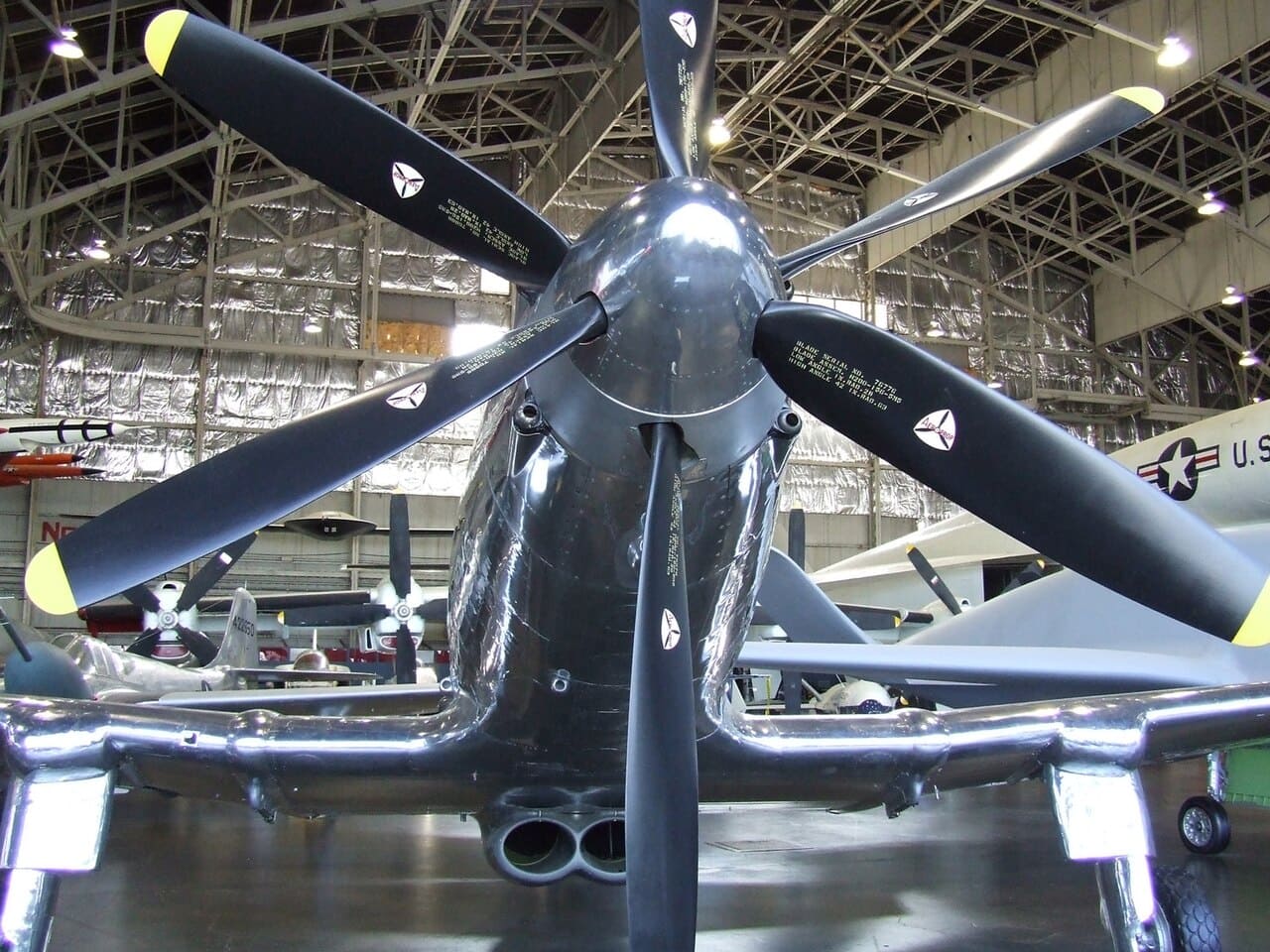
In 1942, someone at General Motors had a tidy idea: instead of designing a new fighter from scratch, why not bolt one together from parts of aircraft that already existed? Take a Mustang’s wings, a dive-bomber’s tail, a Corsair’s landing gear, wrap them around the most powerful engine in America, and you would have a war-winning interceptor in a fraction of the time.
The result was the Fisher P-75 Eagle. It is remembered today as one of the worst aircraft the United States built in the entire Second World War.
DATOS RÁPIDOS
| Role | Single-seat fighter (interceptor, then escort) |
| Primer vuelo | 17 November 1943 |
| Diseñador | Don R. Berlin (Fisher Body Division, General Motors) |
| Central eléctrica | Allison V-3420, 24-cylinder, ~2,885 hp, contra-rotating props |
| Número construido | 14 (8 XP-75 + 6 P-75A) |
| Destino | Cancelled 6 October 1944; one survivor at the NMUSAF |
A fighter from the parts bin
The concept was championed at the highest levels of wartime production, and on paper it was seductive. The outer wings would come from the P-51 Mustang (later swapped for P-40 panels), the tail from the Douglas Dauntless dive-bomber, the landing gear from the F4U Corsair. The engine sat behind the pilot, driving contra-rotating propellers through long extension shafts — the layout of the Bell P-39 Airacobra.
At its heart was the Allison V-3420: essentially two V-1710 engines welded onto a common crankcase, a 24-cylinder monster making close to 2,900 horsepower. The Eagle was designed around a demand for a phenomenal rate of climb, and that engine was supposed to deliver it.
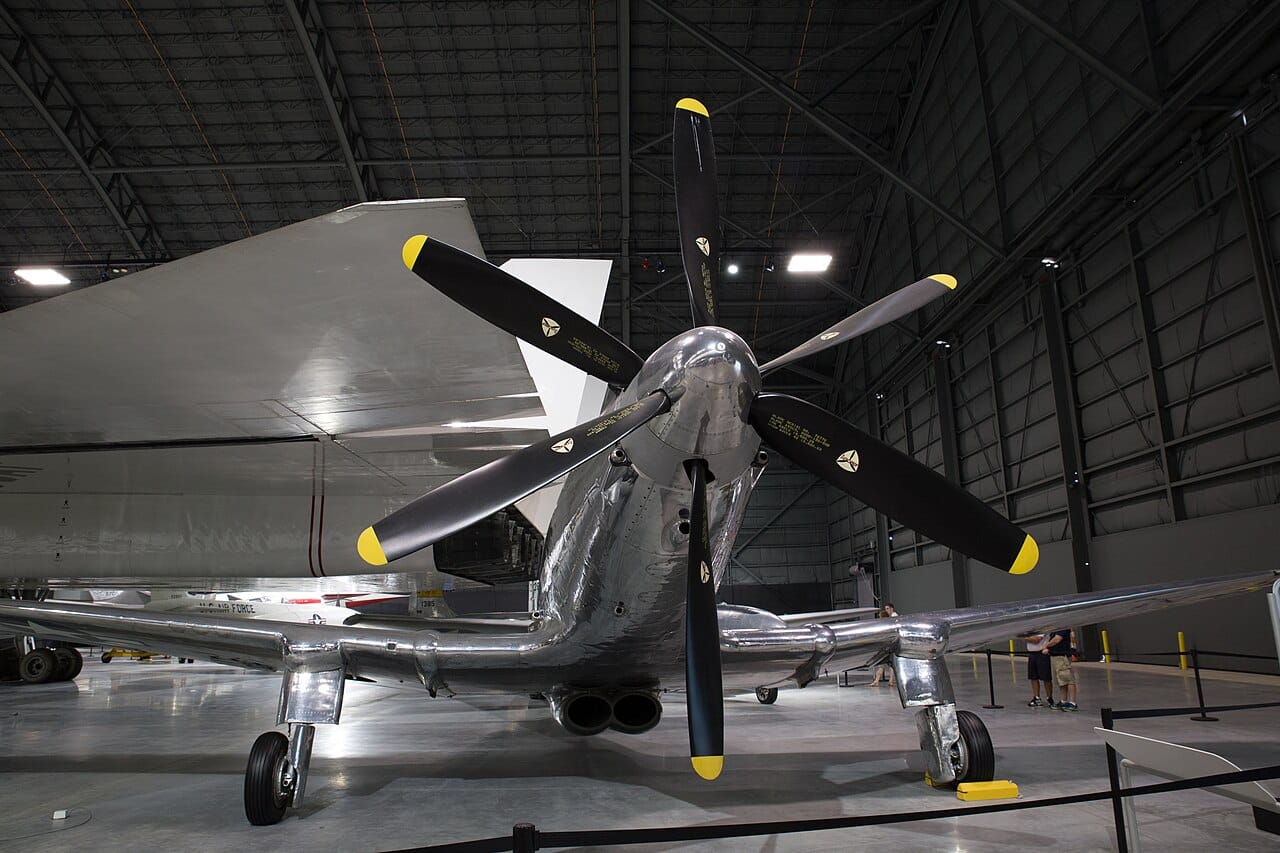
It did not work. When the XP-75 first flew on 17 November 1943, the problems came thick and fast: the centre of gravity was miscalculated, the engine never made its promised power, cooling was inadequate, the ailerons were brutally heavy, and the spin behaviour was dangerous. The parts, it turned out, had been designed for other aircraft with other flight characteristics — and forcing them together produced something that flew worse than any of its donors.
Never an Eagle
Aviation historian Stephan Wilkinson did not mince words about where the P-75 ranks.
By the time the Eagle was flying, the argument for it had collapsed anyway. The P-51 Mustang and P-38 Lightning were already escorting bombers deep into Germany and back, brilliantly. The P-75 offered nothing they did not already do better, could not be fielded quickly, and was no longer needed. A conditional order for 2,500 aircraft was cancelled on 6 October 1944 after just 14 had been built.

The lesson has aged well. A fighter is not a collection of good parts; it is a single, coherent design in which everything is balanced against everything else. Swap in a wing built for a different aircraft and you inherit its assumptions, not just its shape. The Eagle is the cautionary tale every aircraft designer knows — and the sole survivor, sitting quietly in a Dayton museum, is its monument.
Sources: Stephan Wilkinson, "Why America’s XP-75 Eagle Was a Turkey," HistoryNet; National Museum of the USAF; Wikipedia.
Publicaciones relacionadas
0 Comentarios