
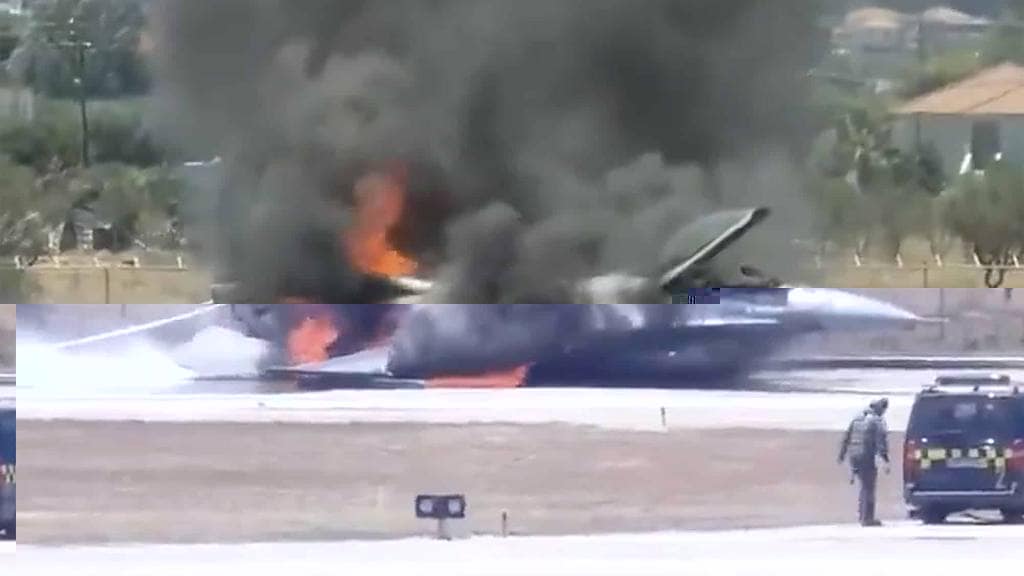
The holidaymakers on Zakynthos came for the beaches. On the afternoon of Jul. 9, 2026, they got something else entirely: a single-seat fighter jet sliding down the runway on its belly, trailing sparks, then wrapped in flame as fire crews rushed to smother it.
The aircraft was a Hellenic Air Force F-16C Fighting Falcon. It had launched on a routine training sortie and, somewhere in the flight, developed a technical malfunction serious enough that the pilot chose not to gamble on a normal recovery. With the landing gear refusing to come down, he brought the jet in wheels-up onto the tarmac of the island better known to Europe as Zante.
He walked away. That is the headline that matters.
• Fecha: 9 July 2026, early afternoon local time
• Aeronave: Hellenic Air Force F-16C Fighting Falcon
• Unidad: 116th Combat Wing, Araxos Air Base, western Greece
• Ubicación: Dionysios Solomos Airport, Zakynthos (Zante)
• Causa: Technical malfunction in flight; landing gear failed to deploy
• Resultado: Gear-up belly landing, post-landing fire extinguished; pilot unhurt, did not eject
A landing with no wheels, and no way around it
A gear-up landing is one of aviation's oldest emergencies, and it never gets less delicate. Without the undercarriage to absorb the touchdown, the airframe itself becomes the landing gear — scraping along the runway on its underside, its fuel tanks and single engine inches from the concrete.
Video filmed from the ground, and later shared widely on social media, confirmed what the pilot already knew on approach: the gear was up as the jet crossed the threshold. Moments after it stopped, fire broke out around the fuselage. Airport crews, pre-positioned along the runway once the emergency was declared, doused the flames with water and foam within seconds.
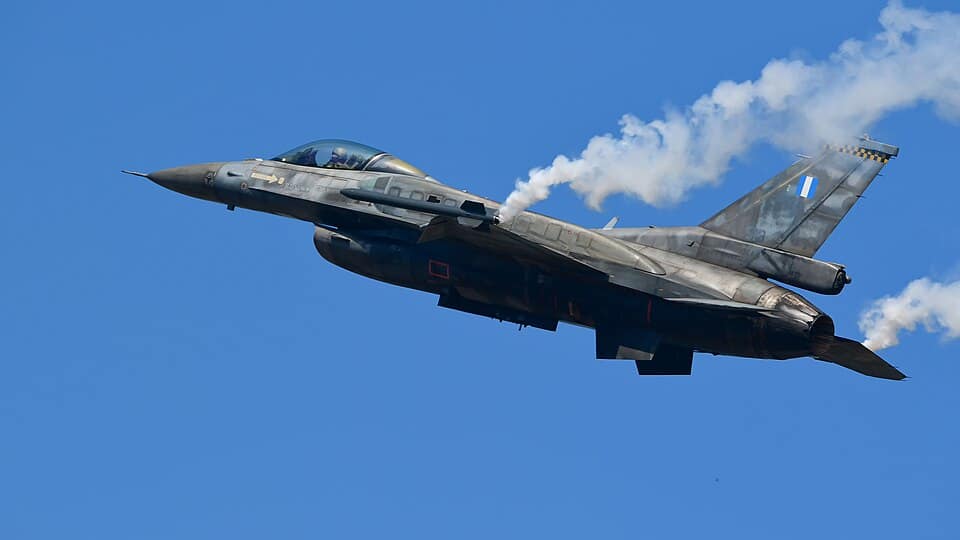
Crucially, the pilot left the cockpit the ordinary way — climbing out rather than ejecting. Both the canopy and the ejection seat were still in place on the burned jet, a small but telling detail: he judged he could ride it down and get out on his own, and he was right.
Caught on camera
The incident played out in front of a phone-wielding public. The Greek daily Kathimerini posted early footage of the aftermath, and aviation trackers quickly confirmed the operator from the dark-grey paint and national markings — despite some first reports mistakenly claiming the jet was American.
Lieutenant Colonel Konstantinos Gravalos, speaking for the Hellenic Air Force, confirmed the pilot was in good health. An investigation into the malfunction is under way.
A tourist runway, briefly a crisis
Zakynthos is a compact holiday airport, not a fighter base, and the emergency threw its afternoon schedule into chaos. A Notice to Airmen closed the single runway to all but approved medical, government and military helicopters, and inbound airliners — including a British Airways flight — were diverted to Athens, Corfu and Thessaloniki.
The jet belongs to the 116th Combat Wing at Araxos, home to the 335th and 336th Squadrons. The wing holds a peculiar footnote in aviation history: it was the last military unit anywhere to fly the Vought A-7 Corsair II, retiring the type in 2014. Today it flies F-16s, part of a Greek fleet of more than 100 Fighting Falcons now being modernised to the potent F-16V Viper configuration.
For all the drama of the flames and the sirens, the outcome is the one every air force hopes for when a jet comes home broken: the aircraft is repairable or replaceable, and the pilot is not. On Zante, that is exactly how it ended.
Sources: The Aviationist; eKathimerini; Defence Blog; Aviation A2Z.
Preguntas relacionadas
What happened to the Greek F-16 on Zakynthos?
On July 9, 2026, a Hellenic Air Force F-16C Fighting Falcon made a wheels-up belly landing at Dionysios Solomos Airport on Zakynthos (Zante) after a technical malfunction left its landing gear unable to deploy. The jet slid down the runway trailing sparks and caught fire, but the pilot climbed out safely and fire crews smothered the flames within seconds.
Did the Greek F-16 pilot survive the belly landing?
Yes. The pilot walked away. He left the cockpit the ordinary way, climbing out rather than ejecting, so both the canopy and ejection seat remained in place on the burned jet. He judged he could ride the crippled aircraft down and get out on his own, and he was right.
What is a belly landing?
A belly landing, or gear-up landing, is when an aircraft touches down on its fuselage because the landing gear failed to extend or was retracted deliberately. Pilots weigh it against ejecting; a well-flown gear-up landing on a prepared runway, with fire crews pre-positioned, can be survivable, as the Greek F-16 case on Zakynthos showed.
How many F-16s does Greece operate?
Greece flies more than 100 F-16s, one of the largest Fighting Falcon fleets in Europe, now being upgraded to the advanced F-16V Viper standard. The accident aircraft belonged to the 116th Combat Wing at Araxos Air Base in western Greece. Romania is another European F-16 operator, having recently scored its first Baltic intercept in the type.
¿Qué es el F-16 Fighting Falcon?
The F-16 is a single-engine, single-seat multirole fighter first flown in the 1970s and operated by dozens of air forces worldwide. Prized for agility and value, it stays front-line into the 2020s through upgrades like the F-16V Viper. Civilians can even ride one, which is why an F-16 beats first class on a transatlantic flight.


0 Comentarios