
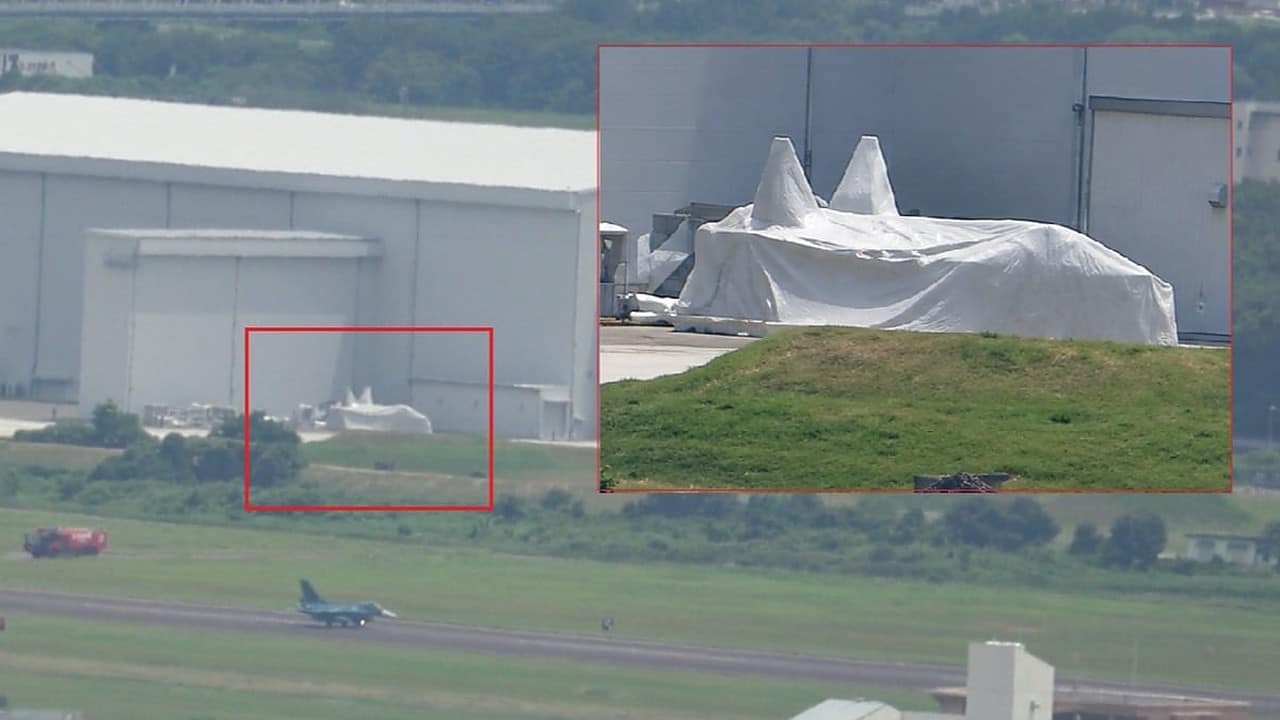
En una húmeda tarde de junio, un aficionado japonés a la aviación apuntó con un teleobjetivo a la pista de aterrizaje de la base aérea de Gifu y se quedó paralizado. Contra la pared de un hangar había algo grande, del tamaño de un caza, envuelto de punta a cola en tela blanca como un mueble en una casa deshabitada. Dos picos afilados sobresalían de la tela donde deberían estar las colas. Todo lo demás estaba oculto.
The spotter, who posts as @intpt93, summed up the moment in a single line: “Huh… Whaaaaaat!!!! Biggest shock of the day.” The photo detonated online, racking up roughly 2.2 million views within hours. And then the guessing began. What, exactly, is Japan keeping under a bedsheet on the ramp of its most important flight-test base?
Here is the honest answer up front: nobody outside a small circle in Tokyo knows for certain, and that is precisely what makes this so interesting. So let’s do the fun part — walk the clues, weigh the theories, and explain why the most tantalising one points toward the most ambitious fighter programme Japan has joined in generations.
Datos rápidos
- Qué: Un avión de doble cola completamente cubierto de tela blanca, estacionado en la pista de aterrizaje.
- Dónde: Gifu Air Base, central Japan — home of the JASDF’s Air Development and Test Wing
- Cuando: Fotografiada el 18 de junio de 2026; publicada por el usuario @intpt93.
- Por qué es importante: Gifu is Japan’s flight-test centre during the country’s biggest aviation push in decades
- La teoría principal (sin confirmar): Podría estar relacionado con el proyecto de caza de próxima generación GCAP/FX (F-3).
- Estado: Speculation. The covering hides every identifying detail — no confirmed ID exists
La foto que revolucionó internet (brevemente)
Plane-spotting at a military airfield is usually a patient hobby of cataloguing the expected: the same fighters, the same trainers, the same tankers, logged and filed. What makes the Gifu image so electric is how badly it breaks that rhythm. A fully shrouded airframe on an open ramp is not normal. It is, almost by definition, someone’s attempt to stop you seeing something.
The covering does its job ruthlessly. It erases markings, sensor apertures, intake shaping, panel lines — every cue an analyst would normally use to pin down a type. What it cannot fully hide is the gross shape, and that is where the detective work starts. Two distinct peaks rise through the fabric near the rear, strongly suggesting a twin, canted-tail configuration. The bulk underneath reads as a full-size combat aircraft, not a trainer or a drone.
Los observadores hicieron lo que mejor saben hacer: buscaron una regla. Con un caza F-2 rodando en primer plano para tener una referencia de tamaño, la forma envuelta parecía tener un tamaño comparable al de un F-15 — in other words, a heavyweight in the same class as Japan’s frontline air-superiority jet, rather than something small and light. That single comparison narrows the field considerably, even if it settles nothing.
Por qué Gifu es el lugar más interesante para esconder un avión a reacción.
Location is half the story. Gifu Air Base, in Gifu Prefecture, is the headquarters of the Air Development and Test Wing — the unit responsible for wringing out new aircraft, avionics and systems before they ever reach an operational squadron. If Japan is testing something genuinely new, Gifu is the natural place to do it. A shrouded mystery here carries more weight than the same sight at an ordinary fighter base.
There is a second clue stacked on top. An OSINT account, @Mumbo_Ghost, flagged that Gifu has been building a new Electronic Warfare Evaluation Facility to replace an ageing anechoic chamber — the kind of signal-absorbing room used to measure an aircraft’s radar cross-section and check its electronic-warfare gear without outside interference. The new facility reportedly supports fighters, stand-off jammers and AWACS-type aircraft. That is a heavy hint about the sort of work Gifu is gearing up for.
Put the two together and a plausible, mundane explanation appears: if an aircraft is being prepared for radar-signature or EW testing, draping it in fabric is a cheap, effective way to keep cameras — and satellites — from reading the exact configuration of any sensitive modifications. The shroud might be operational security around a measurement campaign rather than a brand-new airframe at all.
Berthon was talking about the UK end of the programme, not the Gifu sighting — but his words capture the tempo. Across all three partner nations, next-generation combat air work is moving fast, and a lot of it happens away from the cameras.
The tempting theory: GCAP and Japan’s F-3
This is the part everyone wants to be true, so let’s handle it carefully. Japan is in the middle of one of the most significant periods of military-aviation development in its postwar history. Its domestically led next-generation fighter — long known by the placeholder F-X and now officially designated F-3 — is being developed under the trilateral Programa Aéreo de Combate Global (GCAP).
Una rápida aclaración de los nombres, porque suelen confundir a la gente. GCAP es el programa conjunto, announced by Japan, the United Kingdom and Italy in December 2022 and formalised by treaty the following year. It merged the UK-led BAE Systems Tempest project with Japan’s Mitsubishi F-X. The industrial heavyweights are Mitsubishi Heavy Industries in Japan, BAE Systems in the UK and Leonardo in Italy, now working through a joint venture called Edgewing. The aim is an operational sixth-generation fighter around 2035, with a flying technology demonstrator targeted to take to the air in 2027.
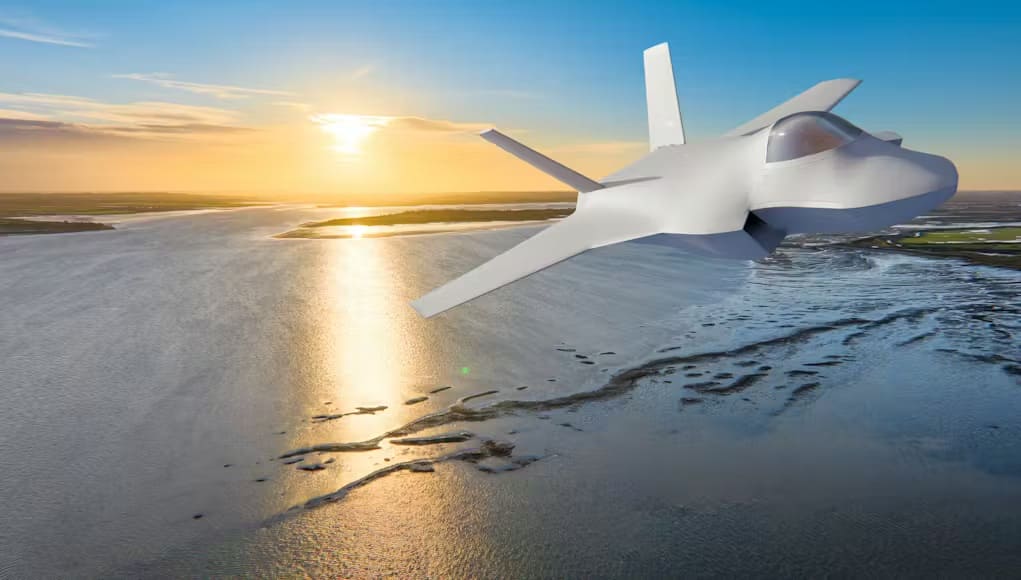
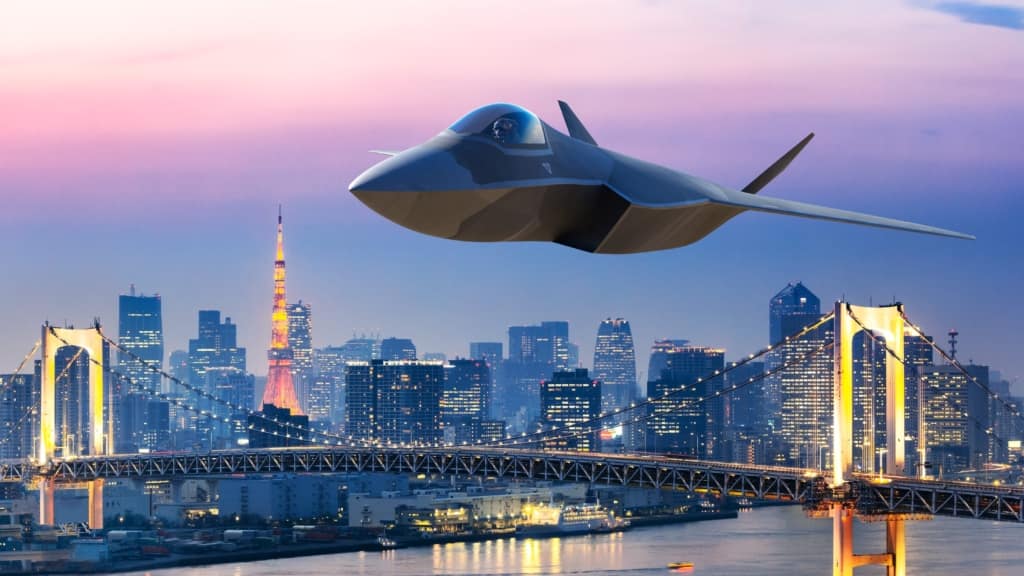
Notice anything? The published GCAP and demonstrator designs feature a canted twin-tail layout — which rhymes neatly with those two peaks poking through the fabric at Gifu. It is an easy leap to make, and that is exactly why caution matters. A twin-tail silhouette is suggestive, not diagnostic. Plenty of aircraft have two tails.
¿Qué podría ser en realidad?
Aquí están las posibilidades reales, aproximadamente de la más mundana a la más emocionante, con la misma advertencia sanitaria para todas ellas: la cobertura oculta la evidencia, por lo que cada opción a continuación es una inferencia, no un hecho.
Un caza existente modificado. The JASDF flies the F-15J and the F-2, and Gifu routinely hosts test work on both — avionics upgrades, radar integration, EW fit checks. An F-15 variant prepared for radar-cross-section or jamming evaluation would plausibly warrant exactly this kind of comprehensive wrap. This is, frankly, the boring-but-likely answer.
Un demostrador tecnológico o banco de pruebas relacionado con GCAP. The F-3 itself is not expected to fly as a prototype for several years, but associated systems — radars, EW suites, sensor packages — are being developed and tested now, and Gifu is the logical home for that. The shroud could be hiding a testbed carrying F-3 subsystems rather than the fighter itself.
Un prototipo o una pieza única. En el mundo del desarrollo de cazas existen maquetas a escala real, modelos de radar y prototipos estructurales para pruebas, y todos ellos son reacios a las cámaras. Ni siquiera es necesario que la forma que se ve bajo la tela vuele.
Algo completamente distinto. La opción menos satisfactoria y la que ningún observador honesto puede descartar. El objetivo de la cobertura es mantenerte en vilo.
Si desea conocer el contexto más amplio sobre por qué un avión cubierto en el centro de Japón despierta tanto interés entre los aficionados, esta explicación detalla qué es GCAP, quién lo está construyendo y por qué es importante el objetivo de 2035:
La cubierta te está diciendo algo.
Si dejamos de lado las especulaciones, un hecho permanece intacto: Japón está realizando pruebas. algo En Gifu, una base que preferiría que no se fotografiara, que acaba de modernizar su infraestructura de evaluación de guerra electrónica, durante el período de mayor actividad en el desarrollo de la aviación japonesa en la historia reciente. Ya sea que la silueta bajo la lona sea un Eagle rediseñado, un prototipo del F-3 o un ingenioso señuelo, el mensaje es el mismo.
A white tarpaulin that pulls 2.2 million views in an afternoon is doing exactly the job it was put there to do: announcing that something matters while revealing nothing about what. Until someone pulls the cover off — or a clearer photo leaks — the smart position is the spotter’s own first reaction. Huh. Whaaaaaat. And we’ll be watching Gifu until we find out.
Fuentes: The Defence Blog; Ministerio de Defensa del Reino Unido / GCAP; Leonardo; Biblioteca de la Cámara de los Comunes; Defense News; Army Recognition; @intpt93 y @Mumbo_Ghost en X.
Preguntas relacionadas
¿Qué era el avión a reacción cubierto que fue fotografiado en la base aérea de Gifu?
El 18 de junio de 2026, un aficionado a la aviación fotografió un avión grande de doble cola, completamente cubierto con tela blanca, en la pista de la base aérea de Gifu, en el centro de Japón. La cubierta ocultaba cualquier rasgo identificativo, por lo que no existe una identificación confirmada. La teoría principal, aunque no confirmada, lo vincula con el programa japonés de desarrollo de cazas de próxima generación.
¿Qué es el programa de cazas GCAP?
El GCAP (Programa Aéreo de Combate Global) es un esfuerzo conjunto de Japón, el Reino Unido e Italia para desarrollar un caza furtivo de sexta generación. La contribución japonesa a veces se conoce como FX o F-3. Su objetivo es desplegar un caza tripulado avanzado que funcione en equipo con drones. Se especula, aunque no está confirmado, que el avión Gifu que aparece en la imagen esté relacionado con este programa.
¿Por qué el avión en Gifu estaba cubierto de tela?
Las fuerzas armadas a menudo cubren prototipos o aeronaves sensibles para ocultar su forma, sensores y otros detalles de diseño clasificados a observadores y satélites. Gifu alberga el Ala de Desarrollo y Pruebas Aéreas de la JASDF, el centro de pruebas de vuelo de Japón, por lo que allí pueden aparecer fuselajes inusuales o experimentales. La tela impidió que los observadores confirmaran si se trataba de un diseño furtivo de próxima generación.
¿Qué es un caza de sexta generación?
Un caza de sexta generación es una futura clase de aeronave de combate que se espera que cuente con tecnología furtiva avanzada, fusión de sensores, tripulación opcional y colaboración con drones autónomos. Programas como el GCAP de Japón, Gran Bretaña e Italia y varios esfuerzos estadounidenses compiten por desplegarlos en la década de 2030, sucediendo a los aviones de quinta generación como el F-35 y F-22.
¿Dónde prueba Japón sus aviones experimentales?
La Fuerza Aérea de Autodefensa de Japón realiza pruebas de vuelo en la base aérea de Gifu, en el centro del país, sede de su Ala de Desarrollo y Pruebas Aéreas. Por eso, el misterioso avión cubierto atrajo tanta atención: Gifu es precisamente el lugar donde se esperaría que aparecieran prototipos o aeronaves experimentales relacionadas con programas como el GCAP.
Publicaciones relacionadas
El caza de sexta generación GCAP consigue su primer contrato de 686 millones de libras.

0 Comentarios