
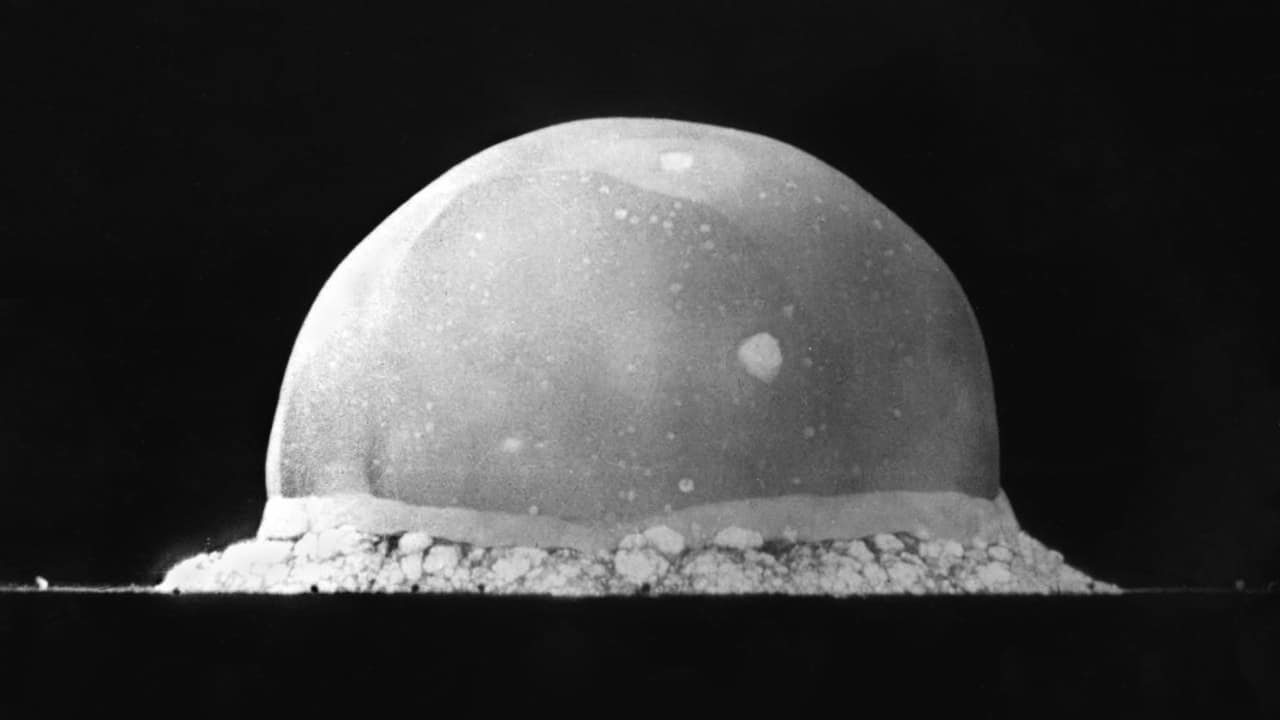
An Afterburner focus series in ten parts, inspired by Richard Rhodes’ masterpiece The Making of the Atomic Bomb.
It is the biggest story of the twentieth century, and it is also, from start to finish, an aviation story. It begins with a refugee physicist at a London traffic light in 1933 and ends with a weather-reconnaissance B-29 catching radioactive dust over the Pacific in 1949. In between: the flight of Europe’s Jewish scientists, a Christmas walk in the Swedish snow, commandos on skis above a Norwegian gorge, a secret city on a New Mexico mesa, the firestorms of Hamburg and Tokyo, a three-billion-dollar bomber, forty-three seconds over Hiroshima, and the spy who handed it all to Stalin.
We have told it in ten parts, each a self-contained story, together a single arc. Read them in order, or jump to the chapter that pulls you in. Every part is built on verified sources, real quotes and period photography and film.
Quick Facts: The Race for the Bomb, by the Numbers
- 16 years — from Szilard’s traffic-light epiphany (1933) to the Soviet bomb (1949)
- $1.9 billion for the Manhattan Project; $3 billion for the B-29 that carried it
- ~130,000 Manhattan Project workers; ~70 scientists in Germany’s program
- 11 Nobel-class physicists exiled by the Third Reich
- 67 Japanese cities burned before the atomic bombs fell
- 21 days — from the Trinity test to Hiroshima
- 4 years, 1 month — the lifespan of the American atomic monopoly
The Series
Part 1: Moonshine: The Idea Born at a Traffic Light
Röntgen’s shimmering screen, the Curies’ glowing shed, Rutherford’s bouncing shell — and the September morning in 1933 when a Hungarian refugee crossed a London street and saw the chain reaction.
Part 2: The Martians Who Fled to America
Szilard, Wigner, Teller, von Neumann: how Hitler’s war on “Jewish physics” mailed the finest minds in Europe — and the bomb itself — to his enemies.
Part 3: Christmas 1938: The Atom Splits
A letter from Berlin, a walk in the Swedish snow, a calculation on scraps of paper — and the letter, the memorandum and the safe that carried fission from a forest to the White House.
Part 4: Hitler’s Bomb Died on a Frozen Plateau
The Uranium Club, the poisoned graphite measurement, nine commandos at Vemork, the cave under the church at Haigerloch — and the hidden microphones of Farm Hall.
Part 5: Two Billion Dollars, One Desert Sunrise
Groves and Oppenheimer, the Chianti under the Chicago stands, the Calutron Girls, the silver-wound magnets — and the light on the Jornada del Muerto.
Part 6: Firestorm: Hamburg, Dresden, and the Whirlwind
The Butt Report’s one-in-three, Window over Hamburg, Black Thursday, the Dresden Historians’ Commission — how burning cities became a technique.
Part 7: The Bomber That Cost More Than the Bomb
Eddie Allen’s last flight, the engine that ate itself, the Battle of Kansas fought outdoors at minus 19 degrees — the $3 billion aircraft of the atomic age.
Part 8: History’s Deadliest Air Raid Wasn’t Nuclear
LeMay’s gamble, the flaming X over Shitamachi, the night of 9–10 March 1945, and the 67 cities that burned before the atomic bombs fell.
Part 9: Forty-Three Seconds Over Hiroshima
The 509th, the Hollywood-premiere floodlights on Tinian, Kokura’s luck, Bockscar on fumes — and the broadcast that ended the Second World War.
Part 10: The Spy Who Gave Stalin the Bomb
Klaus Fuchs, the teenager Moscow never paid, the Jell-O box, Venona, First Lightning — and the WB-29 that heard the starting gun of the arms race.
Extensions
Two companion pieces extend the series beyond its ten-part arc, publishing on 6 August 2026:
When America Built a Bomber Every Hour
A bomber every 63 minutes at Willow Run; 7–8 stealth bombers a year today. What the B-29’s four-year sprint says about aircraft production then and now.
The City at the Top of the List
How the atomic targets were chosen: the Target Committee’s cold criteria, Stimson’s veto, the honeymoon myth — and why Kyoto was the only city its own death list saved.
Where It All Led
The race did not end in 1949; it merely lost its finish line. The hydrogen bomb followed within three years, the missile age within ten, and the aircraft that fill this magazine — the interceptors, the reconnaissance jets, the bombers on permanent alert — were all children of the rivalry this series describes. If the story leaves you wanting the full version, Richard Rhodes’ The Making of the Atomic Bomb remains, four decades on, the definitive account and one of the great nonfiction books in the English language.
Where the series turns: original 1945 footage of the Trinity test, the moment the theoretical became real.
Sources: each part of the series carries its own source list; the series as a whole is indebted to Richard Rhodes: The Making of the Atomic Bomb (1986) and Dark Sun (1995).
0 Comentarios