
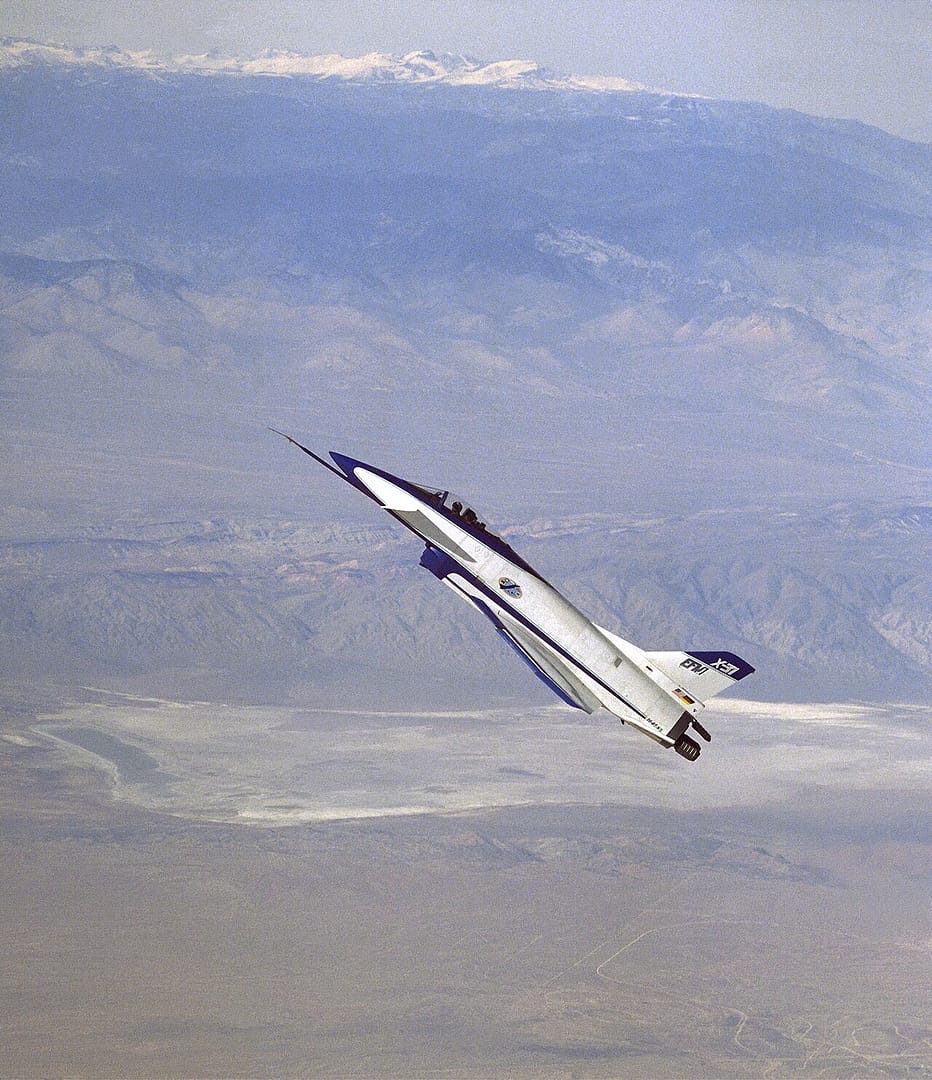
On 19 January 1995, a tiny piece of ice formed on the wrong piece of metal and destroyed one of the two aircraft at the heart of a pioneering German-American research programme. The piece of ice was perhaps half a centimetre across. The piece of metal it formed on was a pitot probe — a 30-centimetre-long sensor sticking out of the nose of one of the most sophisticated experimental fighters ever built, the Rockwell-MBB X-31 Enhanced Fighter Maneuverability demonstrator.
Within thirty-eight seconds of the ice forming, the X-31 was tumbling out of control over Edwards Air Force Base at 90 degrees angle of attack. Within forty-five seconds it was in pieces in the Mojave Desert. The German test pilot, Karl-Heinz Lang, came down safely under his parachute with a story that became the textbook accident-investigation case for the next thirty years.
Datos rápidos
| Programa | X-31 Enhanced Fighter Maneuverability (EFM) — joint US-German demonstrator |
| Construido por | Rockwell International (USA) and Messerschmitt-Bölkow-Blohm (Germany) |
| Primer vuelo | 11 October 1990 |
| Famous capability | Sustained controlled flight at 70 degrees angle of attack via thrust vectoring |
| Accident date | 19 January 1995 |
| Piloto | Karl-Heinz Lang (Daimler-Benz Aerospace test pilot, ejected safely) |
| Causa | Ice in unheated Kiel pitot probe → bad airspeed data → computer-induced loss of control |
The aircraft that turned tighter than physics
The X-31 existed to prove a single point: that with three thrust-vectoring paddles in the jet exhaust and a sufficiently clever flight control computer, a fighter could remain controllable at angles of attack where every conventional aircraft would stall, spin, and depart from controlled flight. The two X-31 airframes flew between 1990 and 1995 in a campaign jointly funded by DARPA, the US Navy, NASA, and the German Federal Ministry of Defence.
On 6 November 1992 the X-31 achieved sustained controlled flight at 70 degrees angle of attack — meaning the nose was pointed 70 degrees above the velocity vector. On 29 April 1993 it executed a "Herbst manoeuvre," a rapid 180-degree minimum-radius turn at post-stall AoA, named after MBB engineer Wolfgang Herbst. By 1995 it had logged over 500 flights and had thoroughly proven its concept. The programme was approaching its planned conclusion.
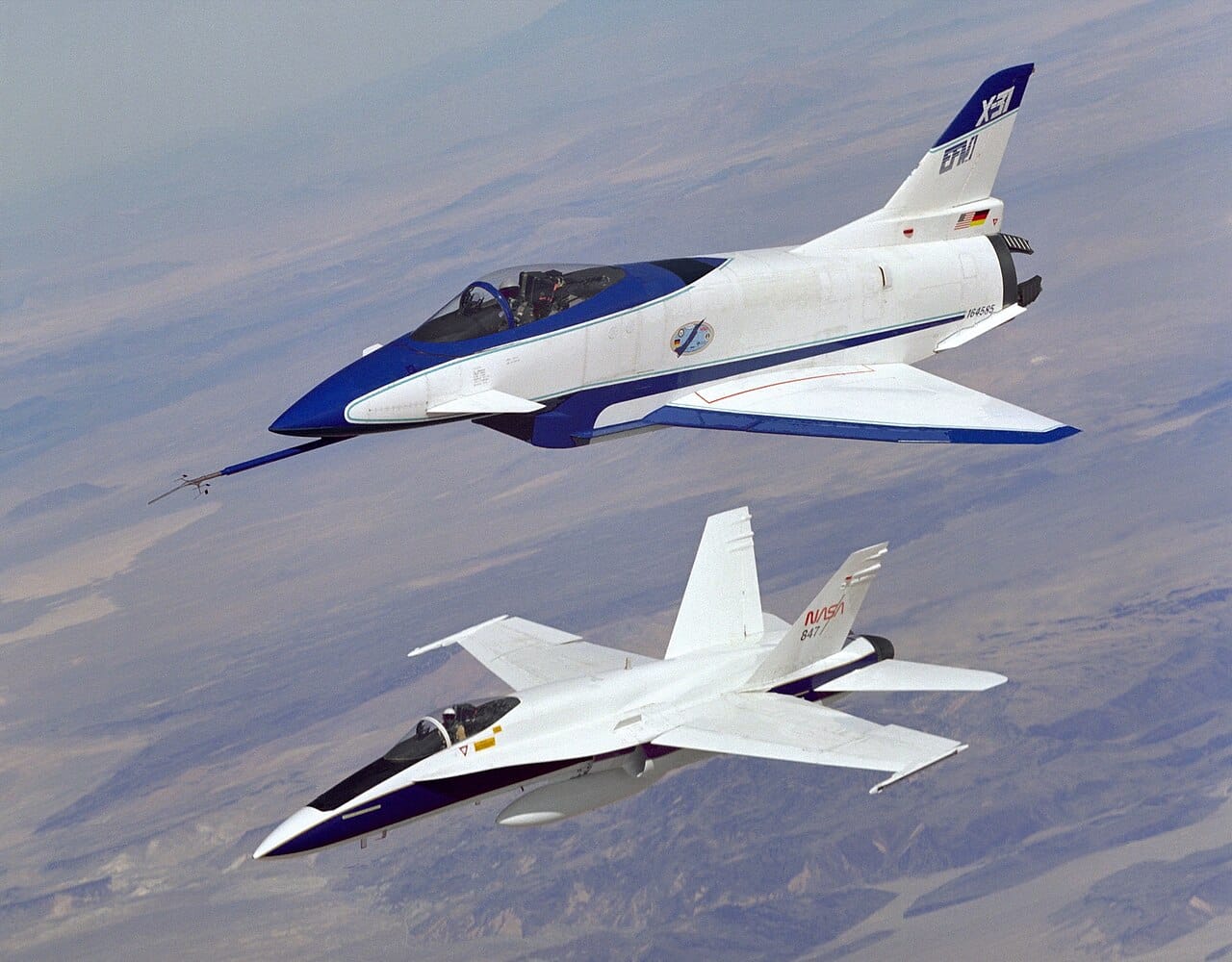
A pitot probe that nobody noticed had changed
The standard X-31 production pitot probe was electrically heated. This is unremarkable on combat aircraft — every fighter you have ever seen has a heated probe specifically to prevent ice forming and feeding garbage data to the airspeed indicator. On the X-31, the heater was important not because of the cockpit gauge but because the same probe fed the flight control computers, and the computers used airspeed as a critical input for blending thrust vectoring authority into the control laws.
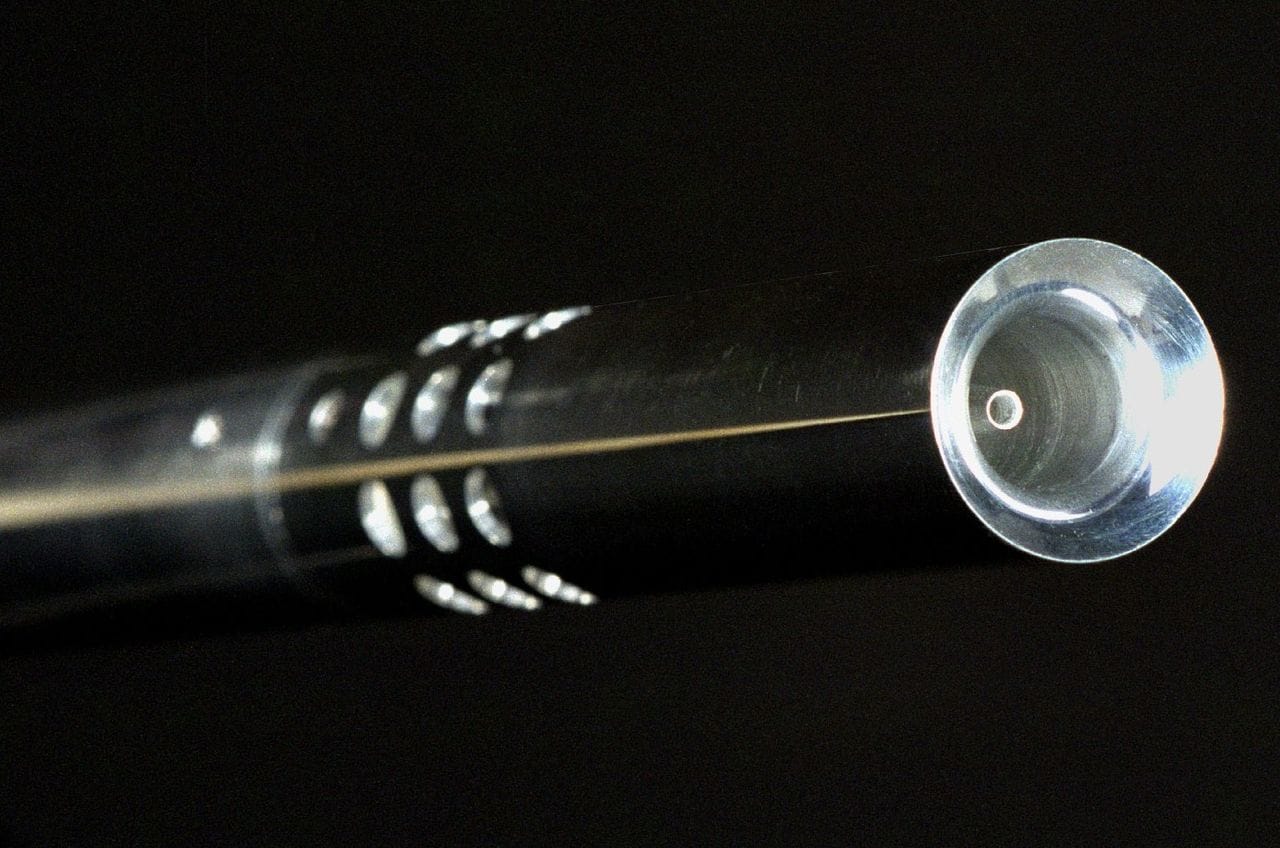
For this final test campaign, the production probe had been removed and a Kiel probe — a specialised research instrument optimised for accuracy in low-speed airflow — had been bolted to the nose boom in its place. The Kiel probe was unheated. The decision to make the swap had been logged, signed off, and forgotten. No one had updated the operating procedures to add an icing restriction. No one had warned the pilot.
Thirty-eight seconds
Lang took off from Edwards at 12:30 PM local. The aircraft passed through a thin cloud layer at low altitude. Ice formed inside the Kiel probe almost immediately. The airspeed indication started drifting low. The flight control computers, sensing the apparent decay in airspeed, began boosting the thrust-vectoring authority to maintain stability. As the discrepancy widened, the computers responded harder. The control surfaces began oscillating.
At T+38 seconds from the first symptom, the X-31 pitched abruptly to a 90-degree nose-up attitude with no airspeed and no recovery options. There was a manual override switch that would have let Lang fly the aircraft directly without computer mediation. He did not know it existed. The training documentation had never mentioned it. Lang reached for the ejection handle.
The textbook lesson
The X-31 crash became one of the most cited case studies in flight-test safety education. The chain of failures — a hardware substitution undocumented, software dependency unverified, training omission uncorrected, pilot override option not communicated — is now a standard example in every introduction to safety management systems. Aviation regulators around the world rewrote their procedures for instrumented research aircraft because of it.
The second X-31 was completed and flew successfully until 2003. It was eventually used to demonstrate VECTOR (Vectoring Extremely Short Takeoff and Landing Control and Tailless Operations Research), proving the EFM concept worked. The first X-31 — the one that broke on 19 January 1995 because of half a centimetre of ice on the wrong probe — never came home.
NASA footage of the X-31 in flight at Edwards — high-AoA manoeuvres, thrust-vectoring demonstrations, and the famous Herbst turn that made it a flight-test legend.
Sources: Wikipedia; NASA Dryden Flight Research Center; FlightGlobal; Aerossurance; official X-31 accident investigation findings.
Preguntas relacionadas
What was the X-31?
The X-31 was a joint U.S.-German experimental jet built to explore extreme manoeuvrability. Using thrust vectoring — deflecting its engine exhaust — it could fly under control at a 70-degree angle of attack, far beyond what normal fighters can manage. It first flew in 1990.
What caused the X-31 to crash?
A tiny amount of ice. On 19 January 1995, ice formed in an unheated pitot probe that measures airspeed, feeding the flight-control computer false data. The confused system made the aircraft uncontrollable, and the pilot ejected safely while the X-31 was lost.
How did half a centimetre of ice destroy the X-31?
The ice blocked the aircraft's pitot probe, corrupting its airspeed readings. The fly-by-wire flight-control system relied on that data and, fed wrong numbers, commanded the aircraft into an uncontrollable state — showing how a trivial sensor fault can doom a sophisticated jet.
What is thrust vectoring?
Thrust vectoring is the ability to deflect an engine's exhaust to steer the aircraft, rather than relying on control surfaces alone. The X-31 used it to stay controllable at extreme angles of attack — up to 70 degrees — demonstrating manoeuvres impossible for conventional fighters.
Did the X-31 pilot survive the crash?
Yes. Test pilot Karl-Heinz Lang ejected safely when the aircraft became uncontrollable on 19 January 1995. The aircraft was destroyed, but the cause — ice in an unheated probe — became an important lesson in fly-by-wire sensor reliability.
Publicaciones relacionadas
XB-70 Valkyrie: When a PR Photo Shoot Killed the Fastest Bomber
0 Comentarios