
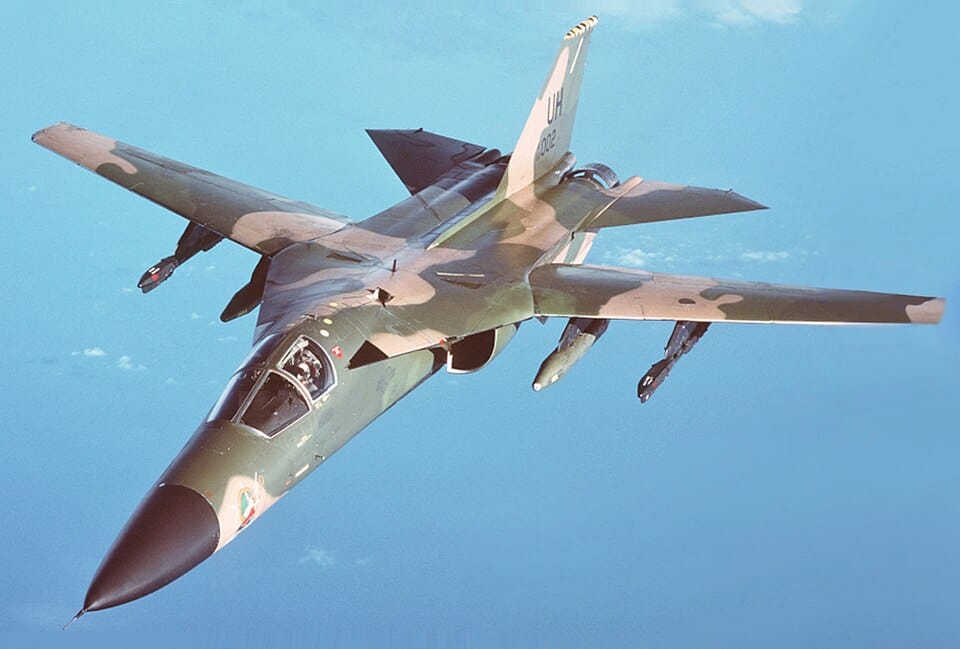
Quick Facts
- First flight: 21 December 1964
- Manufacturer: General Dynamics (Fort Worth Division)
- Engines: 2x Pratt & Whitney TF30 turbofans (the F-111F's TF30-P-100: ~112 kN with afterburner)
- Max speed: Mach 2.5 at altitude, Mach 1.2 at sea level
- Range: ~4,700 km with external fuel
- Innovation: First production variable-sweep wing aircraft
- Gulf War record: 80% of all laser-guided bombs dropped; 1,500+ Iraqi vehicles destroyed
- Retired: USAF 1996, RAAF 2010
The Disaster at Birth
Defence Secretary Robert McNamara wanted one aircraft for both the Air Force and the Navy. The idea was seductive on paper and catastrophic in practice. The Air Force needed a low-level supersonic strike bomber. The Navy needed a fleet air defence fighter. These are fundamentally different missions requiring fundamentally different aircraft. Forcing them into a single design produced a jet that was too heavy for carrier operations and too compromised for either role.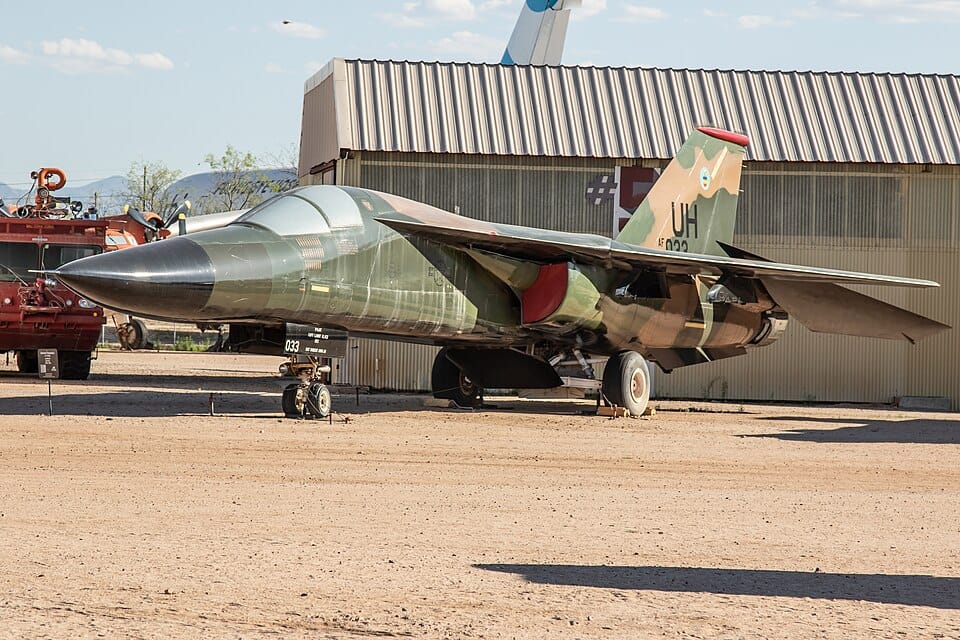
The Redemption: Linebacker and Beyond
By 1972, the F-111 had been debugged, upgraded, and deployed in numbers. During the Linebacker campaigns over North Vietnam, Aardvarks flew 4,000 combat missions at night, at low level, beneath enemy radar coverage. They hit airfields, SAM sites, and supply lines with a precision that no other American aircraft could match in darkness. Only six were lost — one of the lowest loss rates of the entire air war. In April 1986, F-111Fs based in England flew the longest fighter combat mission in history — Operation El Dorado Canyon, a round-trip strike against Libya that required multiple aerial refuellings and overflight of hostile airspace. In 1991, during Desert Storm, 66 F-111Fs dropped 80 per cent of all laser-guided bombs used in the war. Pave Tack’s infrared sensor let crews find and destroy dug-in armour at night — a tactic that became known as “tank plinking”. More than 1,500 Iraqi vehicles were destroyed by F-111s — a record no other platform came close to matching.The Dump and Burn: A Legend's Farewell
The Royal Australian Air Force operated the F-111C from 1973 until 2010 — outlasting the USAF's own fleet by more than a decade. The Australians loved the Aardvark with a ferocity that surprised even the Americans. And they gave it a farewell that has never been equalled. The F-111's party trick was the "dump and burn" — a manoeuvre in which the pilot dumps raw fuel from the aircraft's rear fuel vent while lighting the afterburners. The result is a river of fire trailing behind the jet, hundreds of feet long, visible for miles. It was the most spectacular display in military aviation, and the RAAF performed it at every major Australian airshow for decades. The final dump and burn was flown at the type's retirement ceremony at RAAF Base Amberley on 3 December 2010. Tens of thousands watched as the last F-111 lit the sky one more time. The aircraft that had been called a failure in 1968 left service forty-two years later as one of the most feared, most capable, and most beloved strike aircraft ever built. From Vietnam disaster to Gulf War dominance to a retirement in fire — no American combat aircraft has had a more dramatic arc than the F-111 Aardvark. It arrived hated and left mourned. That is a redemption story worth remembering. Sources: Lockheed Martin Heritage, Air Force Magazine, The National Interest, RAAF MuseumRelated Questions
What was the F-111 Aardvark?
The General Dynamics F-111 Aardvark was an American strike aircraft that first flew in 1964 and pioneered the variable-sweep "swing wing." After a troubled start it matured into one of the most effective long-range precision bombers of the Cold War, serving until 1996 with the USAF.
Why was the F-111 considered a disaster at first?
The F-111 was born from a controversial 1960s plan to build one aircraft for both the Air Force and Navy. Overweight and plagued by technical problems, the Navy version was cancelled and early losses damaged its reputation — making it an early symbol of troubled defence procurement.
How did the F-111 redeem itself?
In the 1991 Gulf War. F-111s dropped about 80% of the war's laser-guided bombs and destroyed more than 1,500 Iraqi vehicles in precision night attacks known as "tank plinking," transforming its reputation from costly failure to deadly precision bomber.
What made the F-111 special?
It was the first production aircraft with a variable-sweep wing, which swept back for high-speed dashes and spread out for efficient long-range cruise and landing. Combined with terrain-following radar, this let it fly fast and low to strike deep targets in any weather.
When was the F-111 retired?
The U.S. Air Force retired the F-111 in 1996, and the Royal Australian Air Force flew it until 2010. By then it had gone from a procurement embarrassment to a respected long-range strike aircraft.
0 Comments