
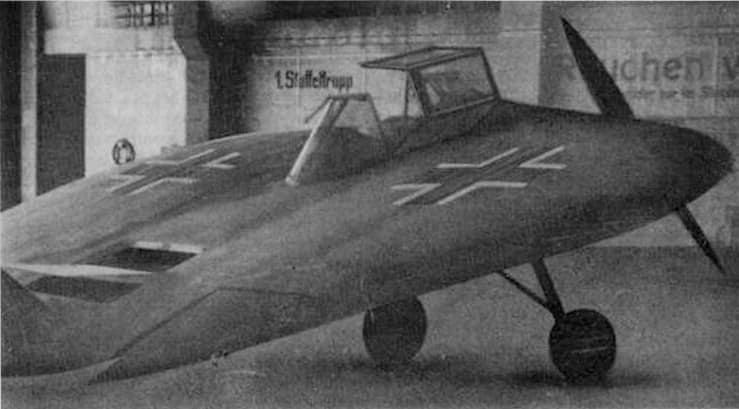
Few aircraft have been asked to carry as much mythology on so little lift as the Sack AS-6. Search the phrase ‘Nazi flying saucer’ and this stubby, disc-winged machine appears again and again, presented as evidence that the Third Reich was on the verge of some world-changing secret. The reality is quieter, stranger, and in its own way more human.
At Afterburner we like our history the way we like our engineering — measured against the evidence. The short version: the machine was real, the ambition was real, and the failure was real. The flying saucer was not.
- Designer & builder: Arthur Sack, a farmer from the Leipzig region with a passion for model aircraft
- Donor parts: undercarriage and cockpit from a Messerschmitt Bf 109; a single Argus As 10 engine of roughly 240 hp
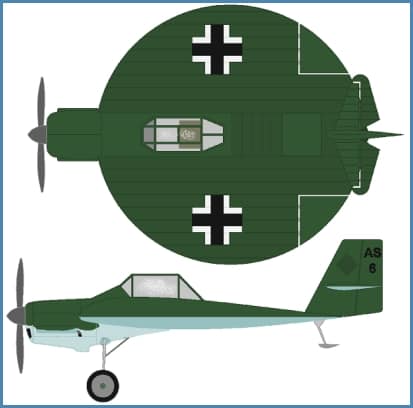
- Wing: a near-circular plan of about 5 m span — hence the nickname ‘fliegender Bierdeckel’ (flying beermat)
- Tested at Brandis airfield near Leipzig from February 1944
- Result: multiple runway attempts that produced only brief, unstable hops — never sustained flight
- Fate: damaged in an Allied strafing run and scrapped; no trace remained when US troops reached Brandis in 1945
From the Model Field
The story begins not in a secret bunker but at a model-flying meeting. In July 1938, Arthur Sack entered his circular-winged model, the AS-1, in a contest for motorized flying models at Leipzig. It is worth correcting a common claim here: the AS-1 did not sweep the field. Its flight was poor and it had to be hand-launched to get airborne at all.
What it did do was catch the eye of the right spectator. Ernst Udet, the Luftwaffe’s chief of aircraft procurement, was present and was struck by the model’s short take-off behaviour. Udet unofficially encouraged Sack to develop the concept — and that informal nod, more than any technical breakthrough, set the whole project in motion.
Building a Full-Size Disc, 1944
Over the following years Sack built a series of larger models, then in January 1944 made the leap to a piloted, full-scale machine: the AS-6. He enlisted an engineer to calculate the loads and persuaded local workshops to fabricate the parts.
The result was a masterclass in wartime improvisation. Rather than tool up new components, Sack cannibalised existing aircraft. The undercarriage, cockpit and pilot’s seat came from a Messerschmitt Bf 109. Power came from a single Argus As 10 — an inverted V8 of about 240 hp — swinging a two-blade wooden propeller. Over this sat the defining feature: a near-circular wing built up over a wooden structure. Small wonder the ground crews called it the flying beermat.
Five Runs, No Flight
Testing began in February 1944 with pilot Rolf Baltabol. Taxi trials immediately showed that the tail was inadequate to handle the torque of the 240 hp engine, and the machine wandered viciously across the runway. Five runs were made along the Brandis strip. Control defects surfaced, and on the fifth attempt the brakes failed and the aircraft was structurally damaged.
It was repaired, and the trials continued. In April 1944 the AS-6 managed a brief hop — then began to porpoise so severely that the pilot aborted, and on a later run the propeller struck the ground and shattered. Baltabol recommended a far more powerful engine and a proper wind-tunnel investigation before anyone flew it again. He then, sensibly, walked away, judging the aircraft dangerous.
Why It Would Not Fly
The disagreement between Sack and his pilot captures the aeroplane’s core problem. A circular, low-aspect-ratio wing can generate lift, but only at a large angle of attack — which is precisely what the AS-6’s fixed, ground-hugging undercarriage made it hard to reach on the roll. To rotate a wing like that into flying attitude you need abundant thrust. With barely 240 hp hauling a heavy, roughly-built airframe, the AS-6 was fundamentally underpowered for its own planform.
When the Me 163 rocket pilots of JG 400 arrived at Brandis in the summer of 1944, Sack secured one more attempt. The outcome did not change: another short hop, another collapsed landing-gear leg. Across every documented trial, the honest conclusion is the same — the Sack AS-6 taxied, swerved and occasionally bounced into the air for a moment, but it never achieved genuine, sustained, controlled flight.
The UFO Myth, Grounded
So how did a plywood beermat become the poster child for Nazi flying saucers? Geography and coincidence. Brandis was an extraordinary place in 1944–45: alongside Sack’s disc sat the rocket-powered Me 163 Komet and other exotic prototypes. When post-war intelligence tried to make sense of captured German technology — and when the 1947 ‘flying saucer’ craze took hold — a genuinely disc-shaped aircraft at such a base was irresistible raw material for legend.
Strip away the rumour, and nothing about the AS-6 supports the super-weapon narrative. It carried no exotic propulsion, reached no remarkable speed, and did not fly. It was an ambitious amateur’s dead end — not a suppressed breakthrough. The most remarkable thing about Arthur Sack is not that he built a UFO, but that a farmer with a model-flying hobby got a full-size aircraft of his own design onto a Luftwaffe runway at all.
Sources: Wikipedia (Sack AS-6); Ebert & Maier via UFX feature; contemporary Brandis records.

0 commentaire