
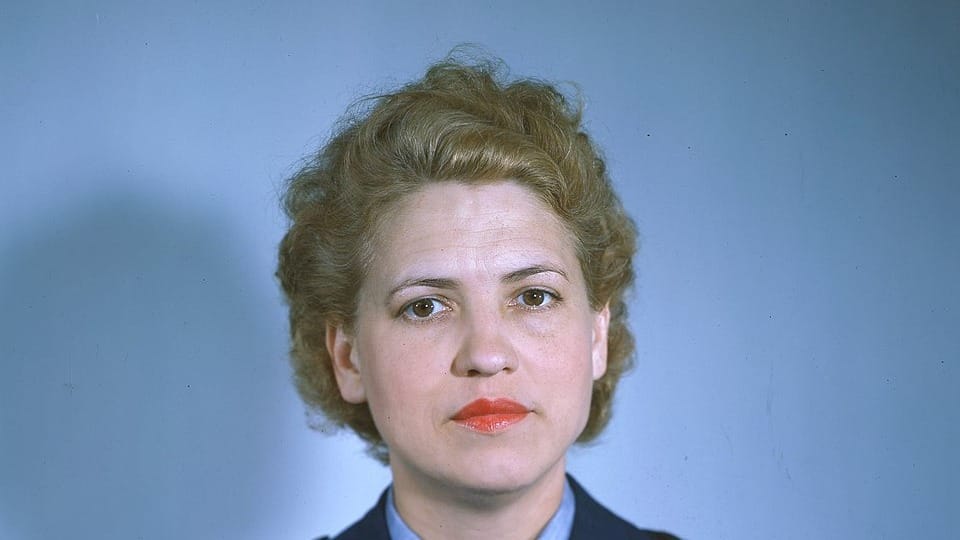
Jacqueline Cochran grew up as an orphan in rural Florida, picking cotton and sleeping on the floor of a shack. By 40, she held more speed, distance, and altitude records than any other pilot alive — male or female. The distance between those two facts was covered entirely by her own will, intelligence, and a ferocious refusal to accept what others told her was possible.
Quick Facts
| Nationality | American 🇺🇸 |
| Achievement | First woman to break the sound barrier (1953); founder of the WASPs; more speed records than any pilot in history |
| Sound Barrier | 18 May 1953, F-86 Sabre, Mach 1.0+, Rogers Dry Lake |
| WASPs | Women Air Force Service Pilots — 1,074 women who flew WWII warbirds |
| Born / Died | c. 11 May 1906 – 9 Aug 1980 (age 74) |

She learned to fly in just three weeks in 1932 — a record that stood for years. She entered the Bendix Trophy air race in 1935 — the first woman to do so — and finished third in 1937. She won it outright in 1938, becoming the first woman to do so. When World War II broke out, she convinced Army Air Force General Hap Arnold — who was initially opposed to the idea — to allow women pilots to fly military aircraft in support roles. Together with Nancy Harkness Love, she formed the Women Air Force Service Pilots (WASPs).
The WASPs flew everything. B-17 Flying Fortresses, P-51 Mustangs, B-29 Superfortresses, dive bombers, transport aircraft. They ferried aircraft from factories to airfields, towed targets for anti-aircraft gunners, flew test flights on newly repaired aircraft, and trained male pilots. In two years of operation, 1,074 women flew 60 million miles of military missions. Thirty-eight of them died. They were classified as civilians, denied military benefits, and quietly disbanded in December 1944 when returning male pilots needed the jobs. They received no Veterans' benefits until 1979.
Faster Than Sound
After the war, Cochran kept flying. On 18 May 1953, with Chuck Yeager flying alongside her as a chase pilot and flight instructor, she broke the sound barrier in a Canadian-built F-86 Sabre over Rogers Dry Lake in California. She became the first woman in history to fly faster than sound. Then she did it again. And again. Over the course of her career, she broke the sound barrier multiple times and set a series of altitude and speed records that stood for years.
“I might have been born in a hovel but I determined to travel with the wind and the stars.”
— Jacqueline CochranCochran died in 1980, holding more aviation speed records than any other pilot in history. The cosmetics empire she had built — Jacqueline Cochran Cosmetics — was still operating. The WASPs she had fought for were finally receiving military recognition. And in aviation circles, her name ranked alongside Lindbergh and Earhart as one of the great pilots of the twentieth century. Not the great female pilots. The great pilots. Full stop.
Watch: Documentary
Related Questions
Who was Jacqueline Cochran?
Jacqueline Cochran (c. 1906–1980) was an American aviator who, by the time of her death, held more speed records than any pilot in history. Orphaned and raised in rural Florida, she became the first woman to break the sound barrier in 1953, founded the Women Airforce Service Pilots (WASPs), and built a successful cosmetics business alongside her flying career.
Who was the first woman to break the sound barrier?
Jacqueline Cochran became the first woman to fly faster than sound on 18 May 1953, piloting a Canadian-built F-86 Sabre over Rogers Dry Lake in California. Chuck Yeager — the first person ever to break the sound barrier — flew alongside her as chase pilot. France's Jacqueline Auriol achieved a similar feat in the same era.
What were the WASPs?
The Women Airforce Service Pilots (WASPs) were a WWII organization of 1,074 American women who flew military aircraft in non-combat roles. Founded by Jacqueline Cochran with Nancy Harkness Love, they ferried warbirds from factories, towed gunnery targets, and test-flew repaired aircraft, logging 60 million miles. Thirty-eight died in service. Classified as civilians, they were disbanded in December 1944.
How quickly did Jacqueline Cochran learn to fly?
Cochran famously earned her pilot's license in about three weeks in 1932 — a remarkably fast record that stood for years. She went on to air racing, finishing third in the 1937 Bendix Trophy and winning it outright in 1938, the first woman to do so. Her rapid mastery foreshadowed a record-breaking career.
Did Jacqueline Cochran win the Bendix Trophy?
Yes. Cochran first entered the prestigious Bendix Trophy cross-country air race in 1935 — the first woman to do so — finished third in 1937, and won it outright in 1938, becoming the first woman to claim the trophy. Victories like these helped establish her as one of the era's premier pilots, male or female.
How many aviation records did Jacqueline Cochran hold?
At her death in 1980, Cochran held more speed, distance, and altitude records than any other pilot in history. Over her career she repeatedly broke the sound barrier and set marks that stood for years. Her contemporaries ranked her alongside Amelia Earhart and Charles Lindbergh among the great aviators of the twentieth century.
0 commentaire