
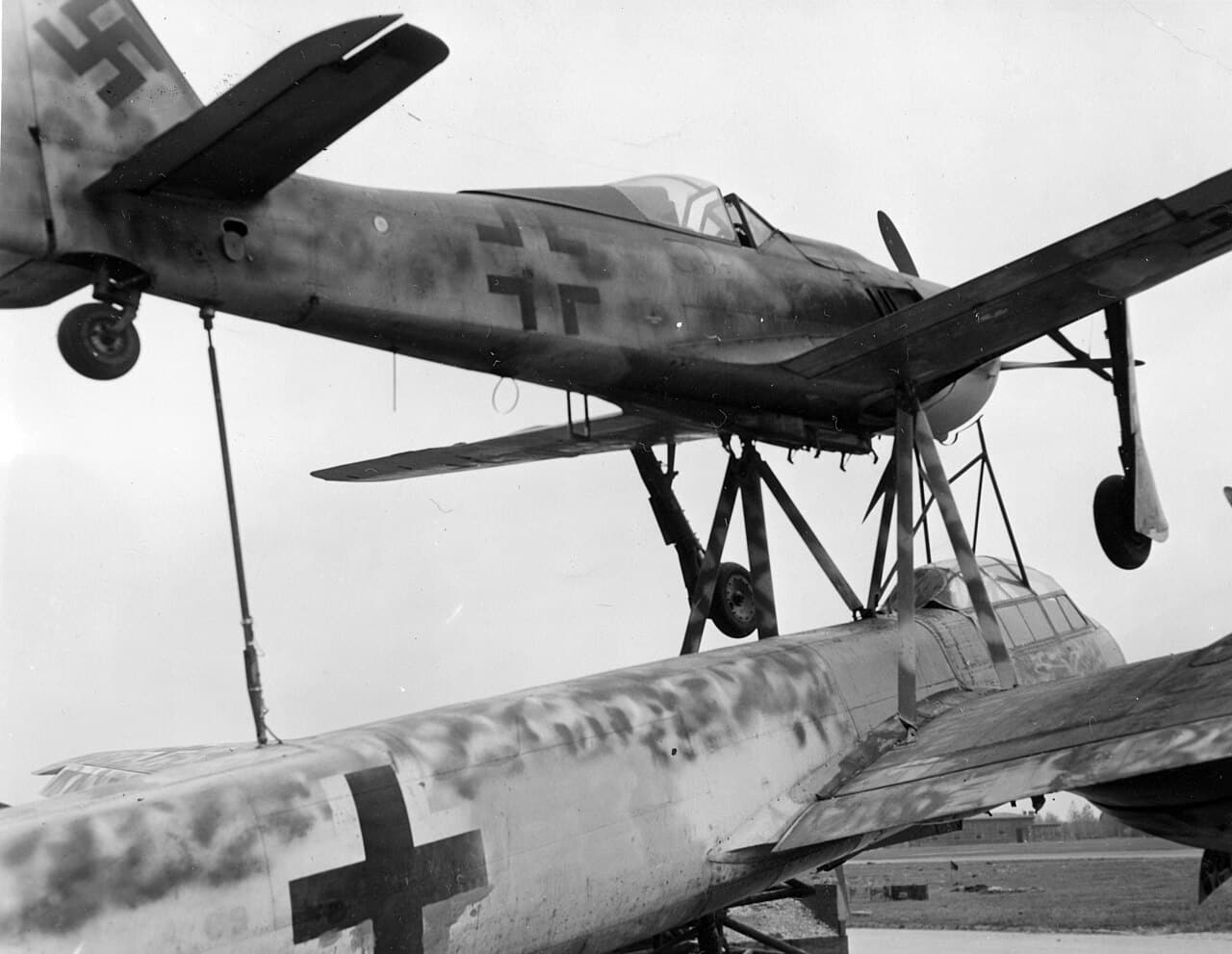
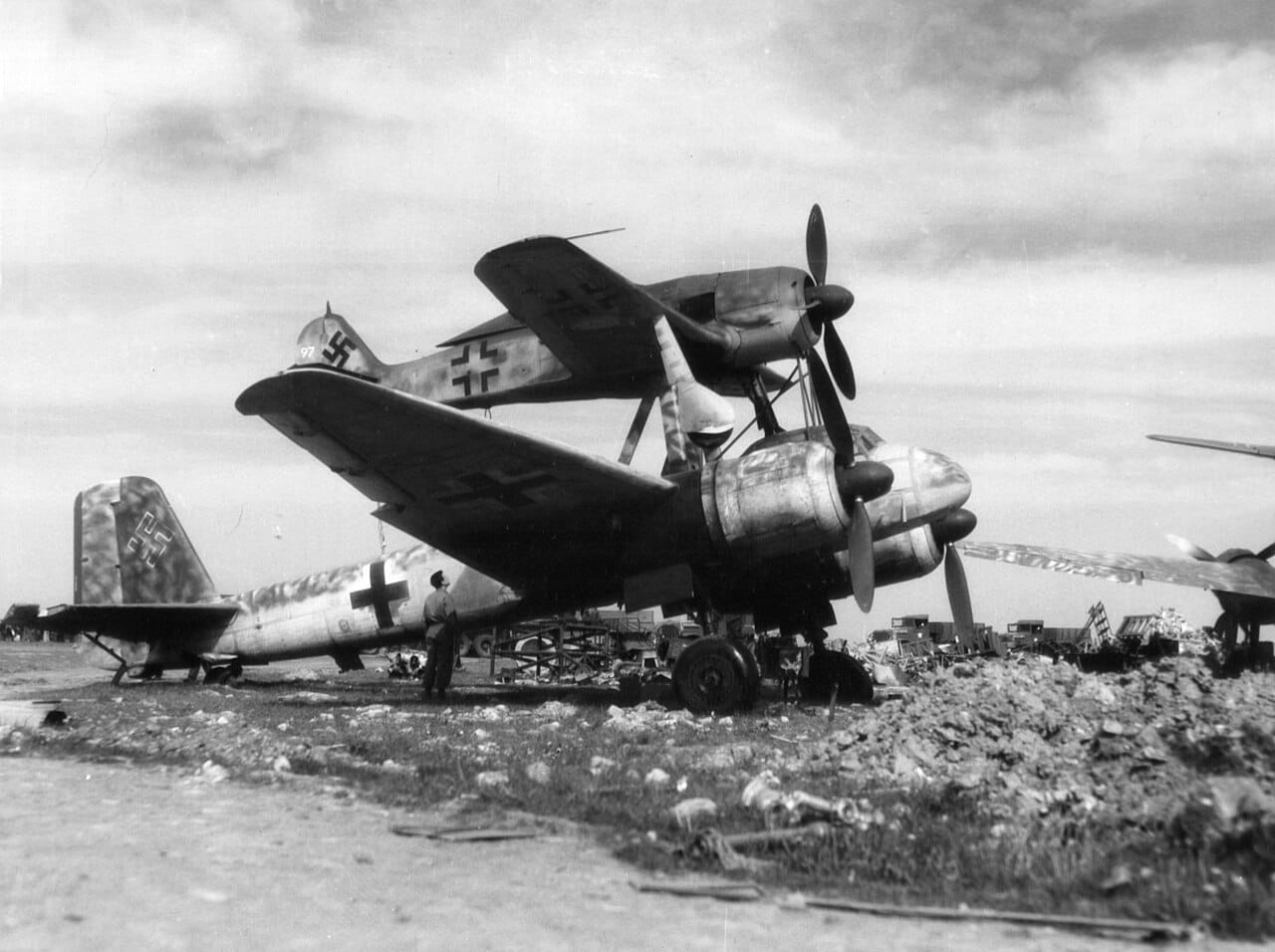
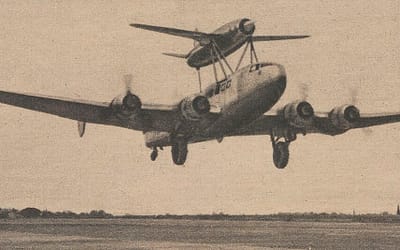
Seen from the ground, it looked like an accident waiting to happen: a single-seat fighter — a Messerschmitt Bf 109 or a Focke-Wulf Fw 190 — bolted rigidly to the spine of a twin-engined Junkers Ju 88 bomber, the two machines climbing away as one grotesque, four-engined creature. This was the Mistel, German for “mistletoe,” the parasitic plant that clings to a host tree. The name was chosen with grim precision.
The lower aircraft was unmanned. In place of its cockpit sat nearly two tonnes of shaped-charge explosive. The pilot, sitting up top in the fighter, flew the whole assembly to within sight of the target, aimed it, then fired the explosive bolts that let the drone-bomber go. The Ju 88 flew on into a warship or a bridge; the fighter, suddenly light, turned for home.
It was one of the most bizarre weapons of the Second World War, and one of the most revealing. The Mistel was a product of 1944 desperation — ingenious in concept, brutally simple in execution, and, when it finally went to war, a near-total failure. This is how it worked, and why it almost never did.
• Name: Mistel (“mistletoe”); also Huckepack (“piggyback”)
• Configuration: unmanned Ju 88 lower component + Bf 109 or Fw 190 fighter mounted above on struts
• Warhead: shaped (hollow) charge of nearly 2 tonnes (~1,800 kg), copper-lined
• First flight (composite): July 1943 • First combat: night of 24/25 June 1944
• Built: ~250 of all variants • Operator: Luftwaffe (KG 200, KG 101)
• Verdict: limited success; no confirmed major sinking matched to Allied records
Mistletoe: A Parasite with a Warhead
The idea did not begin as a weapon. Early German composite experiments used the DFS 230 assault glider as the lower element, with a piston-engined aircraft such as the Bf 109E riding on top — an attempt to give the glider more range than a conventional tow could offer. The step from transport aid to guided bomb was short and, by the standards of 1943, logical.
In the definitive form, the Ju 88’s entire nose-mounted crew compartment was removed and replaced with a purpose-built explosive nose. The fighter sat above on a framework of struts, connected by ball joints fitted with explosive bolts that severed the two aircraft on command. The first such composite flew in July 1943 and impressed enough for the Luftwaffe to launch a programme under the code name “Beethoven.” Some 250 examples of the various combinations were built. The principal service versions paired a Ju 88 with either a Bf 109 F-4 (Mistel 1) or an Fw 190 A-8 (Mistel 2 and 3).
The Killing Nose
What made the Mistel genuinely dangerous was its warhead. The definitive charge weighed close to two tonnes — the mass of an RAF “blockbuster” bomb — and was a hollow (shaped) charge lined with copper. Detonated correctly, it was expected to punch through as much as seven metres (about 23 feet) of reinforced concrete, which is why the planners dreamed of using it against dams, bunkers and battleship armour.
The delivery method was crude but clever. The pilot trimmed the combination into a shallow dive at the target, locked the controls, released the drone, and pulled up and away. In theory the Ju 88 would coast into the aim point on its own. In practice the composite was heavy, slow and sluggish to manoeuvre, and everything depended on the pilot setting up the run precisely before he let go. There was no guidance after release — once the bolts blew, the outcome was ballistics and luck.
A documentary overview of the Mistel programme, its warhead and its brief, ineffective combat career.
Baptism over Normandy
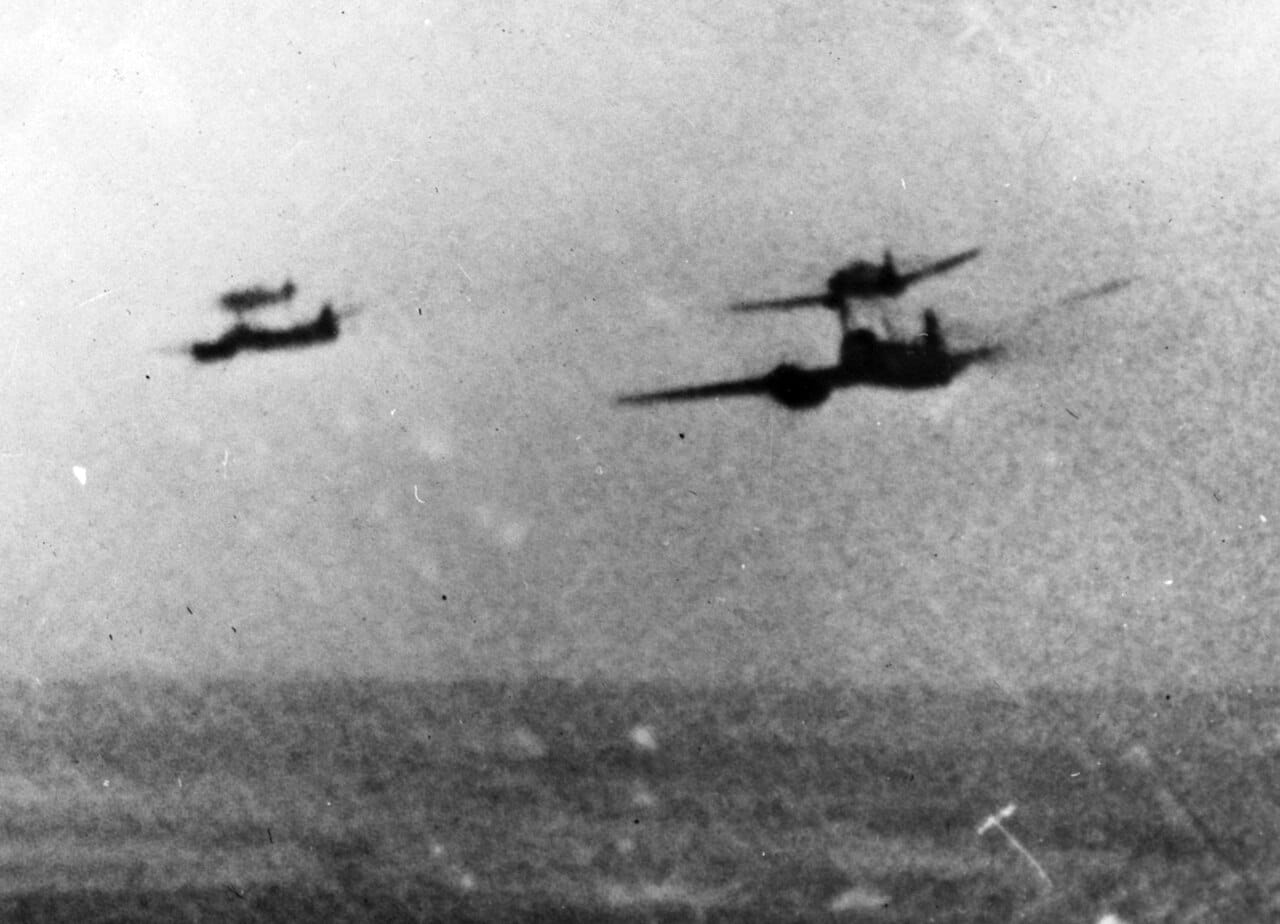
The Mistel’s combat debut came against the greatest concentration of shipping in history. In the weeks after D-Day, Oberleutnant Horst Rudat led a small task force of 2./KG 101 into action against the Allied invasion fleet. On the night of 24/25 June 1944, four Mistel composites took off against the anchorage off Normandy. It did not go to plan — Rudat’s own aircraft was hit by German flak that had not been warned of the mission.
The pilots claimed hits, but none can be matched to Allied loss records. What they most likely struck was the hulk of the old French battleship Courbet, deliberately sunk as part of the Mulberry harbour and dressed up by the Allies as a decoy. The one documented success was oblique: on 24 June a near-miss badly damaged HMS Nith, a frigate serving as a floating headquarters, killing nine men. The Mistel was also easy prey. An RCAF Mosquito flown by Walter Dinsdale claimed the first shoot-down over Normandy.
Iron Hammer and the Bridges of the Oder
The weapon’s most ambitious mission never happened. Under Operation Eisenhammer (“Iron Hammer”), planners intended to send Mistel composites against the electricity-generating stations around Moscow and Gorky — poorly defended, irreplaceable, and, the Germans believed, the Achilles heel of the Soviet war economy. In February 1945 the Luftwaffe assembled roughly 100 Mistel near Berlin and waited for good weather. Then a US air raid on the Rechlin test centre destroyed 18 of them on the ground, and the plan was postponed, then finally abandoned.
With the Red Army now on German soil, the composites were turned against the Soviet bridgeheads over the Oder. On 12 April 1945 Mistel struck the pontoon bridges being thrown across the river at Küstrin. The damage was negligible; the Soviet advance was delayed, at most, a day or two. Subsequent attacks were similarly ineffective. The seven-metres-of-concrete warhead, it turned out, was worth little if the aircraft could not be aimed accurately from a slow, defenceless platform under heavy fire.
Verdict: The Arithmetic of Desperation
Judged coldly, the Mistel failed. Against a target-rich invasion fleet it achieved one confirmed near-miss and a handful of unverifiable claims; against the Oder bridges it changed nothing. It consumed scarce airframes, fuel and trained pilots at exactly the moment Germany could least afford to waste them, and it was cheap to defeat — a night-fighter could pick off the lumbering combination almost at leisure. As a piece of engineering it was inventive; as a war-winning weapon it was a symptom of a regime running out of options.
One survivor remains. An Fw 190 (Werk Nr. 733682), captured at Tirstrup in Denmark in 1945, still carries its explosive-bolt ball joints and is preserved at the Royal Air Force Museum Midlands at Cosford — the last physical trace of the strangest bomber the Luftwaffe ever flew.
Sources: Wikipedia (Mistel; Operation Eisenhammer; Horst Rudat); Robert Forsyth, Luftwaffe Mistel Composite Bomber Units (Osprey, 2015); The War Zone.
Related Questions
What was the Mistel?
The Mistel — German for "mistletoe" — was a World War II composite weapon in which an unmanned, explosive-packed Junkers Ju 88 bomber was flown from a fighter (a Bf 109 or Fw 190) mounted on struts above it. The pilot aimed the whole assembly at a target, released the drone-bomber, and turned for home.
How did the Mistel work?
The Mistel paired an unmanned lower Ju 88, its crew compartment replaced by a shaped-charge warhead, with a piloted fighter fixed on top. The fighter pilot flew the joined pair toward the target, then fired explosive bolts to release the bomber, which continued into a warship or bridge while the now-light fighter escaped.
What was the Mistel's warhead?
In its definitive form the Mistel carried a shaped (hollow) charge of nearly two tonnes — around 1,800 kg — lined with copper, mounted in a purpose-built nose that replaced the Ju 88's cockpit. The hollow-charge design was meant to punch through heavy armour on warships and reinforced structures.
When was the Mistel first used in combat?
The Mistel composite first flew in July 1943, and it went into combat on the night of 24–25 June 1944. It was very much a product of 1944 desperation — ingenious in concept but brutally simple in execution — as Germany sought cheap ways to strike high-value targets late in the war.
How many Mistel aircraft were built, and were they successful?
About 250 Mistel composites of all variants were built, operated by Luftwaffe units including KG 200 and KG 101. Their combat record was limited, with no confirmed major sinking matched to Allied records. Like other late-war German designs such as the Dornier Do 335, ingenuity outran results.
0 commentaire