
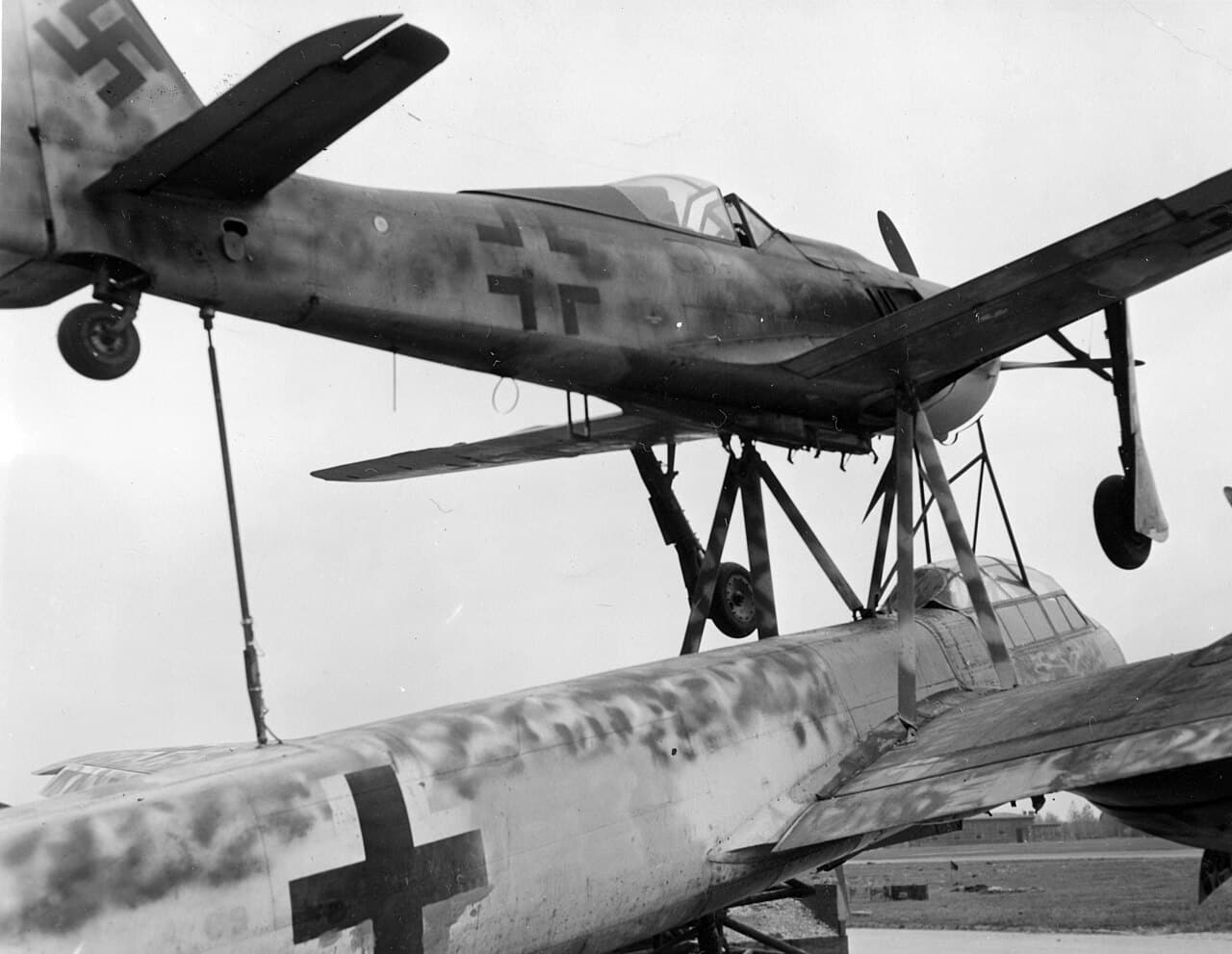
Seen from the ground, it looked like an accident waiting to happen: a single-seat fighter — a Messerschmitt Bf 109 or a Focke-Wulf Fw 190 — bolted rigidly to the spine of a twin-engined Junkers Ju 88 bomber, the two machines climbing away as one grotesque, four-engined creature. This was the Mistel, German for “mistletoe,” the parasitic plant that clings to a host tree. The name was chosen with grim precision.
The lower aircraft was unmanned. In place of its cockpit sat nearly two tonnes of shaped-charge explosive. The pilot, sitting up top in the fighter, flew the whole assembly to within sight of the target, aimed it, then fired the explosive bolts that let the drone-bomber go. The Ju 88 flew on into a warship or a bridge; the fighter, suddenly light, turned for home.
C'était l'une des armes les plus étranges de la Seconde Guerre mondiale, et l'une des plus révélatrices. Mistel was a product of 1944 desperation — ingenious in concept, brutally simple in execution, and, when it finally went to war, a near-total failure. This is how it worked, and why it almost never did.
• Nom: Mistel (“mistletoe”); also Huckepack (“piggyback”)
• Configuration: unmanned Ju 88 lower component + Bf 109 or Fw 190 fighter mounted above on struts
• Ogive: shaped (hollow) charge of nearly 2 tonnes (~1,800 kg), copper-lined
• Premier vol (composite) : July 1943 • Premier combat : nuit du 24 au 25 juin 1944
• Construit: ~250 of all variants • Opérateur: Luftwaffe (KG 200, KG 101)
• Verdict: Succès limité ; aucun naufrage majeur confirmé ne figure dans les archives alliées.
Le gui : un parasite armé jusqu'aux dents
The idea did not begin as a weapon. Early German composite experiments used the DFS 230 assault glider as the lower element, with a piston-engined aircraft such as the Bf 109E riding on top — an attempt to give the glider more range than a conventional tow could offer. The step from transport aid to guided bomb was short and, by the standards of 1943, logical.
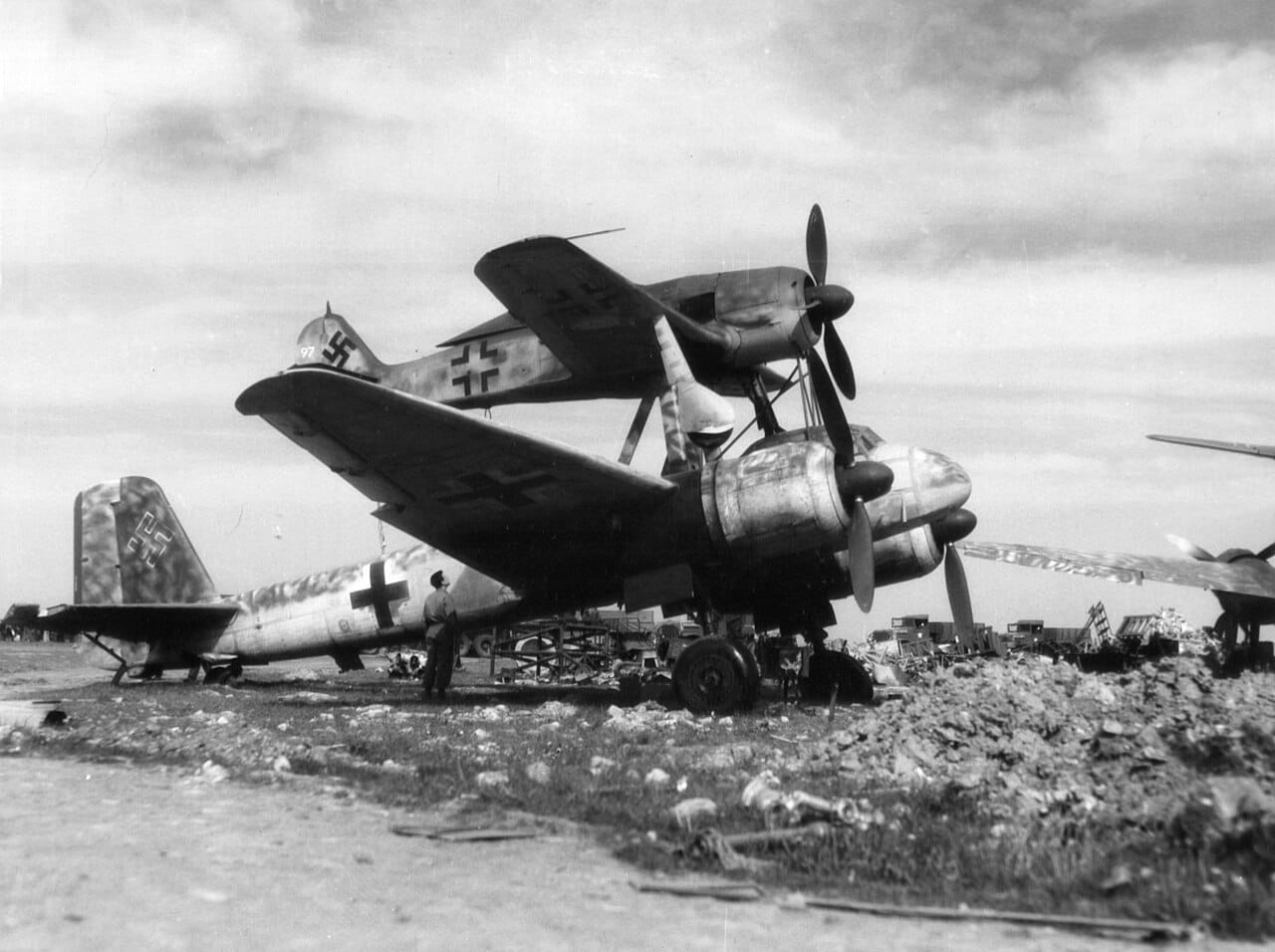
In the definitive form, the Ju 88’s entire nose-mounted crew compartment was removed and replaced with a purpose-built explosive nose. The fighter sat above on a framework of struts, connected by ball joints fitted with explosive bolts that severed the two aircraft on command. The first such composite flew in July 1943 and impressed enough for the Luftwaffe to launch a programme under the code name “Beethoven.” Some 250 examples of the various combinations were built. The principal service versions paired a Ju 88 with either a Bf 109 F-4 (Mistel 1) or an Fw 190 A-8 (Mistel 2 and 3).
Le nez tueur
Ce qui a fait le Mistel genuinely dangerous was its warhead. The definitive charge weighed close to two tonnes — the mass of an RAF “blockbuster” bomb — and was a hollow (shaped) charge lined with copper. Detonated correctly, it was expected to punch through as much as seven metres (about 23 feet) of reinforced concrete, which is why the planners dreamed of using it against dams, bunkers and battleship armour.
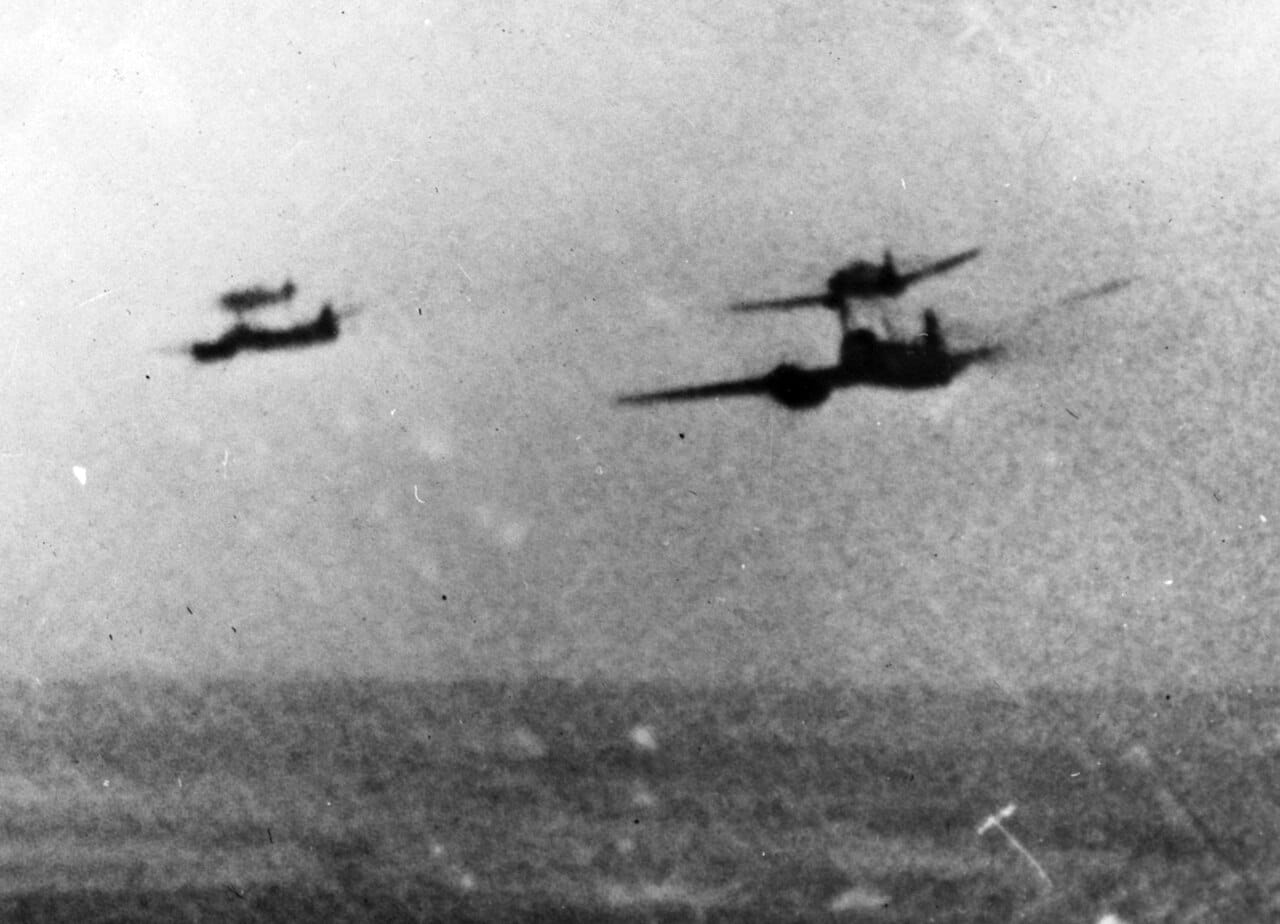
The delivery method was crude but clever. The pilot trimmed the combination into a shallow dive at the target, locked the controls, released the drone, and pulled up and away. In theory the Ju 88 would coast into the aim point on its own. In practice the composite was heavy, slow and sluggish to manoeuvre, and everything depended on the pilot setting up the run precisely before he let go. There was no guidance after release — once the bolts blew, the outcome was ballistics and luck.
Un aperçu documentaire du programme Mistel, de son ogive et de sa brève et inefficace carrière militaire.
Baptême sur la Normandie
Le Mistel’s combat debut came against the greatest concentration of shipping in history. In the weeks after D-Day, Oberleutnant Horst Rudat led a small task force of 2./KG 101 into action against the Allied invasion fleet. On the night of 24/25 June 1944, four Mistel composites took off against the anchorage off Normandy. It did not go to plan — Rudat’s own aircraft was hit by German flak that had not been warned of the mission.
Les pilotes ont revendiqué des impacts, mais aucun ne correspond aux pertes alliées. Ils ont très probablement touché la coque du vieux cuirassé français. Courbet, délibérément coulé dans le cadre du port artificiel Mulberry et transformé en leurre par les Alliés. Le seul succès documenté fut indirect : le 24 juin, un tir manqué de peu endommagea gravement le HMS Nith, une frégate servant de quartier général flottant, tuant neuf hommes. Mistel Il était également une proie facile. Un Mosquito de la RCAF piloté par Walter Dinsdale revendiqua le premier avion abattu au-dessus de la Normandie.
Le Marteau de Fer et les Ponts de l'Oder
The weapon’s most ambitious mission never happened. Under Operation Eisenhammer (“Iron Hammer”), planners intended to send Mistel composites against the electricity-generating stations around Moscow and Gorky — poorly defended, irreplaceable, and, the Germans believed, the Achilles heel of the Soviet war economy. In February 1945 the Luftwaffe assembled roughly 100 Mistel Près de Berlin, ils attendaient des conditions météorologiques favorables. Un raid aérien américain sur le centre d'essais de Rechlin détruisit 18 prototypes au sol, et le plan fut reporté, puis finalement abandonné.
L'Armée rouge ayant désormais pénétré sur le sol allemand, les unités composites furent retournées contre les têtes de pont soviétiques sur l'Oder. Le 12 avril 1945 Mistel struck the pontoon bridges being thrown across the river at Küstrin. The damage was negligible; the Soviet advance was delayed, at most, a day or two. Subsequent attacks were similarly ineffective. The seven-metres-of-concrete warhead, it turned out, was worth little if the aircraft could not be aimed accurately from a slow, defenceless platform under heavy fire.
Verdict : L'arithmétique du désespoir
Jugé froidement, le Mistel failed. Against a target-rich invasion fleet it achieved one confirmed near-miss and a handful of unverifiable claims; against the Oder bridges it changed nothing. It consumed scarce airframes, fuel and trained pilots at exactly the moment Germany could least afford to waste them, and it was cheap to defeat — a night-fighter could pick off the lumbering combination almost at leisure. As a piece of engineering it was inventive; as a war-winning weapon it was a symptom of a regime running out of options.
One survivor remains. An Fw 190 (Werk Nr. 733682), captured at Tirstrup in Denmark in 1945, still carries its explosive-bolt ball joints and is preserved at the Royal Air Force Museum Midlands at Cosford — the last physical trace of the strangest bomber the Luftwaffe ever flew.
Sources : Wikipédia (Mistel ; Opération Eisenhammer ; Horst Rudat) ; Robert Forsyth, Unités de bombardiers composites Mistel de la Luftwaffe (Osprey, 2015) ; La zone de guerre.
Questions connexes
Qu'était-ce que le Mistel ?
The Mistel — German for "mistletoe" — was a World War II composite weapon in which an unmanned, explosive-packed Junkers Ju 88 bomber was flown from a fighter (a Bf 109 or Fw 190) mounted on struts above it. The pilot aimed the whole assembly at a target, released the drone-bomber, and turned for home.
Comment fonctionnait le Mistel ?
Le Mistel associait un Ju 88 inférieur sans pilote, dont le compartiment de l'équipage était remplacé par une ogive à charge creuse, à un chasseur piloté fixé dessus. Le pilote du chasseur dirigeait l'ensemble vers la cible, puis tirait des charges explosives pour larguer le bombardier, qui poursuivait sa course vers un navire de guerre ou un pont, tandis que le chasseur, désormais allégé, s'échappait.
Quelle était la tête nucléaire du Mistel ?
Dans sa version définitive, le Mistel emportait une charge creuse de près de deux tonnes (environ 1 800 kg), revêtue de cuivre et montée dans un nez spécialement conçu à cet effet, remplaçant le cockpit du Ju 88. La conception de cette charge creuse visait à perforer les blindages épais des navires de guerre et les structures renforcées.
Quand le Mistel a-t-il été utilisé pour la première fois au combat ?
Le Mistel, un missile composite, effectua son premier vol en juillet 1943 et entra en action dans la nuit du 24 au 25 juin 1944. Il était un pur produit du désespoir de 1944 — ingénieux dans sa conception mais d'une simplicité brutale dans son exécution — alors que l'Allemagne cherchait des moyens bon marché de frapper des cibles de grande valeur en fin de guerre.
Combien d'avions Mistel ont été construits, et ont-ils connu le succès ?
Environ 250 Mistel, tous types confondus, furent construits et utilisés par des unités de la Luftwaffe, notamment les KG 200 et KG 101. Leur bilan au combat est limité, aucun naufrage majeur n'ayant été confirmé et comparé aux résultats des opérations alliées. À l'instar d'autres appareils allemands de fin de guerre, tels que le Dornier Do 335, L'ingéniosité a surpassé les résultats.
0 commentaire