

Most aircraft are designed to fly straight and level by default. Take your hands off the controls and they glide on, stable, content, reassuring. The F-16 Fighting Falcon is not like most aircraft. Take your hands off the controls in an F-16 and it will try to kill you. That is precisely the point.
The engineers who designed it in the early 1970s made a decision that was, at the time, considered borderline insane: they built a fighter jet that is fundamentally, deliberately, inherently unstable. Not a flaw. A feature.
The Relaxed Static Stability Revolution
Traditional aircraft design places the centre of gravity slightly behind the centre of lift, creating a natural tendency to pitch nose-down — which means the pilot always has to apply gentle back pressure to maintain level flight. This stability is comfortable to fly but limits agility. Any input requires overcoming the aircraft's own natural resistance to turning.
The F-16 reversed this. Its centre of gravity is placed slightly ahead of its centre of lift — making it naturally want to pitch nose-up and tumble. No human being can fly an inherently unstable aircraft by hand; the corrections required happen too fast, dozens of times per second. So the F-16 was designed from the ground up around a fly-by-wire flight control computer that fires corrections to the control surfaces approximately 40 times per second, keeping the aircraft on the edge of controllable flight at all times.
The result: when the pilot pulls the stick, there is no inertia to overcome. The aircraft snaps. Instantaneously. At 9g. General Dynamics test pilot Phil Oestricher, after the first flight in January 1974, described the handling as unlike anything he had experienced — like flying a thought.
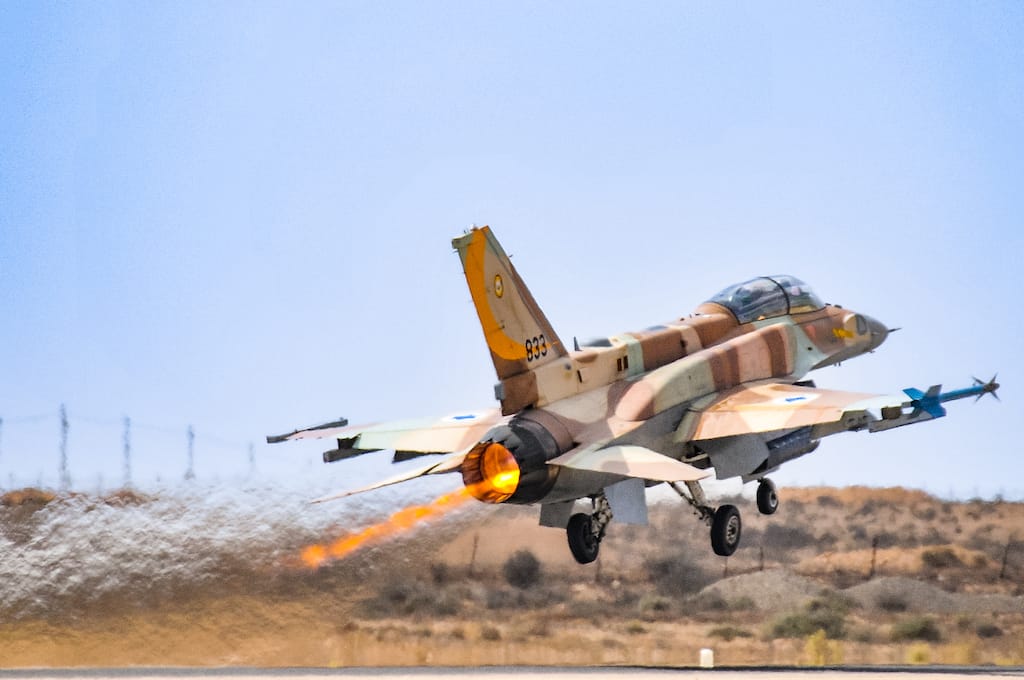
The Numbers That Define a Legend
The F-16 has a thrust-to-weight ratio greater than 1:1 with a light fuel load — meaning it can accelerate vertically, straight up. It can sustain 9g turns, which is near the limit of what a human body can withstand even in the reclined 30-degree seat that the F-16 introduced to help pilots stay conscious under extreme G-loading. From brake release to supersonic flight takes roughly 45 seconds on a clean aircraft with full afterburner. The maximum speed is around Mach 2 — twice the speed of sound.
But the numbers miss the point. What the F-16 represents is a philosophy: that the best fighter is not the most stable or most comfortable to fly, but the one that does exactly what the pilot intends, instantly, without lag or resistance. The computer exists to make that possible. The pilot is the weapon. The aircraft is the delivery mechanism.
The Viper, 50 Years On
The F-16 first flew in 1974. Over 4,600 have been built. It has served in 25 air forces and fought in over a dozen conflicts. It is still in production. Newer jets — the F-35, the Eurofighter, the Rafale — all use fly-by-wire and relaxed static stability, concepts the F-16 pioneered. Every modern fighter is, in some sense, the F-16's descendant.
Pilots almost universally call it "the Viper" — not the official name, never used in any document, just the name the jet earned from the people who flew it. You don't name a machine after a venomous snake because it's comfortable. You name it that because of what it does when it moves.
Sources: General Dynamics / Lockheed Martin; National Museum of the USAF; Air Force Magazine; Fighter Pilot Podcast
Questions connexes
Why is the F-16 called the Viper?
Although its official name is the Fighting Falcon, F-16 pilots nicknamed it the "Viper" — a name often linked to the sleek Colonial Viper fighters of the 1970s Battlestar Galactica series, and to the jet's snake-like profile and lethal agility. The nickname stuck and is used affectionately to this day.
Is the F-16 aerodynamically unstable?
Yes, deliberately so. The F-16 was designed in the early 1970s with relaxed static stability, meaning it naturally wants to depart controlled flight rather than fly straight and level. A fly-by-wire computer makes constant tiny corrections, turning that instability into extraordinary agility.
What is relaxed static stability?
Relaxed static stability is a design approach where an aircraft is intentionally made unstable to boost maneuverability. Because it resists less when changing direction, it responds instantly to control inputs. The trade-off is that it cannot be flown without a computer constantly stabilising it.
How fast is the F-16?
The F-16 has a top speed of around Mach 2, roughly twice the speed of sound. With full afterburner it can go from brake release to supersonic flight in about 45 seconds, and its thrust-to-weight ratio above one lets it accelerate while climbing straight up.
How many F-16s have been built?
The F-16 first flew in 1974 and more than 4,600 have been built, with production still ongoing decades later. It has served in around 25 air forces and fought in more than a dozen conflicts, from early Cold War service to recent NATO intercepts.
What is the F-16's official name?
The F-16's official name is the Fighting Falcon, given by General Dynamics. Pilots, however, almost universally call it the Viper. It can sustain 9g turns, and its reclined 30-degree seat — a feature the F-16 introduced — helps pilots stay conscious under that extreme G-loading.
Why does the F-16 use a fly-by-wire flight control system?
Because the F-16 is deliberately unstable, it relies on a fly-by-wire system in which a computer interprets the pilot's inputs and adjusts the controls many times per second. This makes the jet do exactly what the pilot intends, instantly — a philosophy echoed by the all-flying tail pioneered in Korea.
0 commentaire