
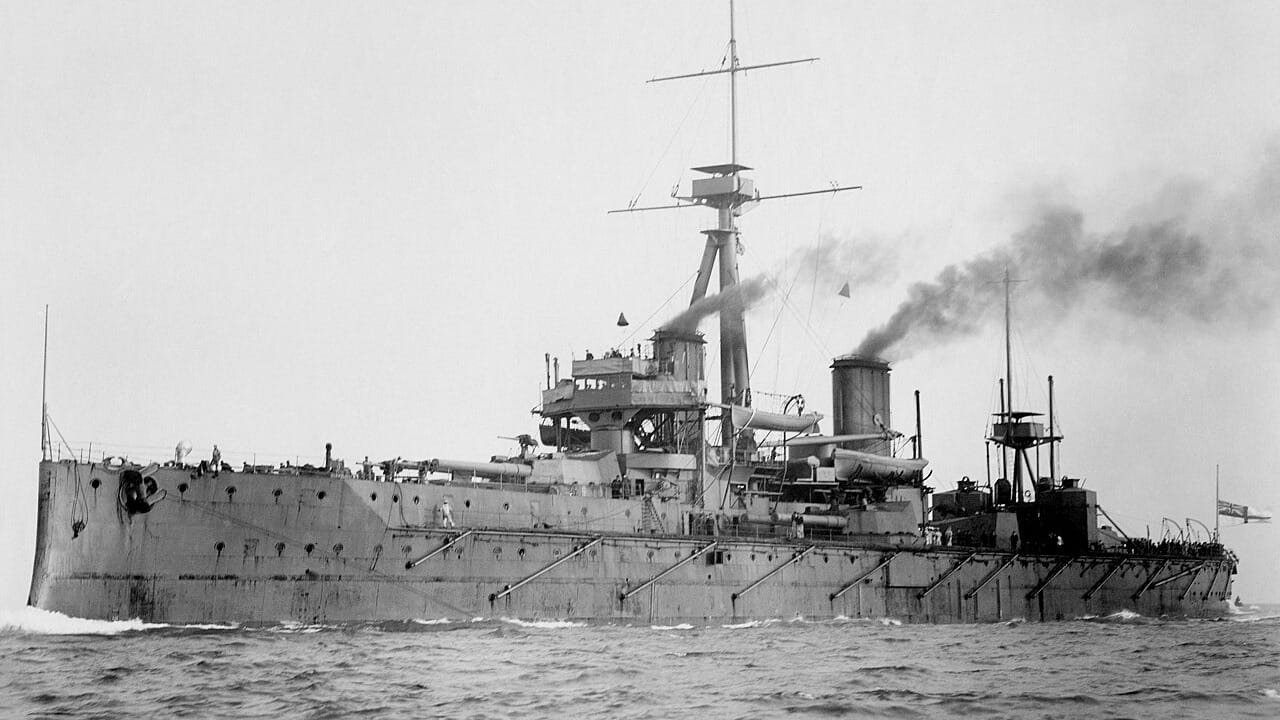
The comparison arrives within about ninety seconds of any conversation about defence budgets. Europe is rearming, China is building warships at a pace nobody can match, and somebody says it: this is how it felt before 1914. Sometimes they reach for the other analogy instead, the 1930s, and the word is appeasement rather than sleepwalking. Either way the point is the same. We have been here before, and it ended badly.
It is a serious argument made by serious people. Christopher Clark, whose 2012 history The Sleepwalkers gave the analogy its modern vocabulary, told NPR in 2013 that our world is getting more like 1914, not less. Margaret MacMillan has made a version of the same case. So has Graham Allison, in a different register.
But an analogy is a claim about magnitude, and magnitude is measurable. We had just finished counting every aircraft, warship and soldier on earth, so we went looking for the same numbers in 1913 and 1938. They exist. They are messier than modern data, and every historian who compiles them attaches a warning label. And they say something more interesting than either side of this argument usually admits.
Informations clés
Fastest five-year growth, 1908–13: Italy, +121% (total spending)
Fastest five-year growth, 1933–38: Germany, +1,540%
Fastest five-year growth, 2020–25: Ukraine, +969%; Russia, +136%
German military burden: about 4% of GNP before 1914, 17% in 1938, 2.3% of GDP in 2025
British army budget, 1908–13: +5.6%. The naval race got the headlines; the armies got the money
Global military spending, 2025: $2,887 billion, the eleventh consecutive annual rise
The sentence everyone quotes
Clark’s book ends with an image so effective that it has escaped the book entirely. It is now shorthand for a whole theory of how catastrophe happens: not through malice, but through momentum.

What gets lost when the line travels on its own is that Clark is not primarily writing about weapons. His argument is about decision-making under uncertainty — about statesmen who each behaved defensively, believed their own intentions were benign, and assumed everyone else’s were not. The armaments are part of the scenery. They are not the engine.
Clark makes that explicit early in the book. Nationalism, armaments, alliances and finance, he argues, carry real explanatory weight only if you can show how they shaped the decisions that actually produced war. That is a much higher bar than “spending went up, and then there was a war”.
Clark laying out the argument in full at Gresham College. The clearest hour available on why he thinks 1914 was a tragedy rather than a crime.
What 1913 actually looked like
Start with the number the pre-war period is famous for. Between 1908 and 1913, spending by the six European great powers rose by roughly 50% in money terms. That is David Stevenson’s figure, and Stevenson is the historian who has done more than anyone to reconstruct these budgets line by line.
A 50% rise in five years is a lot. It is also, by the standards of what came later, modest — and Stevenson says so in the same breath, noting that the increase was far less dramatic than the 1930s and that military spending as a share of national income stayed much lower than it would be before 1939.
Now break it apart, because the aggregate hides the interesting part.
Two things fall out of that table, and both cut against the popular version of the story.
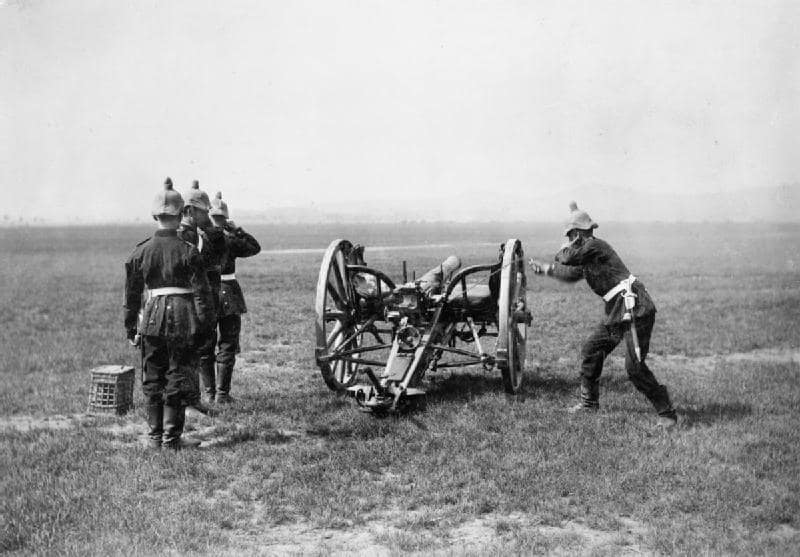
The first: Britain was barely racing at all on land. The British army budget grew 5.6% across those five years while the Italian army budget grew 132% and the German army budget grew 67%. The country that would go on to raise the largest volunteer army in its history was, in the run-up, spending almost nothing extra on soldiers.
The second: the naval race was already over. German naval spending grew 37% between 1908 and 1913 — slower than the German army budget in the same window, and slower than Britain’s 44%. Berlin had effectively conceded. Britain entered the war with roughly forty-five capital ships in service or under construction against Germany’s twenty-six, and everyone involved could see the arithmetic coming.
This matters because the Anglo-German naval race is the single image most people carry of pre-1914 militarism. Dreadnoughts, the Daily Mail, “we want eight and we won’t wait”. It is a genuinely great story. It is also the part of the arms race that had stopped accelerating before the war began.
Historians have been making this point for years without much success against the popular version. Dirk Bönker, writing for the international WWI encyclopedia 1914-1918-online, puts it bluntly: the race was decided early, political leaders learned to set it aside as an issue, and it did not cause the decision for war in 1914 — though it did leave behind an atmosphere of hostility and distrust that narrowed the space for diplomacy.
History Matters on the Anglo-German naval race — a brisk animated summary of the contest that dominates the popular memory of pre-1914 rearmament.
Where the acceleration actually was, in those last five years, is the continental armies. France, Russia, Austria-Hungary, Italy and Germany all pushed hard on land forces between 1908 and 1913 — the Balkan Wars, the Bosnian crisis and successive French and German army laws ratcheting each other upward. Clark describes exactly this dynamic in The Sleepwalkers: German measures triggering French and Russian increases that immediately cancelled out the German gain, with the Russians setting the pace in one cycle and the Germans in the next.
What 1938 actually looked like
If the pre-1914 numbers are smaller than the reputation, the 1930s numbers are larger than almost anyone expects. This is not the same phenomenon at a different intensity. It is a different phenomenon.
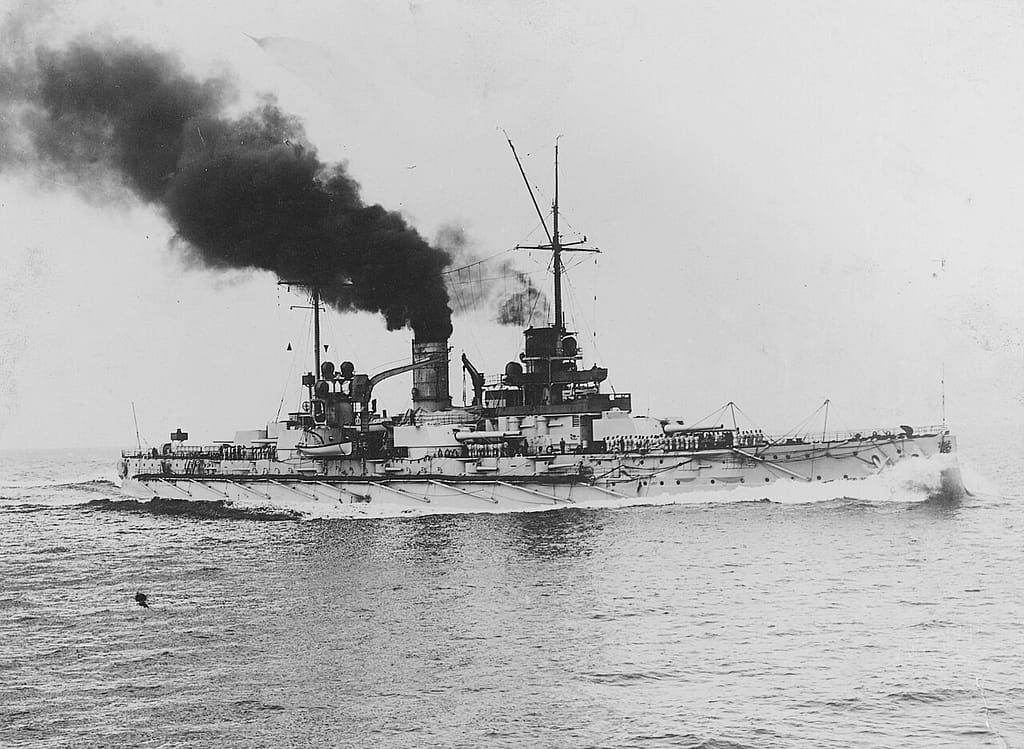
German military spending rose roughly sixteenfold between 1933 and 1938. Not 16%. Sixteen times. Japan’s rose nearly eightfold. Britain, starting from a disarmed base and moving late, still managed a fivefold increase. Adam Tooze, in The Wages of Destruction, notes that between 1933 and 1935 the military share of German national income went from under 1% to close to 10%, and that a reallocation of national production on that scale in that little time had never before been seen in any capitalist state in peacetime.
By 1938 Germany was spending more on weapons than Britain, France and the United States combined — Paul Kennedy’s calculation, in the year of Munich. Roughly half of all German government spending was going to the military.

Read that last sentence again, because it is the whole comparison in one line, written by the leading economic historian of Nazi Germany. Overy’s 3% is at the low end — other reconstructions put pre-1914 Germany between 4% and 4.7%, depending on whether military pensions and strategic railways are counted. It makes no difference to the point. The arms race that produced the First World War ran somewhere between three and five per cent of German national income. The one that produced the Second ran at seventeen.
The three eras on one chart
Here is the same question asked of all three build-ups: how fast was military spending rising in the five years before things broke?
The shape of that chart is the answer to the question anyone is really asking when they invoke 1914.
Today looks like 1913. It does not look like 1938.
Russia’s +136% over five years is the modern Italy, which managed +121% in the five years to 1913. Germany’s +77% sits above the Kaiser’s Germany at +53%, but below Italy then. Japan, China, Britain and France all fall inside the pre-1914 band. The United States is the modern Britain: the incumbent superpower, spending vast sums in absolute terms, and flat or slightly down in real terms.
The 1930s panel, by contrast, does not fit on the chart. Six of its seven bars run past the edge. Only one modern country breaks the scale, and it is Ukraine, which is being invaded.
Widen the window to a decade and the two patterns converge further.
Over ten years Germany is at +118%, against +109% for the Kaiser’s Germany and +113% for Austria-Hungary in the decade to 1913. Russia is at +96% against Russia’s own +77%. These are not merely similar orders of magnitude. They are close to the same numbers.
The 1930s cannot even be drawn on the same terms. German rearmament began in 1933 and the war came in 1939, so there was never a ten-year build-up to measure. Across the eight years that did exist, German military spending rose more than forty-fold.
The measure that survives a century
Growth rates are treacherous across eras, because they depend entirely on where you start. A country that disarmed can triple its budget and still be weak. The more honest measure is how much of the economy a country hands to its military — and that number, unlike currency values, means roughly the same thing in 1913 as it does today.
This is the table that should end the 1938 comparison permanently.
Germany today spends 2.3% of its economy on defence. The Germany that built the High Seas Fleet, alarmed Europe and went to war in 1914 spent about 4%. The Germany of 1938 spent seventeen. Modern Germany is not approaching 1938; it has not yet got back to 1913.
The same holds across most of Europe. Britain is at 2.4% against 3.4% before 1914. France is at 2.0% against 4.1%. China, the power whose rise supposedly makes this era dangerous, spends 1.7% — a smaller share of its economy than any European great power carried in 1913.
Two countries break the pattern, and they are the two you would expect. Russia is at 7.5%, above every 1913 great power and level with Britain in 1938. Ukraine is at about 40%, which is not a peacetime figure at all — it is roughly where Germany was in 1940, with the war already running.
Where the analogy does hold
None of this means the comparison is worthless. It means the comparison is being made about the wrong variable.
Stevenson’s own conclusion is not that armaments caused the war. It is narrower and more unsettling than that.

Critical to the timing. Not to the fact. In the same chapter Stevenson identifies what he thinks the genuinely dangerous moment is: the point of crossover, when one side threatens to overhaul the other. He lists the historical examples — Britain and France closing on Germany in the late 1930s, the United States pulling ahead of the Soviet Union in the early 1960s — and then adds, in print, that the same logic may apply as China narrows the gap with the United States today.
That is a much more specific worry than “spending is going up”. It says the risk is not the level of armament but the direction of the trend, and specifically the fear of a power that believes it is about to be overtaken, or about to lose its chance.
It also happens to be the mechanism Niall Ferguson has argued was decisive in 1914 — that German leaders went to war not because they were winning the arms race but because they had concluded they could not win it against Russia and France combined.
Historians do not actually believe arms races cause wars
This is probably the most surprising thing we found, and it sits oddly with how confidently the analogy gets deployed. The scholarly consensus is not that the pre-1914 arms race caused the First World War. There is no such consensus, and there has not been one for decades.
Eric Dorn Brose states it flatly in the standard WWI encyclopedia: historians today do not explain the outbreak of war in 1914 as simply the result of tensions caused by the arms race. The positions range from Stevenson’s “necessary precondition” through to the view that the arms race was a symptom rather than a cause — that political rivalry produced both the spending and the war.
Even Edward Grey, the British foreign secretary whose line about great armaments leading inevitably to war is quoted more than any other, contradicted himself within the same chapter — writing a few pages later that the military power in Germany chose the time and precipitated the war. Almost nobody quotes that half.
What these numbers cannot tell you
Everything above should be read with the warning label the historians themselves attach. Comparing military spending across a century is genuinely treacherous, and the people who compile these series are the first to say so.
The Correlates of War dataset — the only series that spans both eras — is denominated in pounds sterling until 1913 and US dollars from 1914. There is no continuous line across the two. Anyone who draws one is splicing two different currencies and hoping nobody checks.
The denominators are not the same thing either. The figures in our burden table are variously shares of GDP, GNP, net national product, net national expenditure and, for the Soviet Union, net material product. Pre-1945 national income estimates are themselves reconstructions built decades after the fact.
German rearmament is the worst case of all, because Hitler deliberately hid much of it. Mefo bills were designed to keep spending off the books. Hans-Erich Volkmann, writing in the official German history of the war, notes that armament figures for the Third Reich vary considerably precisely because the real total includes public and private investment as well as Wehrmacht costs. Published estimates for the 1938 burden run from 14.6% to 20%. We printed 17%, the middle.
And conscript armies distort everything. A continental power that pays conscripts a token wage looks cheap next to Britain’s volunteer force, even when it fields five times the men. Richard Overy’s own instruction to readers of his rearmament tables is that the value of military expenditure is not directly comparable across countries — what can be compared is the scale and pace of change.
That is exactly what we have done here, and it is all these numbers will bear. Read them as orders of magnitude, not measurements.
The last caution is about the 1930s analogy specifically, and it comes from the historian whose work on the Nazi economy is most often used to justify it.

Tooze’s point is arithmetic, not politics. European governments are arguing about whether to move from 2% of GDP to 3% or 4%. The 1930s comparison implies 30% or 40%. Using the second vocabulary for the first debate does not raise the stakes; it just muddies them.
So are we sleepwalking?
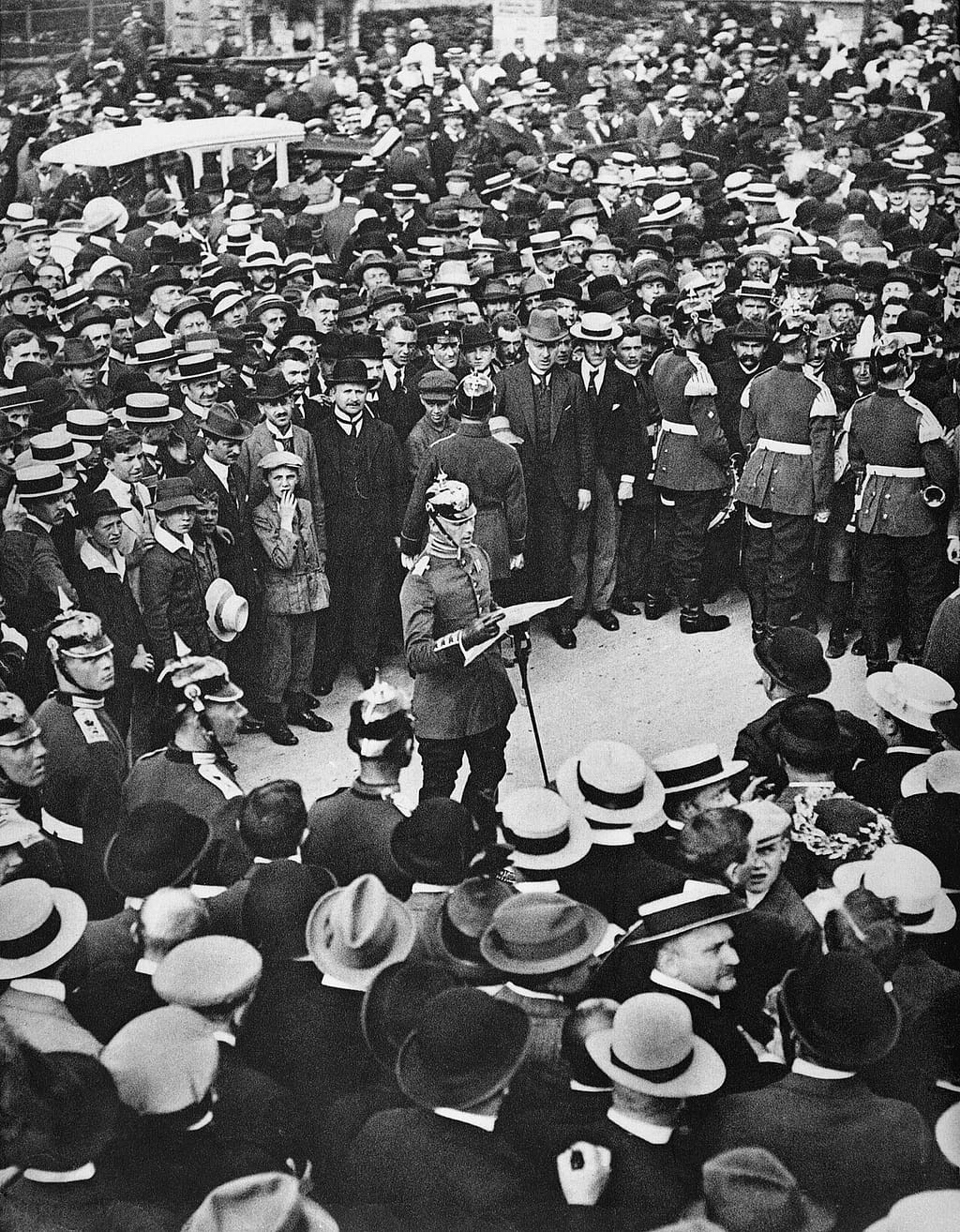
On the evidence, the honest answer is that today’s build-up is real, is broad, and is running at roughly the intensity of the decade before 1914 rather than the decade before 1939 — with two exceptions, both of which involve a war that is already happening.
But the more useful conclusion is that the spending was never the point. Clark’s sleepwalkers were not sleepwalking because their budgets were large. They were sleepwalking because each of them was reasoning defensively, on incomplete information, about opponents whose intentions they consistently read as aggressive and whose fears they never took seriously. The armaments were how that mistrust expressed itself, not what caused it.
Clark himself, asked in 2014 whether we were repeating the pattern, put it in one sentence that has nothing to do with money.
That is the warning worth taking from 1914. Not a number. A habit of mind.
Sources : SIPRI, Trends in World Military Expenditure 2025 (April 2026); Correlates of War, National Material Capabilities v7.0; David Stevenson, ‘Land Armaments in Europe, 1866–1914’, in Mahnken, Maiolo & Stevenson (eds), Arms Races in International Politics (Oxford University Press, 2016); Christopher Clark, The Sleepwalkers (Allen Lane, 2012); Richard Overy, War and Economy in the Third Reich (Clarendon Press, 1994) and The Origins of the Second World War (Longman, 1987); Paul Kennedy, The Rise and Fall of the Great Powers (1987); Adam Tooze, The Wages of Destruction (2006) and Chartbook 360 (2025); Mark Harrison, Economic History Review 41:2 (1988); Eric Dorn Brose and Dirk Bönker, 1914-1918-online; Sir Michael Howard, The Wilson Quarterly (1984).
0 commentaire