

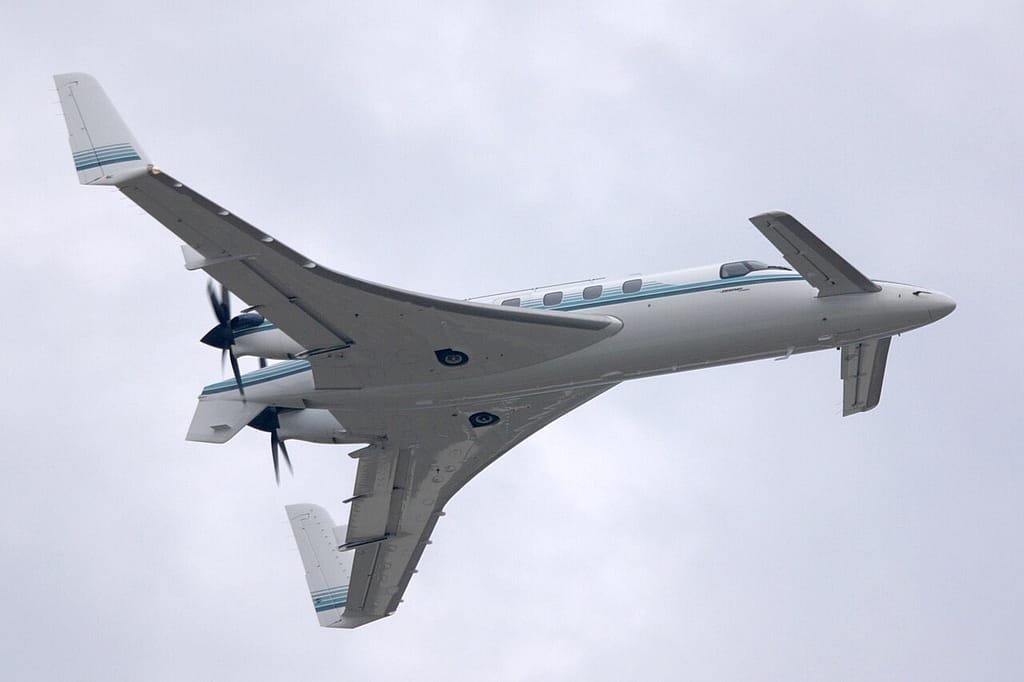
In the mid-1980s, Beechcraft decided to leap a generation ahead of everyone else. It teamed up with Burt Rutan, the most imaginative aircraft designer alive, and built a business aeroplane that looked like it had flown in from the next century: an all-carbon-fibre airframe, a canard wing that swept forward, twin propellers facing backward, and a cockpit full of glass screens where the dials used to be. They called it the Starship.
It was gorgeous, radical, and years ahead of its time. It was also one of the most expensive flops in the history of private aviation, so complete a failure that Beechcraft eventually spent years hunting down its own aircraft to burn them. This is the story of a machine that was too clever for its own good.
Informations clés
| Aéronef | Beechcraft Starship 2000/2000A |
| Designed with | Burt Rutan’s Scaled Composites |
| Configuration | All-composite, variable-sweep canard, twin pusher turboprops, all-glass cockpit |
| Premier vol | March 1986 (full-size aircraft) |
| Construit | 53 (production 1988 to 1995) |
| The problem | Heavier, costlier and no faster than the metal King Air it was meant to beat |
| Destin | Beechcraft bought back and incinerated around 40; roughly six still fly |
The Future, Delivered Early
On paper the Starship was everything a 1990s executive could want. Rutan's Scaled Composites had proven the layout with a scaled-down flying model, and the full-size aircraft that followed was a technical tour de force. The carbon-fibre structure promised strength without weight. The forward canard swept to change the aircraft's handling as it slowed for landing. The two Pratt & Whitney turboprops pushed rather than pulled, keeping the cabin quiet and the view forward clean. And the Collins glass cockpit was straight out of an airliner.
Where It All Went Wrong
The trouble was that revolutionary and certifiable are two very different things. Composite airframes were new to the FAA, so regulators demanded conservative safety margins that piled weight back onto the very structure that was supposed to be light. The finished Starship ended up heavier than promised, no faster than the cheaper, all-metal King Air it was meant to replace, and priced like a small jet. To fly it, you needed a full type rating.
Then the timing turned cruel. The Starship arrived into the business-aviation downturn of the late 1980s and early 1990s, exactly when wealthy buyers were tightening their belts. Faced with a plane that cost jet money, flew like a turboprop and demanded extra training, customers simply bought the King Air instead. Only 53 Starships were built before Beechcraft pulled the plug in 1995.
Burning the Evidence
What happened next is the strangest part. Rather than support an ageing fleet of complex composite aircraft it could no longer sell, the manufacturer decided to make the problem disappear. Beechcraft offered to buy the Starships back from their owners, and beginning in 2003 flew roughly 40 of them to the Arizona desert, where they were deliberately incinerated and dismantled.
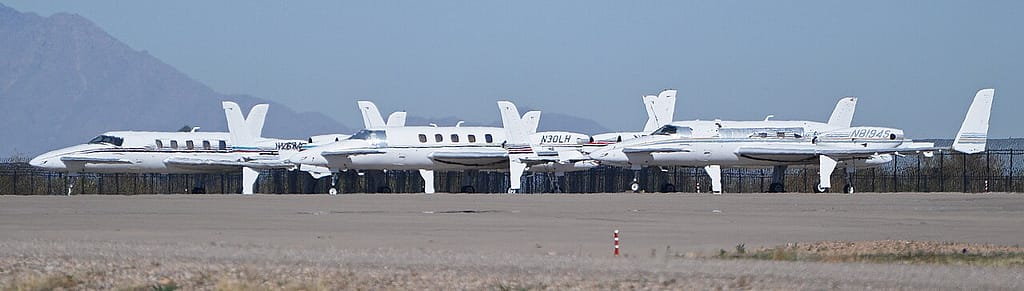
A few escaped the fire. Perhaps six remain airworthy today, flown and doted on by a small, devoted band of owners, with others preserved in museums or quietly cannibalised for the parts that keep the survivors going. Each one is now a rare, flying artefact of a future that never quite arrived on schedule.
The Starship's tragedy is that almost everything about it was right, just twenty years too soon. Carbon composites, glass cockpits and clever aerodynamics are utterly normal now. Beechcraft simply tried to sell all of them at once, at a jet's price, in a recession. The result was a masterpiece that the market refused, and that its own maker chose to erase. Beautiful, brilliant, and burned.
Sources: HistoryNet; The Autopian; Simple Flying; Air Facts Journal; Pilot Mall; Pima Air & Space Museum.



0 commentaire