
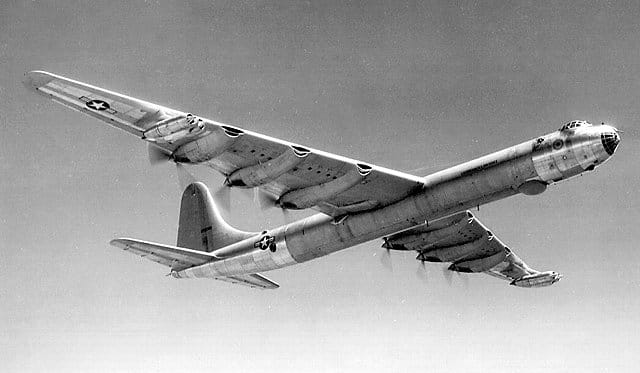
" Six moteurs en rotation, quatre en combustion " est une expression consacrée de l'aviation. Les six moteurs sont des Pratt & Whitney R-4360 Wasp Major à 28 cylindres, montés à l'envers le long du bord de fuite de l'aile, propulsant d'énormes hélices propulsives dans un air plus raréfié que jamais. Les quatre turboréacteurs sont des General Electric J47, fixés par paires sous les ailes. Ils fonctionnent tous simultanément. Et ils propulsent 186 tonnes d'aluminium, d'uranium, de carburant et de bombes aux confins de la stratosphère.
Le Convair B-36 Peacemaker est, à presque tous les égards, l'avion de combat le plus absurde jamais construit par les États-Unis. Son envergure atteignait 70,1 mètres, soit plus qu'un 747. Il pouvait emporter jusqu'à 39 000 kilogrammes de bombes. Son fuselage était si long que les équipages se déplaçaient entre les compartiments avant et arrière à l'aide d'un chariot à roulettes traversant un tunnel pressurisé. Enfin, c'est le seul avion de l'histoire à avoir été conçu spécifiquement pour bombarder Moscou depuis le Texas sans ravitaillement en vol.
Informations clés
Designer: Convair (Consolidated Vultee)
Premier vol : 8 août 1946
En service : 1948–1959
Envergure: 70,1 m (230 pieds) — plus large qu'un Boeing 747
Centrale électrique : 6 moteurs à pistons Pratt & Whitney R-4360 + 4 turboréacteurs GE J47
Gamme: 16 000 km (10 000 miles) sans ravitaillement
Construit: 384 avions
Le bombardier que la Guerre froide exigeait
Le B-36 fut conçu en 1941, lorsque la perspective d'une chute de la Grande-Bretagne aux mains des nazis incita l'US Army Air Forces à envisager sérieusement la conception d'un bombardier capable de décoller d'Amérique du Nord, d'attaquer l'Allemagne et de revenir. Le cahier des charges exigeait une autonomie de 16 000 kilomètres et un rayon d'action de 6 400 kilomètres, avec une charge de bombes de 4 500 kilogrammes — des performances qu'aucun avion au monde ne pouvait atteindre.
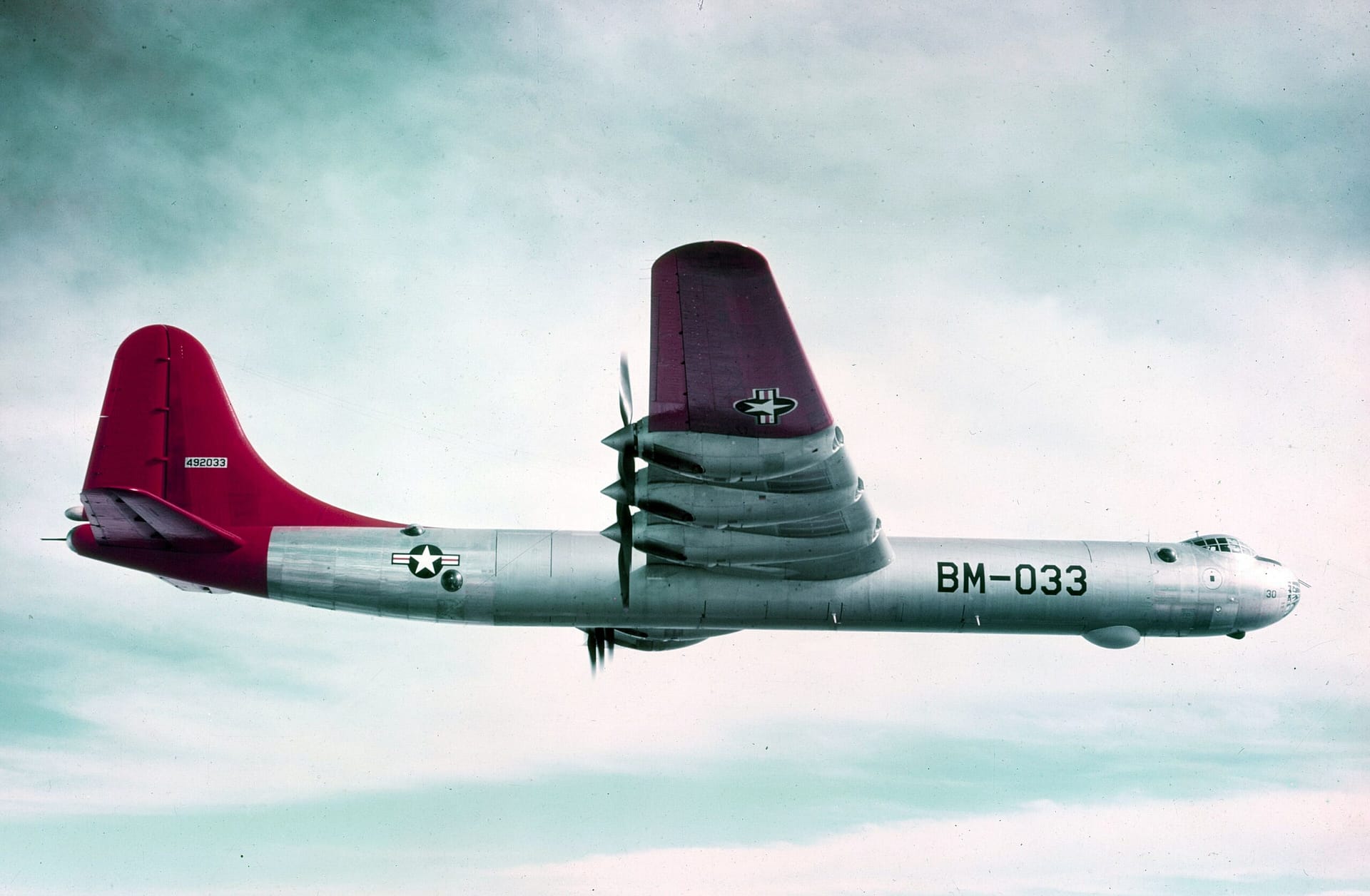
La guerre prit fin avant même que l'avion ne décolle. La mission, elle, se poursuivit. Dès 1946, l'enjeu était devenu le problème des bombardiers stratégiques du début de la Guerre froide : larguer une arme atomique sur l'Union soviétique sans transiter par des bases aériennes européennes qui n'existaient pas encore. Le B-36 était le seul avion au monde capable d'accomplir cette mission. Le B-50 (version améliorée du B-29) nécessitait des bases avancées en Grande-Bretagne. Tu-95 Du côté soviétique, le programme Bear n'en était encore qu'à l'état de projet. Le Peacemaker, quant à lui, avait toute la latitude pour mener à bien ce projet.
Conçu avant l'ère du jet, puis entraîné de force dans celle-ci
Les moteurs à pistons constituaient le choix initial et représentaient un problème majeur durant la Guerre froide. Le R-4360 Wasp Major est le plus gros moteur à pistons jamais produit en série pour l'aviation : 28 cylindres, 71,5 litres de cylindrée, 3 800 chevaux à pleine puissance militaire. Le B-36 en était équipé de six. Chaque cylindre disposait de deux bougies d'allumage, soit 336 bougies par appareil. Un simple changement de bougies pour l'ensemble de la flotte de B-36 du SAC nécessitait environ 35 000 bougies.
Le R-4360 souffrait d'un grave problème : son refroidissement était insuffisant. Les moteurs étant montés à l'envers derrière l'aile, le flux d'air entrant dans les cylindres était perturbé par l'aile elle-même. Les incendies de moteurs en vol étaient un problème récurrent, si fréquent que les équipages plaisantaient en disant que le slogan était en réalité : " Deux moteurs qui tournent, deux qui brûlent, deux qui fument, deux qui s'étouffent et deux autres dont on est sans nouvelles. "
Les réacteurs sur les ailes, puis le chant du cygne
Les quatre turboréacteurs J47 boulonnés sous les ailes extérieures furent ajoutés pendant la guerre de Corée. Ils n'étaient pas destinés au vol de croisière, mais au décollage, à la montée et à l'attaque au sol. Avec ses dix moteurs en marche, le B-36 pouvait dépasser les 700 km/h en altitude – une vitesse suffisante, pendant une courte période au début des années 1950, pour que la police militaire soviétique ne dispose d'aucun chasseur capable de l'intercepter efficacement.
Cette fenêtre s'est fermée lorsque MiG-15 Entré en service, le B-36, dès 1955, n'opérait plus qu'à des altitudes supérieures à 13 000 mètres, où sa taille et sa faible vitesse en faisaient une cible facile. Le système de missiles sol-air soviétique S-75 finit par anéantir le problème des bombardiers stratégiques. En 1959, avec le B-52 En pleine exploitation, le dernier B-36 a été mis hors service et envoyé au cimetière d'avions de Davis-Monthan.
L'avion n'a jamais largué de bombe en situation de combat. Il ne s'est jamais écrasé au combat non plus. Son véritable héritage réside dans la doctrine — selon laquelle l'Union soviétique pouvait être atteinte depuis le territoire continental américain par un seul avion porteur d'armes nucléaires — qui a défini tous les programmes de bombardiers stratégiques américains qui lui ont succédé. Le B-52 a hérité de la mission. Le B-1 a hérité de la vitesse. B-2 Il a hérité de la furtivité. Le B-21 héritera des trois. Mais c'est le B-36 qui a conçu l'architecture.
Quatre Peacemakers complets sont conservés dans des musées américains. Chacun d'eux est, d'une certaine manière, plus imposant qu'on ne l'imagine en s'approchant. En 2026, ils ressemblent encore à des avions d'une autre époque, un peu folle. Et c'est bien le cas.
Sources : Musée national de l'US Air Force, Musée commémoratif du Commandement aérien stratégique, Agence de recherche historique de l'Air Force.
Questions connexes
Qu'était-ce que le B-36 Peacemaker ?
Le Convair B-36 Peacemaker était un bombardier intercontinental américain géant du début de la Guerre froide. Avec une envergure de 70 mètres (plus large qu'un Boeing 747) et dix moteurs, il pouvait parcourir 16 000 kilomètres sans ravitaillement pour frapper des cibles partout dans le monde.
Pourquoi le B-36 est-il surnommé ' six moteurs tournants et quatre moteurs en feu ' ?
En raison de sa configuration inhabituelle à dix moteurs : six moteurs à pistons avec hélices (" six moteurs tournants ") et quatre turboréacteurs (" quatre moteurs à combustion "), cette expression décrivait la combinaison de propulsion par hélices et par réacteurs utilisée par cet énorme bombardier pour décoller et voler en croisière.
Quelle était la taille du B-36 Peacemaker ?
Son envergure était de 70,1 mètres (230 pieds) — encore plus large qu'un Boeing 747. Le B-36 était l'un des plus grands avions de combat jamais construits, conçu pour transporter de lourdes charges de bombes sur des distances intercontinentales.
De quels moteurs était équipé le B-36 ?
Il était équipé de dix moteurs : six moteurs à pistons Pratt & Whitney R-4360 entraînant des hélices, plus quatre turboréacteurs General Electric J47 pour une vitesse accrue et des performances en haute altitude — la combinaison à l'origine du fameux six moteurs tournants et quatre moteurs en combustion.
Pourquoi le B-36 a-t-il été construit ?
L'idée a vu le jour en 1941, lorsque les stratèges craignaient que la Grande-Bretagne ne tombe aux mains de l'Allemagne nazie et que les États-Unis aient besoin d'un bombardier capable de frapper l'Europe directement depuis l'Amérique du Nord. Il en résulta un bombardier intercontinental doté d'une autonomie de 16 000 kilomètres sans ravitaillement.
0 commentaire