
There is a company on the New York Stock Exchange today whose name is a peace treaty between two men who spent a decade trying to destroy each other in court.
Orville and Wilbur Wright patented powered flight. Glenn Curtiss started building aeroplanes anyway. The lawsuits that followed did more damage to early American aviation than any technical problem, and it took a world war and the future president Franklin Roosevelt to stop them.
Twelve years after that, the two rival firms merged. The result built more aircraft engines in the Second World War than almost anyone, missed the jet age completely, sold off its aeroplane business, and quietly became something else entirely.
Which brings us to the interesting question of what Curtiss-Wright actually does now — and whether the thing people are currently saying about it is true.
Informations clés
| Fondé | 5 July 1929, by the merger of the Curtiss Aeroplane and Motor Company and the Wright Aeronautical Corporation, plus a group of related firms |
| The feud | The Wright brothers sued Glenn Curtiss over US Patent 821,393, filed 1903 and granted 1906, covering the method of lateral control |
| How it ended | A patent pool formed on 24 July 1917 on the recommendation of a committee set up by Franklin D. Roosevelt, then Assistant Secretary of the Navy |
| WWII output | By the company’s own accounting: 142,840 aircraft engines, 146,468 electric propellers and 29,269 aeroplanes |
| Most famous aircraft | The P-40 Warhawk — 13,738 built, the third most-produced US fighter of the war |
| The exit | The XF-87 Blackhawk contract was cancelled on 14 October 1948. The Columbus plant passed to North American Aviation, which began operations there in November 1950 |
| Aujourd'hui | Three segments: Aerospace & Industrial, Defense Electronics, and Naval & Power. FY2025 revenue $3.498 billion, around 9,100 employees, headquartered in Davidson, North Carolina |
The patent war
The dispute is usually described as wing warping versus ailerons. That is not quite right, and the distinction is what made the litigation so damaging.
The Wrights' patent did not claim a mechanism. It claimed the method of controlling roll by presenting the left and right sides of the wing at different angles — and it explicitly contemplated ways of doing that other than twisting the wing. So when Curtiss fitted hinged surfaces instead, the Wrights argued he was still infringing, because he was achieving the same thing by a different means.
Judge John R. Hazel granted a preliminary injunction in 1910 and found for the Wrights on the merits on 21 February 1913. The Second Circuit affirmed in January 1914. The Wrights won all twelve of their American suits.
They won, and American aviation lost. While European manufacturers iterated freely, US firms spent years and fortunes in court. By the time the United States entered the First World War in 1917 its aircraft industry was so far behind that American pilots largely flew French and British machines.
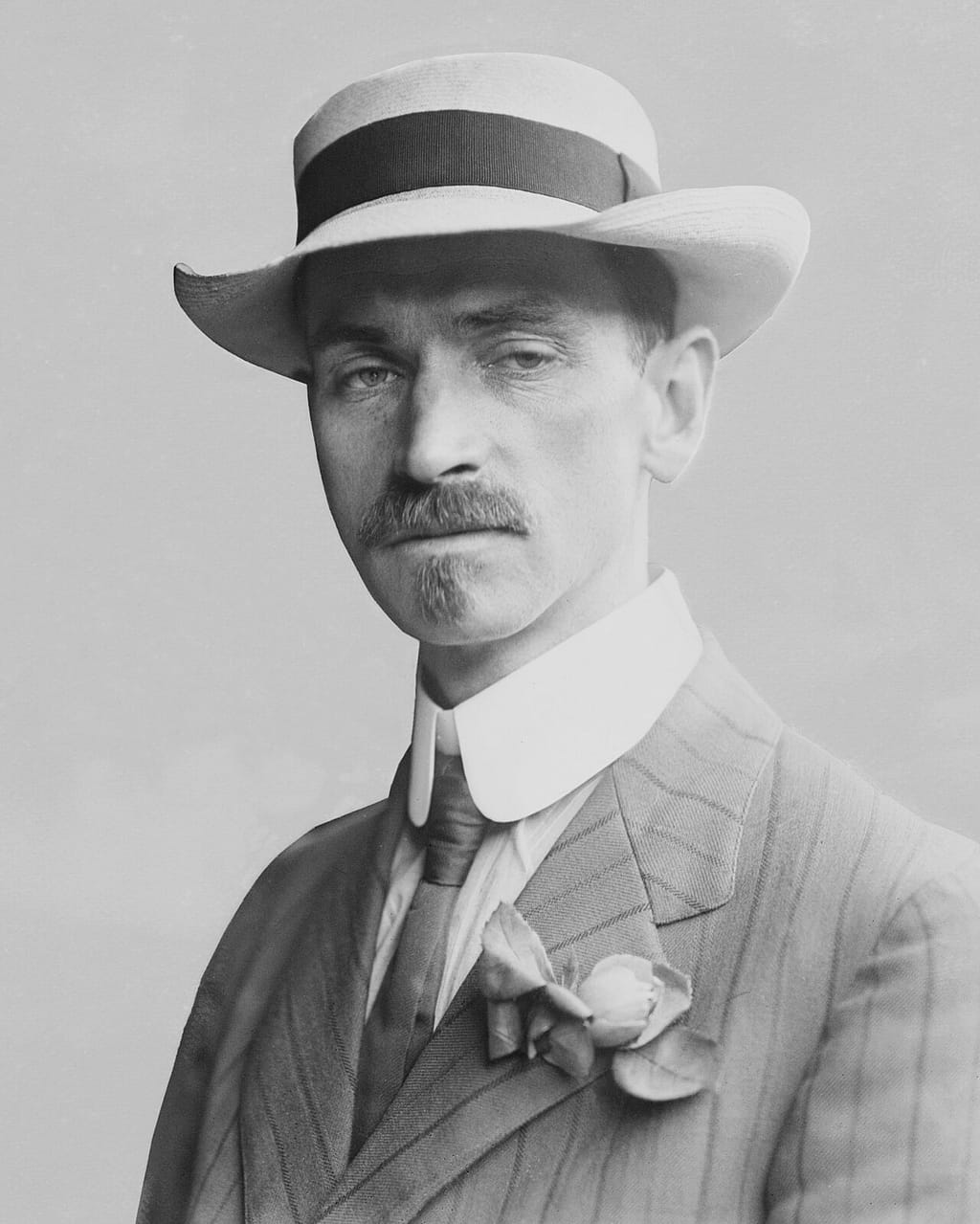
Wilbur did not live to see it settled. He died of typhoid on 30 May 1912, aged 45, with the litigation still running. Orville carried it on alone.
What finally ended it was not a court. It was the war. With the US Army unable to buy aircraft in useful numbers because every manufacturer was suing every other manufacturer, a committee formed by Assistant Secretary of the Navy Franklin D. Roosevelt recommended a compulsory cross-licensing arrangement. The Manufacturers Aircraft Association was created on 24 July 1917, with a blanket royalty initially set at $200 per aircraft.
Everyone could now build anything. And in 1929, the two names at the centre of the fight ended up on the same letterhead.
The peak
The merger of 5 July 1929 brought together the Curtiss and Wright companies along with a group of affiliated firms — usually given as twelve, though Curtiss-Wright's own published history is inconsistent about the number. It is often called the largest aviation company in America at the time. That claim is difficult to source to anything other than the company's own marketing, so treat it as atmosphere rather than fact.
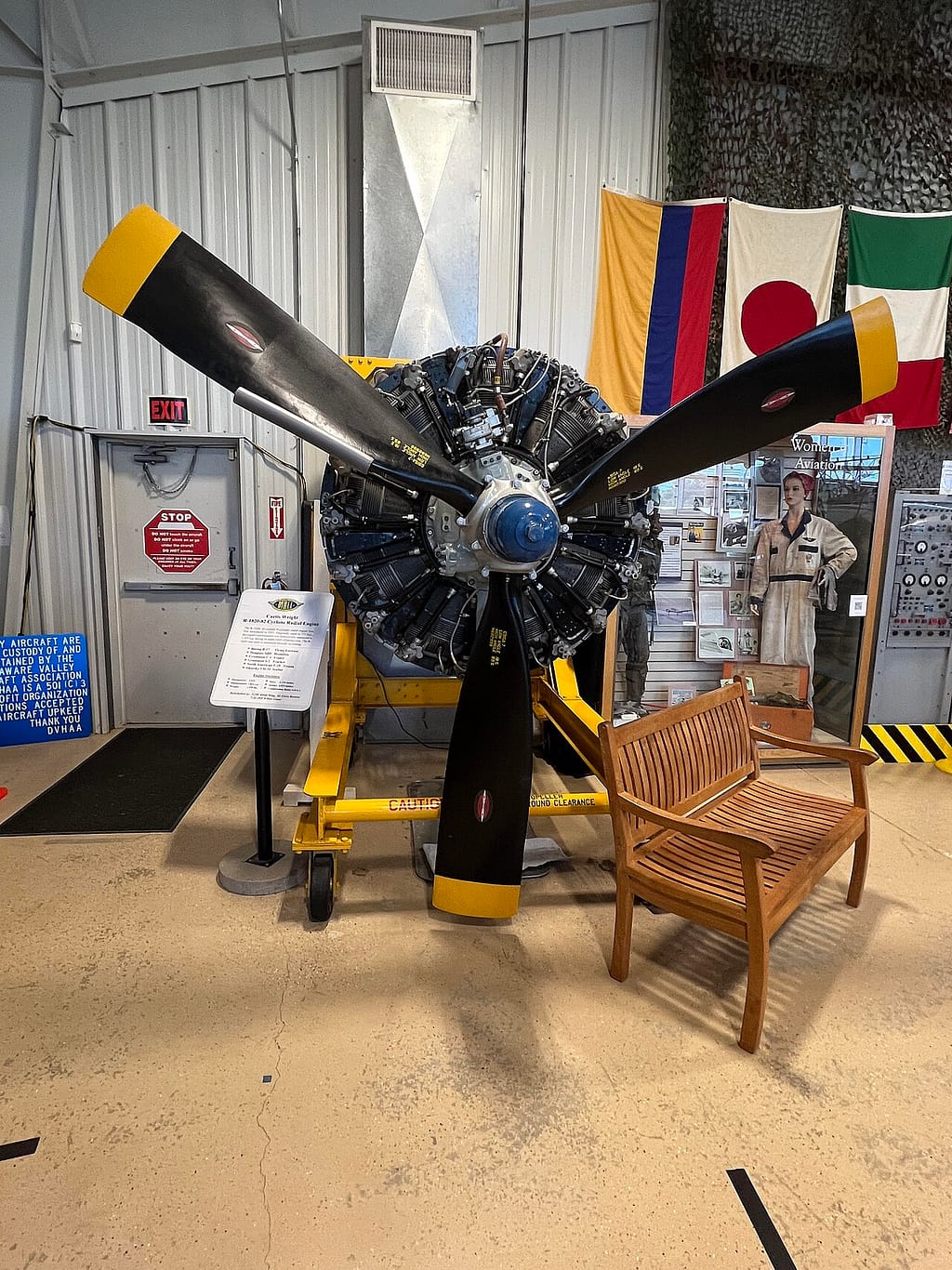
What is not in doubt is what happened next. In the Second World War Curtiss-Wright became an industrial machine: by its own accounting nearly 143,000 aero engines, over 146,000 propellers and more than 29,000 aircraft, with 180,000 people on the payroll. Measured by the value of its wartime contracts it ranked second among all American corporations, behind General Motors.

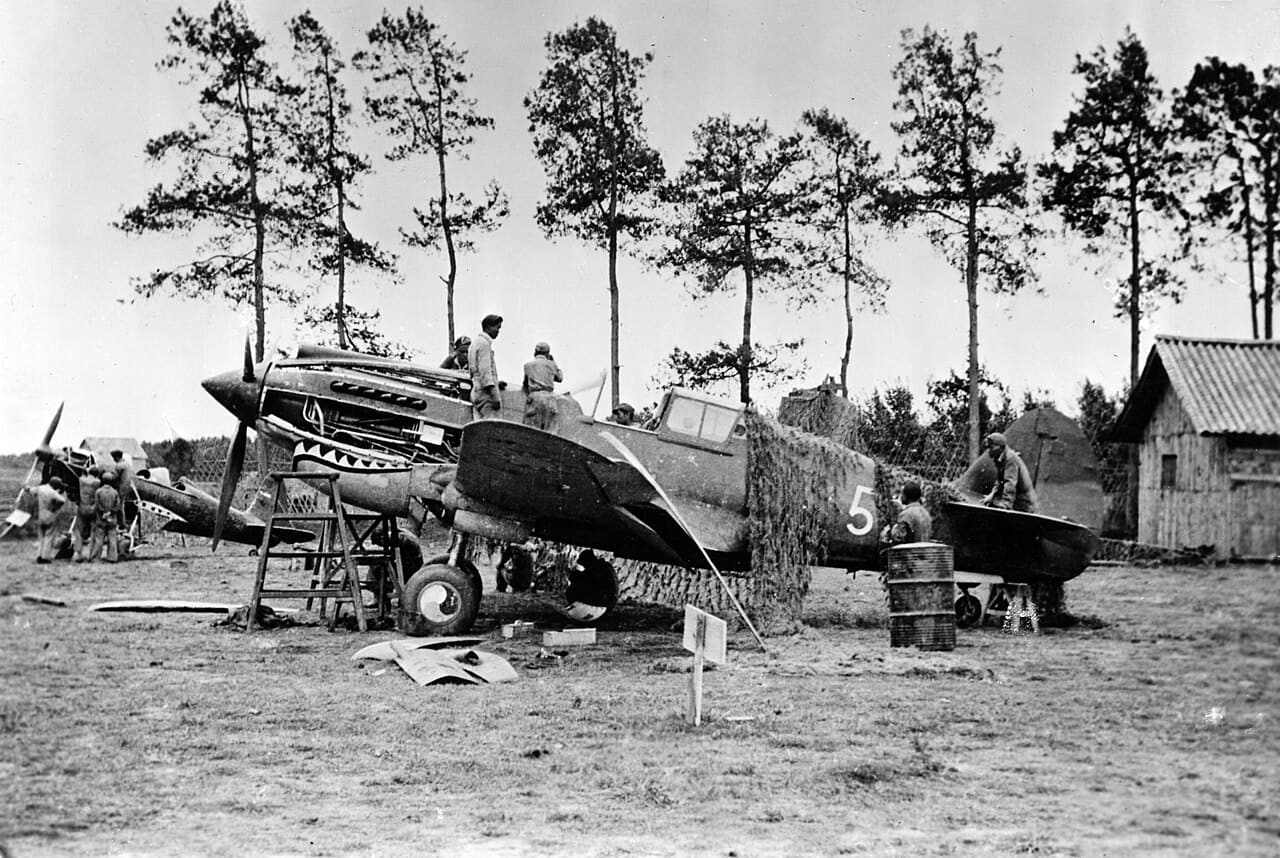
The most famous product was the P-40 Warhawk: 13,738 built, and the aircraft the American Volunteer Group flew over China with sharks' teeth painted on the nose.
A word on that record, because it is one of the most inflated numbers in aviation history. The AVG was officially credited with 297 Japanese aircraft destroyed, and the bounty payments its pilots received totalled 296. But those counts included ground kills and shared claims. Set against surviving Japanese records, the actual figure is roughly 115 — which is the number the Smithsonian's National Air and Space Museum uses. Still a remarkable result for a mercenary outfit that fought for less than seven months. Just not 297.
We have covered the P-40 and the Flying Tigers in detail separately.
Missing the jet age
Curtiss-Wright's collapse as an aircraft manufacturer was fast and, in retrospect, self-inflicted.
The company had spent the war improving aircraft that were already in production rather than investing in fundamental research. It made money doing it. But when the jet engine arrived, Curtiss-Wright had almost nothing in the pipeline — the American development of Frank Whittle's turbojet went to General Electric, not to the country's largest engine manufacturer.
The XF-87 Blackhawk, its attempt at a jet interceptor, was cancelled on 14 October 1948 in favour of the Northrop design that became the F-89. That was effectively the end. The Columbus plant was sold to North American Aviation, which began operations there in November 1950, and Curtiss-Wright stopped building aeroplanes.
What survived was the parts business. Instead of winding down, the company turned itself into a supplier of highly specialised components — valves, pumps, actuators, sensors, electronics — for people who build large complicated machines. It is one of the few genuinely successful reinventions in American industrial history, and it is why the name is still on the exchange while most of its 1929 contemporaries are not.
Now, about the nuclear thing
There is a claim circulating — it comes up on business podcasts fairly often — that Curtiss-Wright has something close to a monopoly on the small reactors that power American submarines and aircraft carriers, and is therefore beautifully positioned for the small modular reactors that might one day power AI data centres.
It is worth taking apart, because some of it is true, some of it is badly overstated, and the part that sounds most like analyst fantasy turns out to be in the company's own annual report.
What is true: Curtiss-Wright is a long-standing supplier to the US Naval Nuclear Propulsion Program. Its 2025 annual report lists what it provides: main coolant pumps, compact motors, generators, steam turbines, valves and secondary propulsion systems, supporting the Virginia-class and Columbia-class submarines and the Ford-class carriers, plus development work on the future SSN(X). The company describes itself as having “a long legacy of providing products that support nuclear propulsion systems on naval vessels.”
What is false: it does not build the reactors. Naval reactors and their fuel are manufactured by BWX Technologies, under a programme directed by Naval Reactors with Bechtel Plant Machinery as the procurement prime contractor. The Department of Energy's own description of the programme notes that a number of private companies perform the design and fabrication of major propulsion plant components — plural, by design.
Read the wording carefully and Curtiss-Wright is telling you this itself. Products that support nuclear propulsion. Pumps, valves and turbines are the steam plant and the fluid systems around the reactor. They are not the reactor.
On "monopoly": the word does not appear anywhere in the filing in connection with this work, and neither does “sole source” for any specific naval nuclear component. Genuine incumbency, decades deep — but incumbency is not monopoly, and the company does not claim otherwise.
The category error: naval propulsion reactors and commercial small modular reactors share the word "reactor" and very little else. Naval plants use highly enriched fuel, are shock-hardened for combat, and are built to standards the Department of Energy describes as more stringent than civilian requirements. They are not a product you can adapt for a data centre.
The part that is real
Strip out the exaggeration and something genuinely interesting remains — it is just not the naval story.
On the commercial side, Curtiss-Wright supplies reactor coolant pumps and control rod drive mechanisms for the Westinghouse AP1000, and states that it has content on every reactor operating in the United States, Canada and the United Kingdom. That is the real ubiquity claim, and it is about civilian power stations.
On small modular reactors, it has two documented agreements: a preferred supplier deal with X-energy signed in September 2022 covering three subsystems of the Xe-100 reactor, worth by the company's estimate over $100 million per four-unit plant, alongside a minority equity stake; and a partnership with Rolls-Royce SMR announced in August 2025 to supply reactor protection systems.
And the data centre angle is not something commentators invented. The 2025 annual report says the company is pursuing business on leading SMR designs anticipated to serve purposes ranging from electricity and industrial process heat “to powering data centers,” and separately cites nuclear power's “potential to meet surging data-center power demand driven by AI.” It notes investment flowing in from Amazon, Microsoft and Google, and says it is engaged with all major 300 MW-plus reactor designers.
The catch is scale and timing. Naval defence and commercial power together made up 45 percent of revenue in 2025; roughly 70 percent of the company is still aerospace and defence. Within the commercial nuclear business, new build is about a tenth of the activity — the rest is servicing the existing fleet. SMR revenue today is a rounding error.
The company's own guidance is that SMR work shifts to prototypes from around 2026, reaches initial production orders by the end of this decade, and hits steady state in the middle of the next one. Its risk factors explicitly warn that delays in SMR development could hurt results.
So: a real position, honestly disclosed, on a timeline measured in decades rather than quarters. Which is a less thrilling story than a monopoly on submarine reactors, and considerably more likely to be true.
There is a pleasing symmetry to it. A company born from a fight over who owned the idea of turning an aeroplane, which stopped building aeroplanes seventy-five years ago, is now selling pumps and valves into an argument about how to power the machines that write our emails.
The P-40 and the Flying Tigers — Curtiss-Wright’s most famous product. Note that documentaries generally use the inflated 297 kill figure rather than the ~115 supported by Japanese records.
Sources: Curtiss-Wright Corporation FY2025 Form 10-K (SEC); BWX Technologies FY2025 Form 10-K (SEC); US Department of Energy, National Nuclear Security Administration; Curtiss-Wright press releases; Smithsonian National Air and Space Museum; Wright State University Libraries; Wikipedia.


0 commentaire