
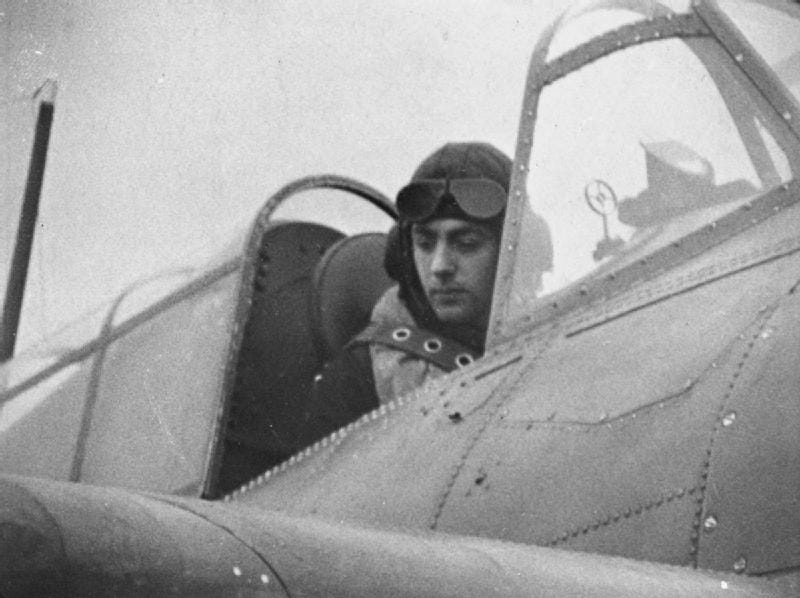
At the 1936 Berlin Olympics, a Scottish teenager was taken flying by a First World War fighter ace. As they landed, the German told the boy two things: learn to fly, and learn German. The boy did both — and grew up to fly more different aircraft than any human being who has ever lived.
His name was Eric Melrose Brown, though everyone called him “Winkle.” Over a career spanning propellers to jets, he flew 487 types, landed on carriers 2,407 times, and test-flew Germany’s most dangerous secret aircraft. No pilot before or since has come close.
FAITS RAPIDES
| Nom | Captain Eric “Winkle” Brown (1919–2016) |
| Service | Royal Navy, Fleet Air Arm — Chief Naval Test Pilot |
| Types flown | 487 — a world record that still stands |
| Carrier landings | 2,407 — also a world record |
| Famous first | First jet landing on an aircraft carrier, 3 Dec 1945 |
| Rarest flight | Only non-German to fly the rocket-powered Me 163 under power |
| Surnom | “Winkle” — after the tiny periwinkle mollusc |
The making of a legend
Brown was slight — just five foot seven — which is how he earned his nickname. But size never mattered in a cockpit. When war came, he flew Grumman Wildcats from the tiny escort carrier HMS Audacity, shooting down long-range German bombers over the Atlantic until the ship was torpedoed in 1941. He was one of only a handful of survivors, and he never lost his affection for that stubby little fighter.
His fluent German, learned on that Olympic advice, made him extraordinarily valuable. After the war he interrogated captured Luftwaffe leaders, including Hermann Göring and the test pilot Hanna Reitsch, and he was among the first Allied officers to enter the liberated Belsen concentration camp — an experience that stayed with him for life.

The BBC’s portrait of Britain’s greatest pilot.
The man who flew everything
As Chief Naval Test Pilot at Farnborough, Brown ran the Royal Navy’s Enemy Aircraft Flight, which meant flying captured German machines to learn their secrets. He flew the Moi 262 jet and the Bf 109; he nearly crashed a two-seat 109 because he could barely see out of the back seat. Most astonishing of all, he flew the rocket-powered Messerschmitt Me 163 Komet under power — the only non-German pilot ever to do so, after signing a disclaimer for the nervous German ground crew.
On 3 December 1945 he made history in a de Havilland Sea Vampire, setting it down on the deck of HMS Ocean — the first time any jet had landed on a carrier. It was one of three carrier-aviation firsts to his name. He counted his 487 types conservatively: fourteen different marks of Spitfire and Seafire appear in his logbook as a single entry.

Ask him his favourites and he answered without hesitation.
For jets, he chose the F-86 Sabre, and described the feeling in words only a test pilot could.
Brown, in his own words, from a rare interview.
A record that will never be broken
Brown himself believed no one would ever match his 487 types — and he was almost certainly right. His career sat astride a unique moment: the frantic experimentation of the 1940s and 50s, when a single gifted pilot could be handed British, American, German, Soviet, Italian and Japanese aircraft in a matter of months. That era is gone, and with it the possibility of another Winkle Brown.
He kept lecturing into his nineties, still bought himself a sports car at 95, and died in 2016. The most prolific aviator in history had, by then, become something rarer still: living proof of how much one determined person can pack into a single lifetime in the air.
Remembering the world’s greatest test pilot.
Sources: Eric Brown, Wings on My Sleeve; National Air and Space Museum tribute; HistoryNet; BBC.
0 commentaire