
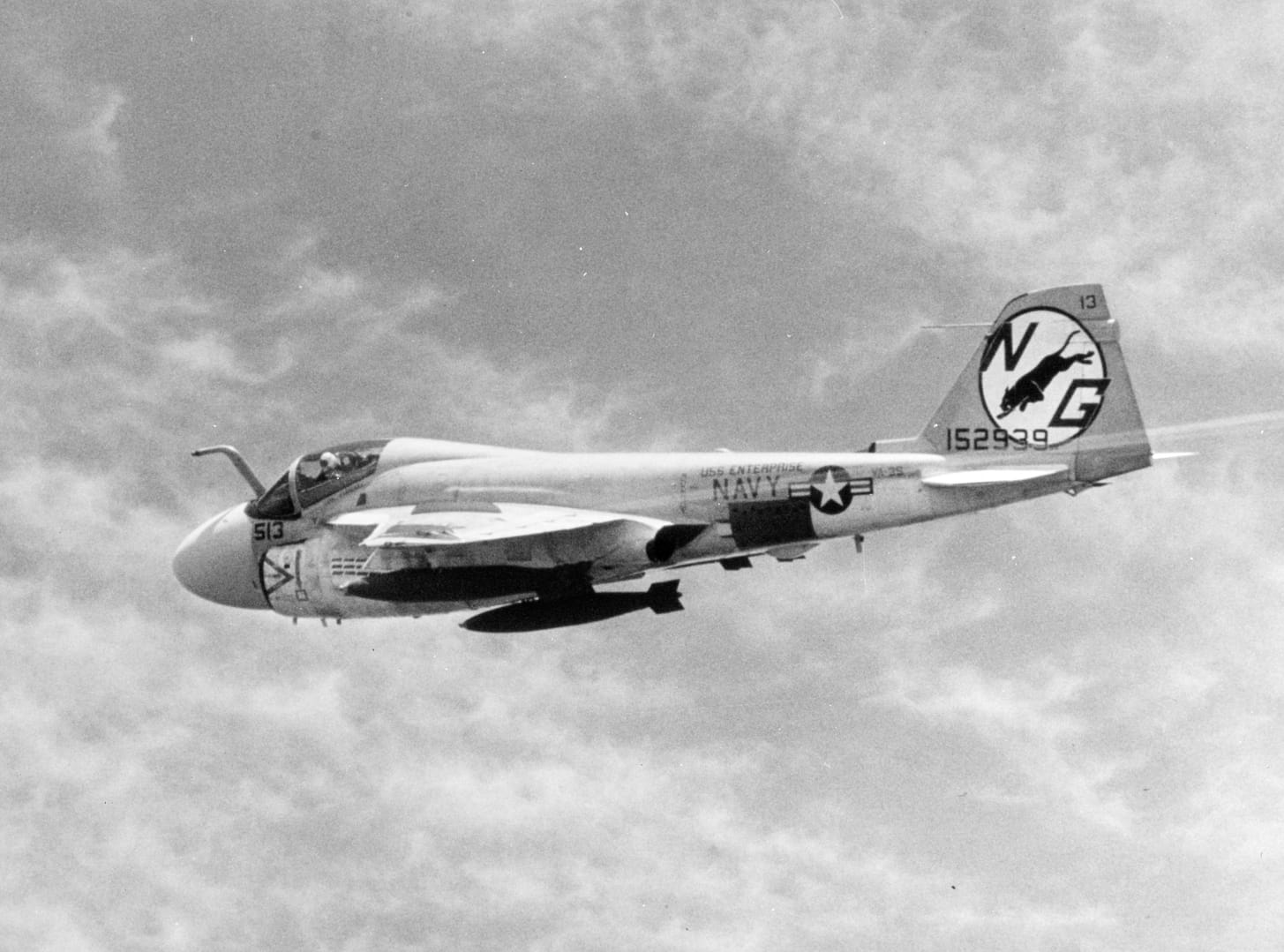
It was not fast. It was not pretty. It could not dogfight. And for thirty years, when the weather closed in and the target sat hidden under cloud and darkness that grounded everything else, the US Navy sent the Grumman A-6 Intruder. Subsonic, snub-nosed and slab-sided, the Intruder was the aircraft that could find a target on the blackest night and put a bomb through its window — and come home having never seen the ground.
Pilots loved it precisely because it was ugly and honest. One former Intruder crewman summed up the fleet’s looks better than any spec sheet.
| Aéronef | Grumman A-6 Intruder |
| Rôle | All-weather carrier attack |
| Équipage | 2 — pilot + bombardier/navigator, side by side |
| Premier vol | 19 April 1960 |
| Service | US Navy 1963 – 1997 |
| Remplacé par | F/A-18 Super Hornet |
A truck built around a computer
When Grumman won a 1956 Navy competition for a long-range, all-weather attack aircraft, it did something unusual: it built the jet around its electronics. The heart of the Intruder was DIANE — the Digital Integrated Attack Navigation Equipment — a system that painted the terrain and the target on a screen so the crew could strike in zero visibility. The two men sat side by side, the pilot and his bombardier/navigator, close enough to share a glance in the dark.
It entered service in 1963, the first genuinely all-weather attack bomber in history. It was slow and it had no gun. It did not care. Its job was to carry up to nine tonnes of ordnance a long way, at night, in weather, and deliver it precisely. Nothing else in the fleet could do that.
Vietnam and the long war
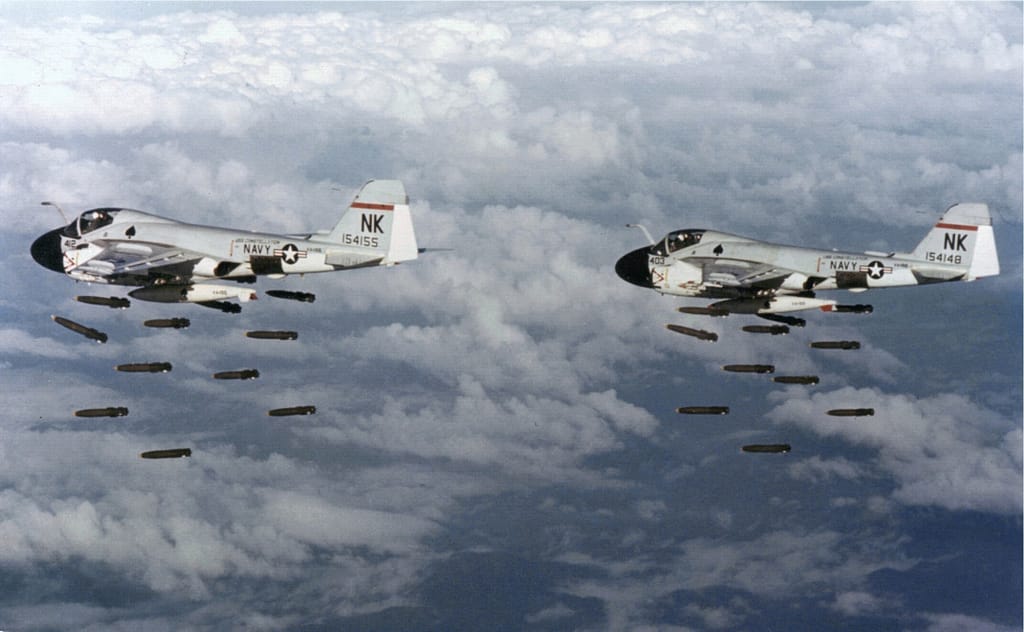
Over Vietnam the Intruder became indispensable and vulnerable in equal measure. It flew the missions no one else could — and it flew them low, into the teeth of the heaviest air defences on Earth. On the night of 30 October 1967, a single Intruder crewed by Charles Hunter and Lyle Bull ran the gauntlet of ten surface-to-air missiles to strike the Hanoi ferry docks at rooftop height. Both men received the Navy Cross. Eighty-four Intruders did not come home from that war.
The airframe proved endlessly adaptable. The KA-6D turned it into a carrier tanker, trailing a hose to refuel thirsty F-14 Tomcats. The electronic-warfare EA-6A grew into the four-seat EA-6B Prowler, the Navy’s jammer for another four decades. The bomb truck spawned a dynasty.
The last cruise
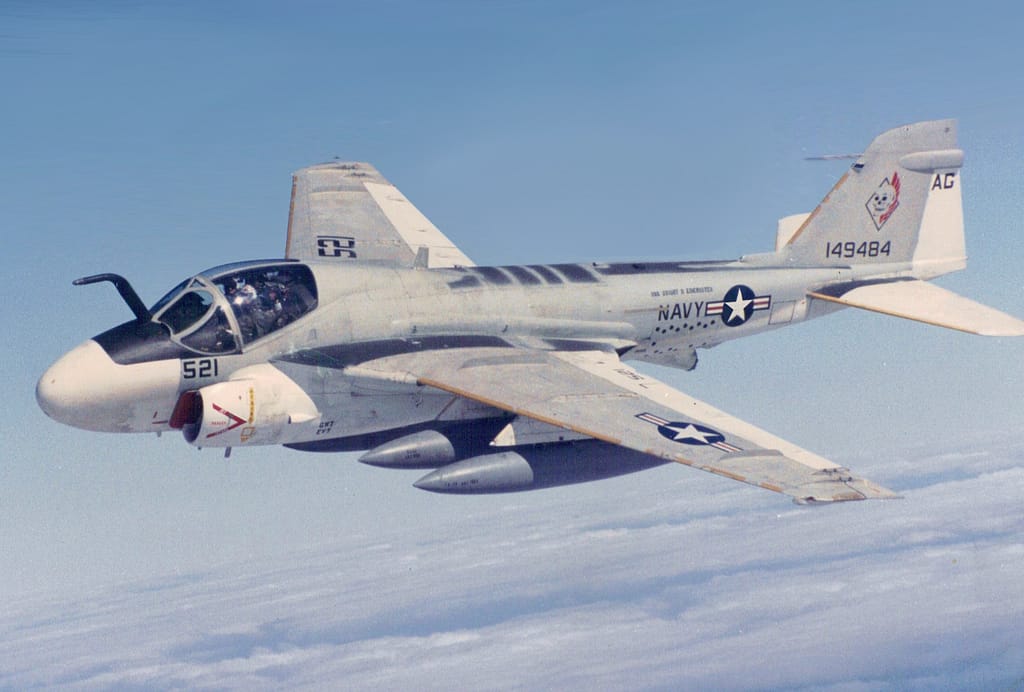
In Operation Desert Storm the Intruder flew more than 4,700 combat sorties — hunting tanks, ships and bridges by day and night. But its intended successor, the stealthy A-12 Avenger II, collapsed under cost overruns and was cancelled. Rather than replace the Intruder, the Navy simply retired it: the Marines in 1993, the Navy in 1997. The role passed to the F/A-18 Super Hornet.
The Intruder earned a second, stranger kind of immortality. A former A-6 pilot named Stephen Coonts turned his two combat cruises into a novel, Flight of the Intruder, that spent twenty-eight weeks on the bestseller list and became a film. The war club had become literature.
Some of the retired airframes were stripped and sunk off the Florida coast, an artificial reef called Intruder Reef. It is a fitting end for the ugly, indispensable jet: still working, quietly, where no one can see it.
Sources: Naval History and Heritage Command; National Naval Aviation Museum; The War Zone; Stephen Coonts.
0 commentaire