
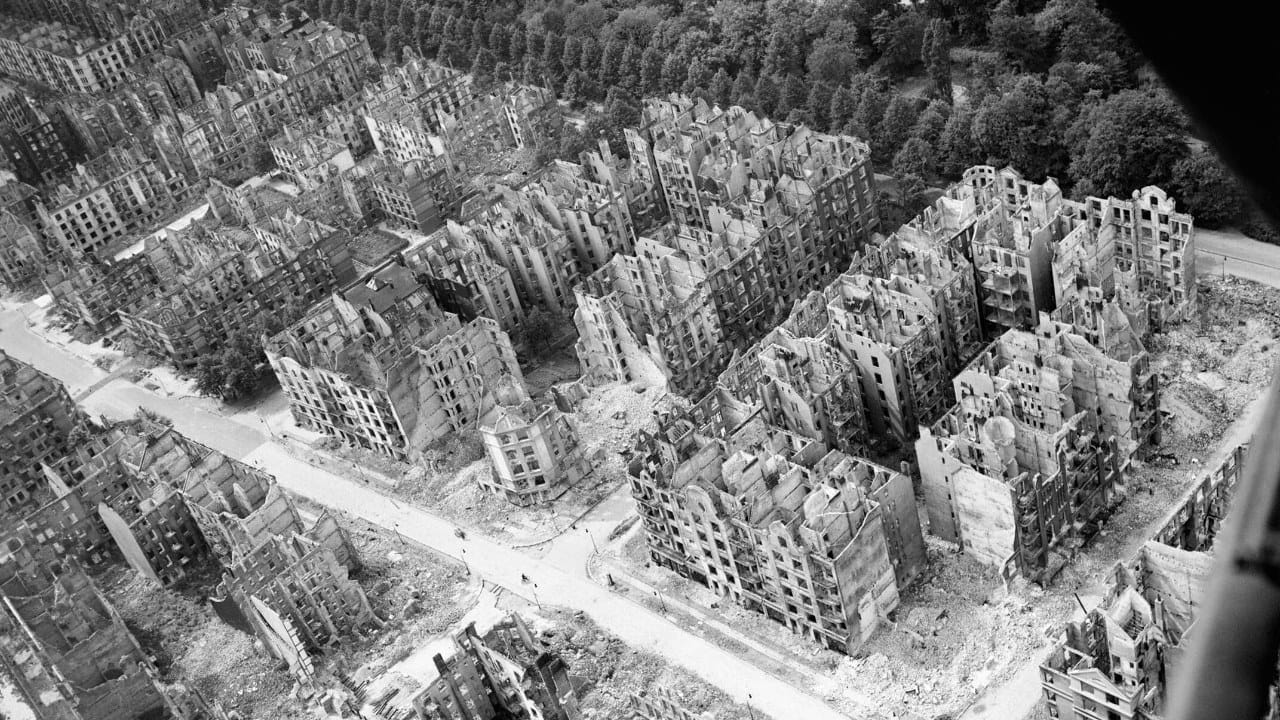
Part 6 of The Race for the Bomb, an Afterburner focus series. Before one aircraft could destroy one city, the burning of cities had to become ordinary. This part tells how that happened over Germany — soberly, by the numbers, and through the people under the bombs and inside the bombers.
Hamburg, the Hammerbrook district, just after midnight on 28 July 1943. In a basement shelter the air has gone thin and strange; the candles gutter for lack of oxygen. Nineteen-year-old Käte Hoffmeister and her family decide the burning building above them is the greater danger, and open the steel door.
Outside, the street has become something that has no name yet. Winds of 240 kilometres per hour are roaring inward, feeding a single fire perhaps three kilometres across; the asphalt of the Eiffestrasse has melted, and there are people stuck in it. Fifteen-year-old Traute Koch, a few streets away, is wrapped in wet sheets by her mother, kissed, and told a single word: run. Six-year-old Wolf Biermann — one day to be East Germany’s most famous songwriter — is carried into the firestorm clutching what his mother put in his hands, a small bucket of plum jam.
German meteorologists, surveying what was left, needed a new word and coined one: Feuersturm. The men who made it had a different vocabulary. To Bomber Command, the night of 27–28 July was a successful area attack, and the ten days of Operation Gomorrah were, in the dry language of the directive that governed them, focused on the morale of the enemy civil population. How the great air forces of the West arrived at that language — and where it led — is the necessary, uncomfortable chapter of this series.
Quick Facts: The Bombing War Over Germany
- 1 in 3 — crews that bombed within five miles of their target, per the 1941 Butt Report (1 in 10 over the Ruhr)
- ~2,200 strips per bundle — the aluminium “Window” that blinded German radar over Hamburg, 24/25 July 1943
- ~34,000–37,000 dead — Operation Gomorrah, Hamburg, July–August 1943
- 240 km/h and ~800°C — firestorm winds and street temperatures, 27/28 July 1943
- 60 B-17s lost on each of the two 1943 Schweinfurt raids — about 20 percent of the force each time
- 22,700–25,000 dead — Dresden, February 1945, per the city’s 2010 Historians’ Commission; Nazi propaganda claimed 200,000
- 55,573 — RAF Bomber Command aircrew killed, of about 125,000 who served: a 44 percent death rate
The Precision Lie
It began with a failure nobody wanted to see. Britain went to war believing its bombers would find and hit factories at night. In August 1941, a Cabinet Office civil servant named David Bensusan-Butt examined 633 photographs taken by bombing crews at the moment of release and produced the most devastating audit in air-power history: of crews recorded as attacking their targets, only one in three had come within five miles. Over the smog-covered Ruhr, one in ten. Counting every aircraft dispatched, about five percent put bombs anywhere near the aiming point. Night precision bombing, the report said between its lines, did not exist.
The response was not to abandon night bombing but to redefine the target. On 14 February 1942 the Air Ministry issued its area bombing directive: operations were now to be focused on the morale of the enemy civil population and in particular the industrial workers. The Chief of the Air Staff, Sir Charles Portal, added a clarification the following day that history has not forgotten: I suppose it is clear the aiming points will be the built up areas, and not, for instance, the dockyards or aircraft factories. A week later, Air Marshal Arthur Harris took over Bomber Command and gave the new doctrine its public voice, delivered flat and unblinking into a newsreel camera.
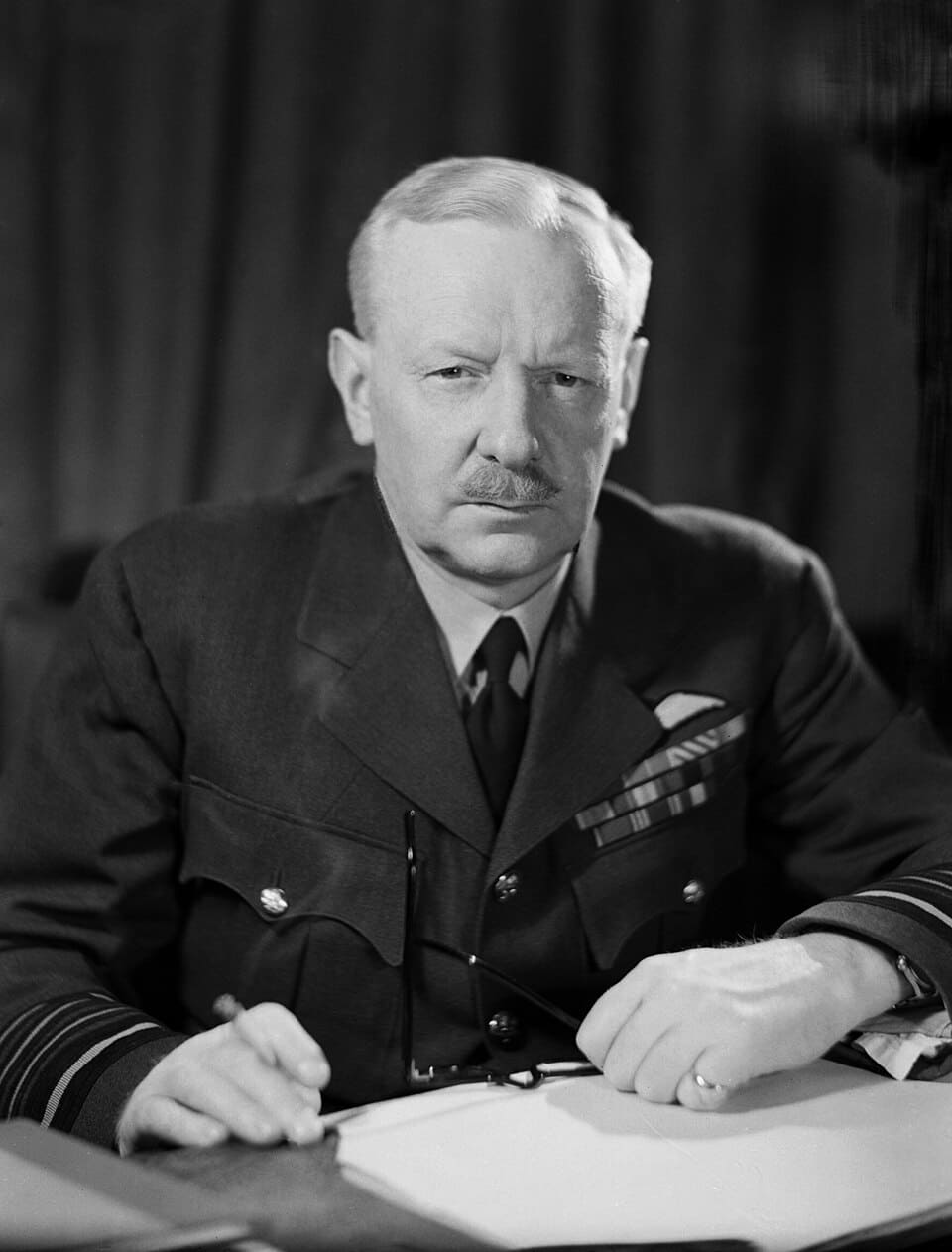
The actual 1942 newsreel: Harris delivers the “whirlwind” statement to camera.
Gomorrah
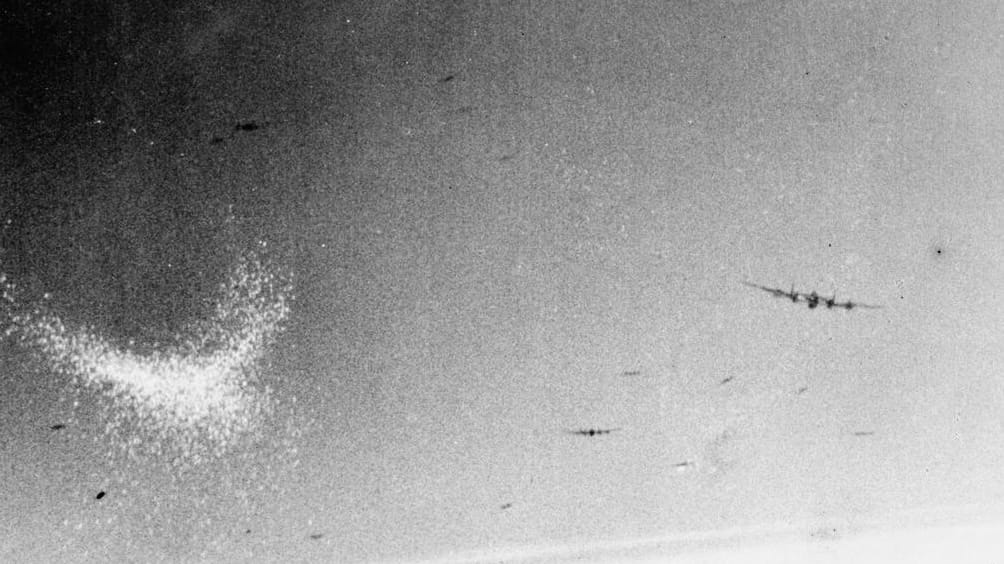
By mid-1943 the whirlwind had machinery: four-engined Avro Lancasters and Handley Page Halifaxes by the hundred, wooden de Havilland Mosquitos marking targets with coloured indicators the Germans called Christmas trees, H2S ground-mapping radar — and, held back for months as too secret to use, a countermeasure of surreal simplicity. On the night of 24/25 July 1943, 791 bombers heading for Hamburg shoved some 7,000 paper bundles down their flare chutes, each bursting into 2,200 strips of aluminium foil cut to half the wavelength of the German Würzburg radar. To the operators below, the sky filled with thousands of phantom bombers. Searchlights wandered; flak fired at ghosts; the night-fighter control system collapsed. The German night-fighter general Josef Kammhuber put it in one sentence: the whole defense was blinded in one stroke.
Three nights later came the conjunction no one had engineered and no one could stop: a hot, dry city, rubble-choked streets from the earlier raids, and 722 bombers delivering 1,174 tons of incendiaries into the same square miles in 45 minutes. The separate fires joined, and the joined fire began to breathe — sucking in air at ground level with hurricane force, pushing temperatures toward 800 degrees Celsius. Most of the roughly 34,000 to 37,000 dead of Gomorrah did not burn: in the shelters, the firestorm silently replaced the oxygen with carbon monoxide. A million people fled the city in the following week. A survivor named Henni Klank left the sentence that stands for all of it: the streets were burning, the trees were burning, the air was burning.
Two facts belong beside that sentence. Armaments minister Albert Speer told Hitler that six more Hamburgs in quick succession would end the war. And Hamburg’s industry was back to roughly 80 percent of capacity within five months. Both facts are true; the whole moral argument about area bombing lives in the space between them.
The Operations Room reconstructs Operation Gomorrah minute by minute — the Window drop, the raids, and the firestorm night.
Black Thursday
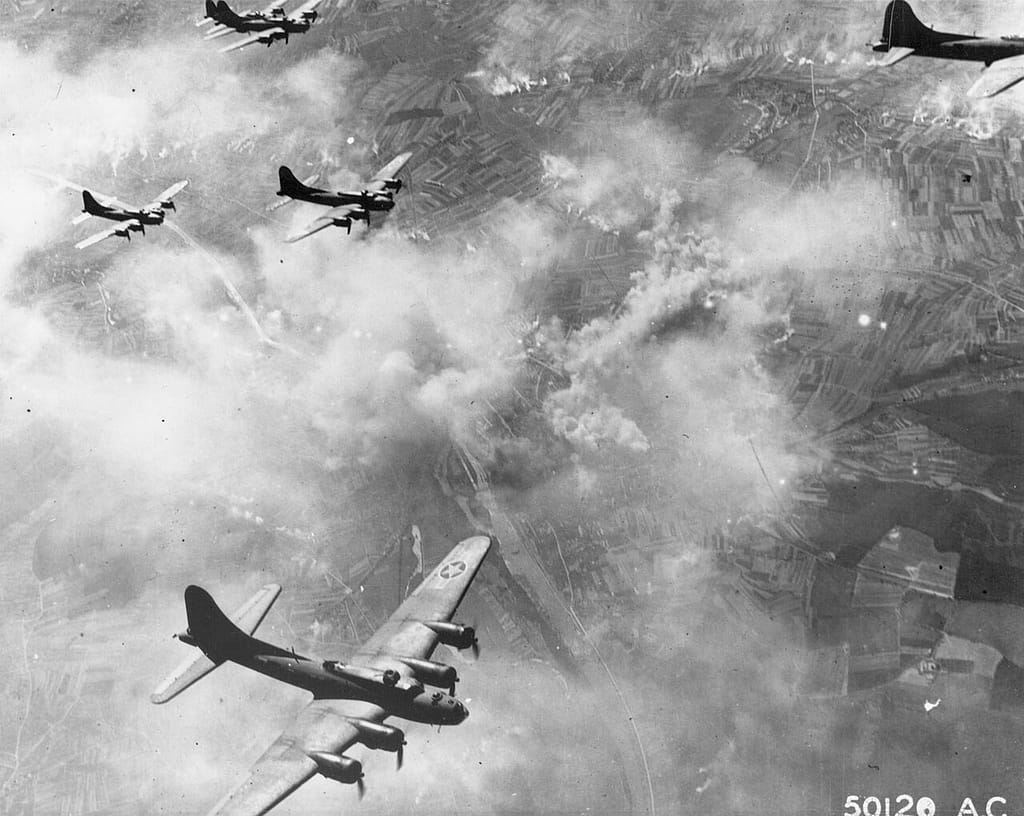
The Americans, flying by day in the belief that precision was possible from 25,000 feet, were being taught their own doctrine’s limits at the same time. On 17 August 1943, the double strike against the Schweinfurt ball-bearing works and the Regensburg Messerschmitt plant cost 60 B-17 Flying Fortresses in a single day — one in five of the attacking force. On 14 October — Black Thursday — a return to Schweinfurt cost 60 more shot down and 17 written off, with over 600 airmen killed, wounded or missing in an afternoon. Unescorted daylight bombing deep into Germany was suspended; it resumed only when the long-range P-51 Mustang could ride shotgun the whole way. The lesson both air forces drew was the same grim one: the bomber would get through only at a price no one had honestly budgeted — and the men paying it were, on average, twenty-two years old.
The arithmetic of the bomber war remains difficult to hold in the mind. RAF Bomber Command flew roughly half a million sorties and lost 8,325 aircraft; of about 125,000 aircrew who served, 55,573 were killed — a death rate over 44 percent, worse odds than a British infantry officer faced in the First World War. A crewman’s tour was thirty operations; only a quarter of the men came through the war unscathed.
Dresden
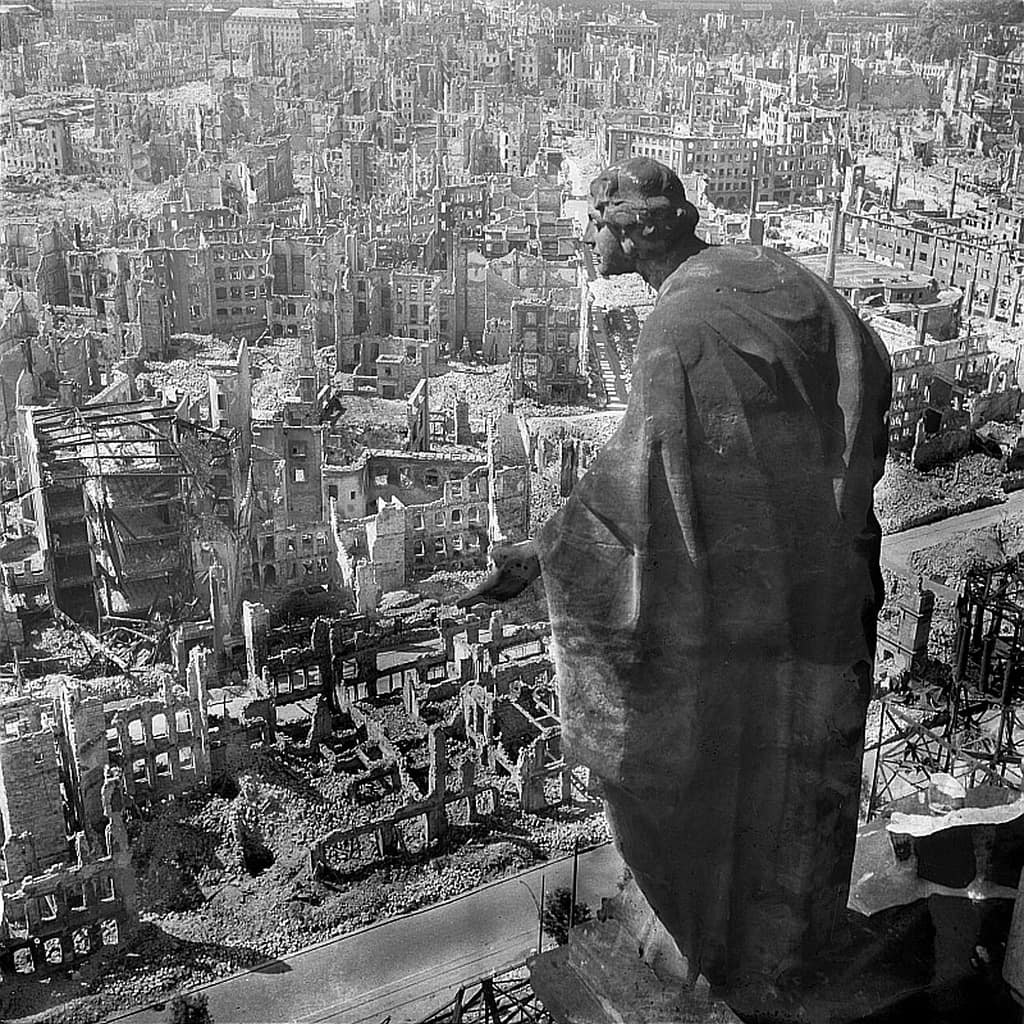
By February 1945 the machinery was perfected, and it was turned on a city whose name has stood ever since for the question the machinery raised. On the night of 13/14 February, 772 RAF heavy bombers struck Dresden in the classic double blow — a second wave timed three hours after the first, catching rescuers in the open — followed the next two days by 527 American B-17s. More than 3,900 tons of bombs fell on a baroque city packed with refugees from the Eastern Front. The firestorm consumed the old town. At the zoo, keeper Otto Sailer-Jackson heard his elephants screaming as blast lifted the dome of their house.
In a slaughterhouse cellar two storeys down, an American prisoner of war rode out the raid that would define his life’s work. Kurt Vonnegut, captured at the Bulge, spent the following weeks excavating bodies from the ruins, and twenty-four years later turned the experience into Slaughterhouse-Five.
How many died at Dresden is a question with a documented answer and a long history of abuse. Goebbels’ propaganda ministry took the police tally of roughly 20,000 and published it with a zero added; the discredited figures of 135,000 and more entered Western memory through David Irving’s 1963 book and, innocently, through Vonnegut’s novel; German far-right groups inflate the toll to this day. The city of Dresden’s own independent Historians’ Commission — thirteen historians, five years of archival work, reporting in 2010 — established the answer: between 22,700 and 25,000 dead. The true number is terrible enough; the false ones were manufactured to serve the people who started the war.
“A Serious Query”
Six weeks after Dresden, the man who had endorsed the campaign put the question on paper. In a minute to his Chiefs of Staff on 28 March 1945, Winston Churchill wrote that the moment had come to review the bombing of German cities simply for the sake of increasing the terror, though under other pretexts, adding that the destruction of Dresden remains a serious query against the conduct of Allied bombing. The Air Staff protested; Churchill withdrew the minute and issued a softer version. Harris, for his part, answered that he did not regard the whole of the remaining cities of Germany as worth the bones of one British Grenadier — and never retreated an inch. Britain gave his crews no campaign medal; their memorial in Green Park was unveiled only in 2012. The documents still argue with each other, which is precisely why this article quotes them rather than adjudicating them.
The Operations Room’s animated reconstruction of the Dresden raid — the double blow, wave by wave.
For this series, the essential point is what Europe normalised. By the spring of 1945, the deliberate burning of a city was a proven technique with a manual, a tonnage table and a meteorology; the moral threshold had been crossed at Hamburg and recrossed nightly for two years. When American planners studied how to bring Japan’s war economy down, the Hamburg data was in the room — and Japan’s cities were built of wood. The aircraft that would carry that logic to its conclusion, a pressurised marvel that cost more than the atomic bomb itself, is where the series goes next.
Sources: The Butt Report and Area Bombing Directive via UK National Archives summaries, IWM, National WWII Museum, Dresden Historians’ Commission (2010), Martin Middlebrook: The Battle of Hamburg, Jörg Friedrich: The Fire, The Paris Review, Richard Langworth / International Churchill Society, Wikipedia.
The Race for the Bomb — an Afterburner Focus Series
Series overview: all ten parts
Previous — Part 5: Two Billion Dollars, One Desert Sunrise
Next — Part 7: The Bomber That Cost More Than the Bomb

0 commentaire