
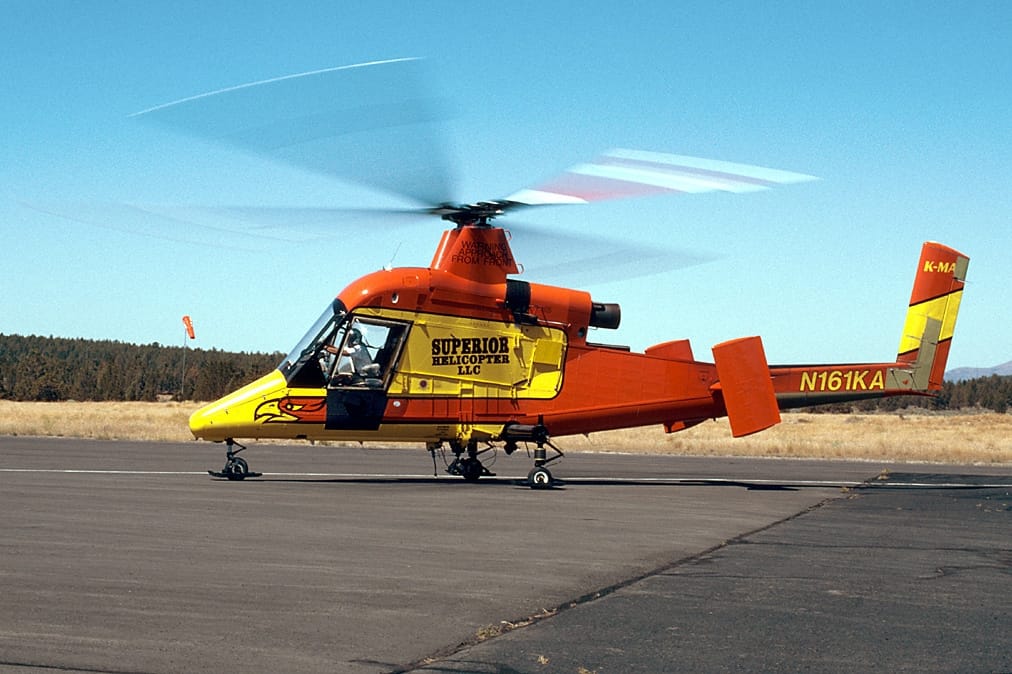
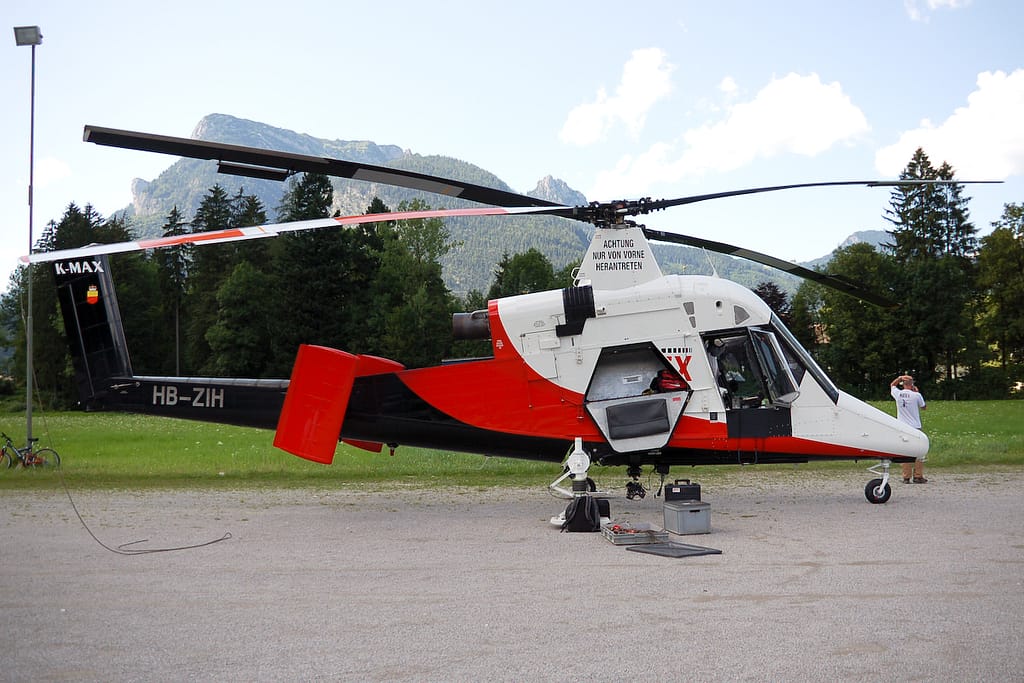
Watch a K-MAX work a mountainside and something looks wrong. Two rotor masts lean apart in a shallow V, their blades slicing through each other's arc, and yet nothing collides. There is no tail rotor at all. This is the Kaman K-MAX, a synchropter built for one purpose: lifting.
Charles Kaman's company had chased intermeshing rotors for decades. Two rotors turning in opposite directions cancel each other's torque, so no power is wasted spinning a tail rotor to stop the machine from twisting. Every bit of that engine goes straight into the hook.
FAITS RAPIDES
| Taper | Intermeshing-rotor (synchropter) cargo helicopter |
| Premier vol | 23 December 1991 |
| Rôle | Aerial crane, logging, firefighting; unmanned cargo |
| centrale électrique | 1 x Honeywell (Lycoming) T53 turboshaft, ~1,800 shp |
| Rotors | Two intermeshing rotors; no tail rotor |
| vitesse maximale | Around 185 km/h (100 kn) |
| Nombre construit | About 60 |
A flying crane, not a bus
The K-MAX is unapologetically single-minded. It carries just a pilot, seated in a narrow fuselage with bulged windows for looking down at the load. It cannot haul a cabin full of passengers, and it was never meant to. What it can do is lift a slung load heavier than the helicopter's own empty weight.
That makes it a favourite for logging remote timber, stringing power lines, resupplying ski resorts and dropping water on wildfires. A single turboshaft drives the whole affair, flat-rated so it keeps its punch high in thin mountain air where lift is scarce.
The robot that resupplied Marines
Then the K-MAX went unmanned. Kaman and Lockheed Martin turned it into a pilotless cargo drone, and the US Marine Corps flew it in Afghanistan, hauling supplies to forward bases without risking a crew on the road or in the cockpit.
Kaman closed the original line after 38 aircraft, then reopened it years later as demand for heavy-lift helicopters climbed, bringing the total to around sixty. Few designs are so narrow in purpose and so hard to beat at it.
The K-MAX will never win a beauty contest. But when the load is heavy and the landing zone is a clearing on a cliff, that eggbeater silhouette is exactly what you want overhead.
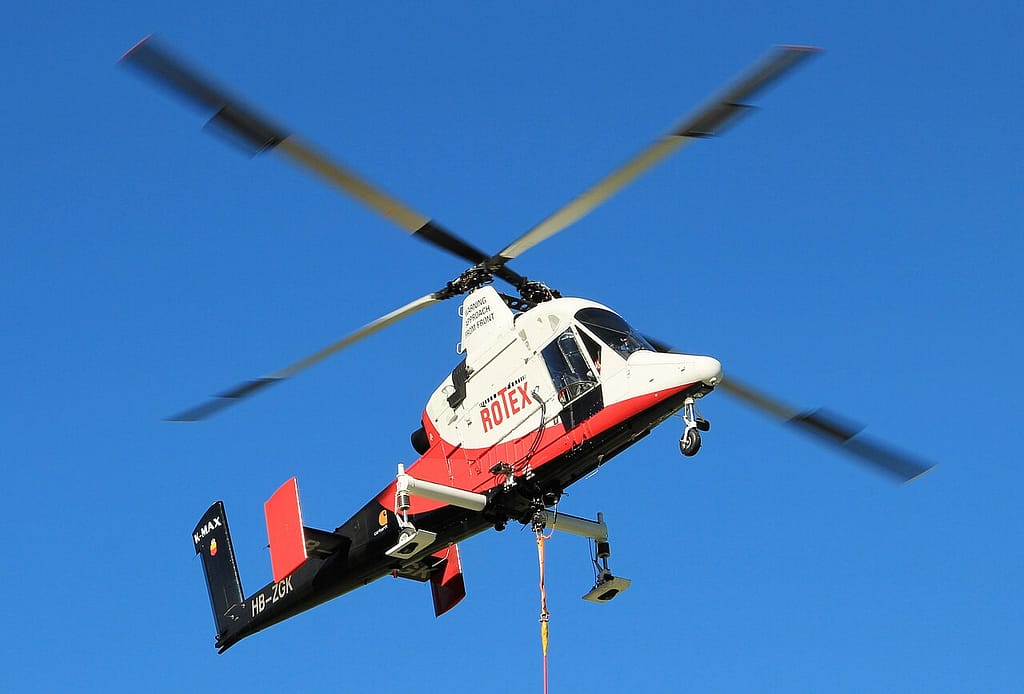
The weird and wonderful K-MAX, hard at work slinging loads:
Sources: Heli-Archive; Wildfire Today; Wikipedia.
0 commentaire