
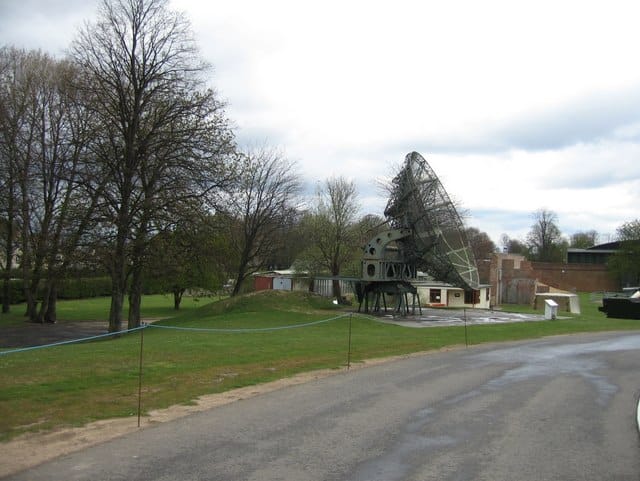
On a moonless night in 1942, an RAF bomber crossing the Dutch coast flew into a wall it could not see. There was no barrier in the sky — only an invisible grid of radar beams, searchlights and waiting fighters, each box of it engineered to catch one aircraft at a time. The British called it the Kammhuber Line. The Germans called the machinery inside each box the Himmelbett — the four-poster bed.
It was the first integrated, radar-directed air-defence system in history: a chain of control zones stacked three deep from Denmark to the middle of France, each one a self-contained trap. For nearly three years it made the night skies over occupied Europe lethal for Bomber Command.
And then, on a single July night in 1943, a bomber crew tipped a few bundles of tinfoil out of a hatch, and the entire wall went blind.
Informations clés
Nom: Kammhuber Line (Allied name); the German control system was the Himmelbett
Architect: General Josef Kammhuber, from July 1940
Mise en page: zones roughly 32 km by 20 km, stacked three deep from Denmark to central France
Each box: one long-range Freya radar (~100 km), two precise Würzburg tracking radars (~30 km), searchlights, and one primary plus one backup night fighter
Main fighter: Messerschmitt Bf 110, later with Lichtenstein airborne radar and upward-firing Schräge Musik cannon
Defeated by: the concentrated bomber stream, then Window (radar chaff), first used over Hamburg on the night of 24–25 July 1943
One Box, One Fighter, One Bomber
The genius and the flaw of the Kammhuber Line were the same thing: it worked one target at a time. Inside each Himmelbett box, a long-range Freya radar first detected a bomber crossing in. Then two Würzburg dishes — accurate tracking radars with a range of about 30 kilometres — took over: one locked onto the bomber, the other onto the German night fighter orbiting a radio beacon nearby.
On the ground, a controller watched both blips plotted together on an illuminated Seeburg table and talked his fighter into visual range, step by step, until the pilot could see the bomber's exhausts against the stars. It was ground-controlled interception in its purest early form — a human spider at the centre of an electronic web, guiding one predator to one prey.
The Messerschmitt Bf 110 became the backbone of the German night-fighter arm.
The Backbone: the Bf 110
The hunter waiting in each box was, more often than not, the Messerschmitt Bf 110. Too heavy to survive as a day fighter in the Battle of Britain, the twin-engined Zerstörer found its true calling in the dark. From 1941 it carried its own Lichtenstein airborne interception radar, whose forward-projecting dipole aerials earned the nickname "stag's antlers", and from 1943 many mounted Schräge Musik — a pair of cannon angled to fire almost straight up.
The tactic was merciless in its logic: slide unseen beneath a bomber, formate on it in the dark, and fire up into the wings and fuel tanks from below, where the RAF's four-engined heavies had no gun turret. The system's finest exponent, Heinz-Wolfgang Schnaufer, was credited with 121 night kills — more than any night-fighter pilot in history.
The FuG 220 Lichtenstein airborne radar that let a night fighter find its prey in the dark.
The Flaw: One Fighter at a Time
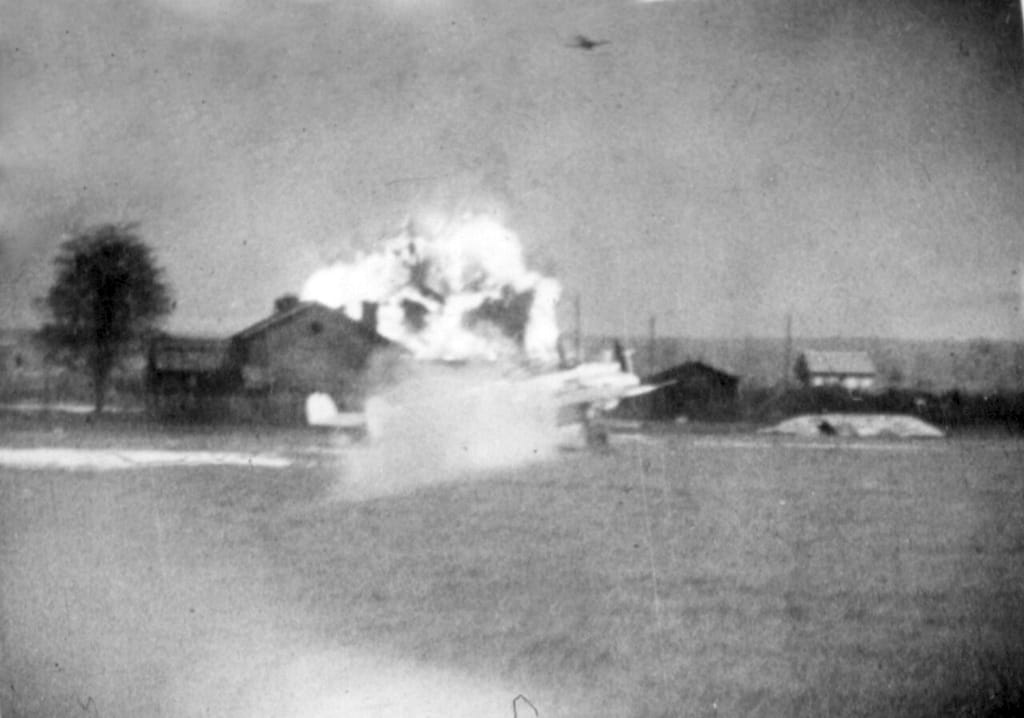
Because each box could commit only one fighter to one interception, the whole line had a fixed throughput. Send bombers across in a thin trickle, spread over hours and many zones, and the system coped beautifully — each box picked off its share. The Royal Air Force's answer was to stop trickling.
Beginning with the thousand-bomber raid on Cologne in 1942, Bomber Command concentrated its aircraft into a single dense "bomber stream", routed to pour through as few boxes as possible in the shortest possible time. A box that could handle one bomber every few minutes was suddenly asked to deal with dozens at once. Most simply flew past untouched.
The Night the Wall Fell
The stream strained the line. Window broke it. On the night of 24–25 July 1943, as Bomber Command opened Operation Gomorrah against Hamburg, its aircraft began dumping bundles of aluminium-coated paper strips — each strip cut to half the wavelength of the German radars. To a Würzburg or a Lichtenstein set, every fluttering strip looked like a bomber. Screens that had shown a handful of clean blips filled with thousands of false echoes.
The idea was not new. British scientist R.V. Jones had championed it years earlier, and Joan Curran had worked out the exact dimensions of the strips; the Germans had independently invented their own version, Düppel, and both sides had sat on the secret, each fearing the other would copy it. When Britain finally used it, the effect was total. On that first Hamburg raid the RAF lost just 12 of 791 bombers. The firestorm that followed on the ground was one of the war's great civilian catastrophes.
Operation Gomorrah: the Hamburg raids where Window was first unleashed.

After the Wall
The rigid box system never fully recovered. With ground control blinded, the Luftwaffe turned to looser tactics — freelance "Wilde Sau" fighters chasing bombers over the burning target by the light of the fires, and "Zahme Sau" packs fed loosely into the bomber stream to hunt on their own radar. The night war stayed brutal until 1945, but the elegant, deterministic wall of 1942 was gone. Kammhuber himself, at odds with his superiors, was pushed aside that same year.
His line is remembered less for how it fell than for what it started. Freya and Würzburg feeding a controller who guided an interceptor to its target was the template for every integrated air-defence system that followed — the direct ancestor of the radar networks that still watch the skies today. The Kammhuber Line lost its war. It also, quietly, invented modern air defence.
Sources: Wikipedia (Kammhuber Line; Josef Kammhuber; Battle of Hamburg); Wilhelm Johnen, Duel Under the Stars; R.V. Jones, Most Secret War; Air & Space Forces Magazine; World History Encyclopedia.

0 commentaire