
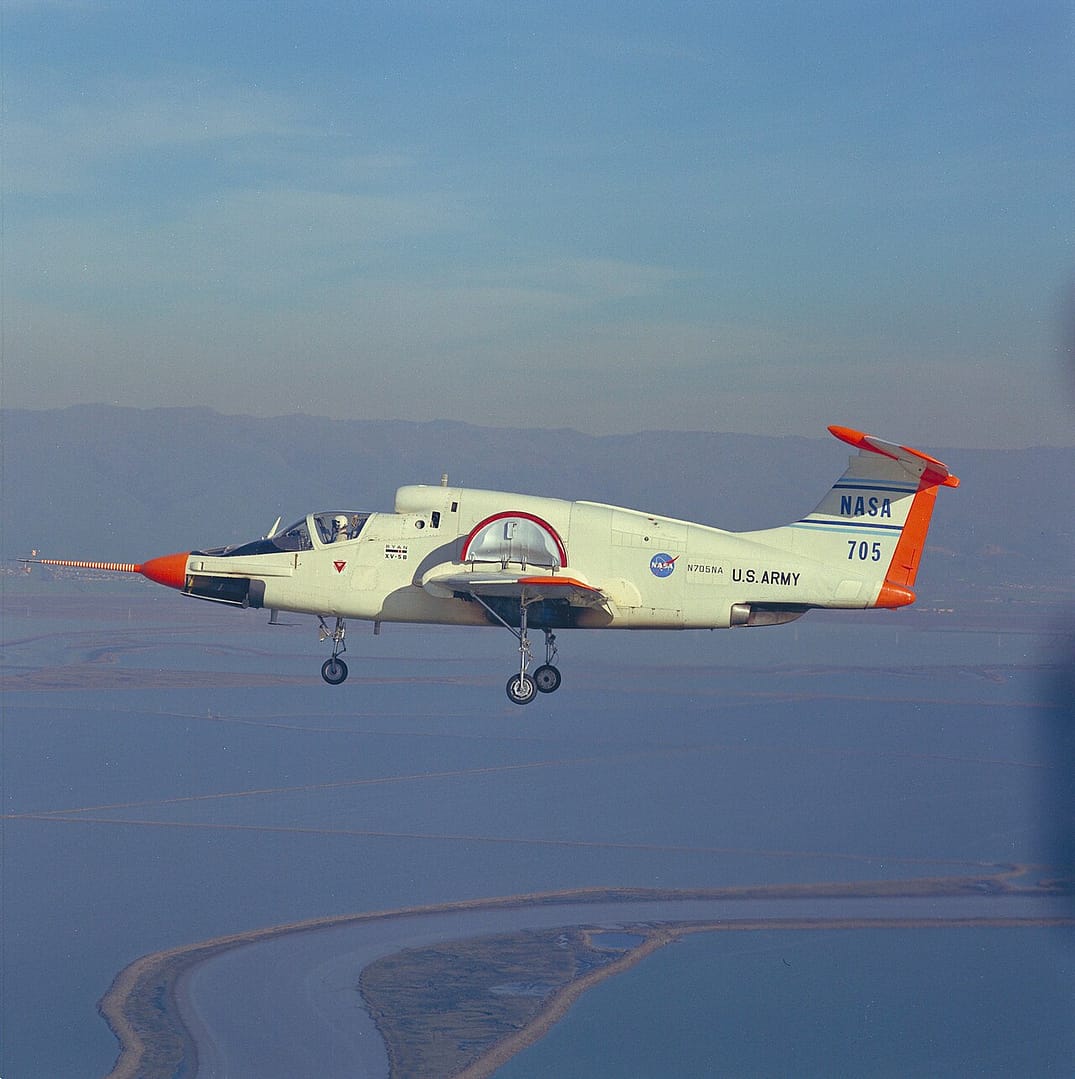
Most vertical-takeoff jets of the 1960s did the obvious thing: point the engine nozzles down and blast the aircraft off the ground. Ryan’s XV-5 Vertifan did something far stranger. It hid two enormous fans inside its wings, spun them with its own jet exhaust, and rose gently into the air through doors that opened in the wing surface.
It was clever, quiet, and genuinely ahead of its time. It was also unforgiving — and it killed two test pilots before the programme ended.
Yet the idea did not die with the aircraft. The fan buried in the XV-5’s wing is a direct ancestor of the lift fan that lets an F-35B hover today.
Informations clés
| Aéronef | Ryan XV-5 Vertifan |
| Rôle | Experimental V/STOL (U.S. Army, later NASA) |
| Premier vol | 25 May 1964 — two built |
| Lift system | Two wing fans + a nose fan, spun by diverted jet exhaust |
| Fan lift | ~16,000 lbf — about three times the engines’ jet thrust |
| vitesse maximale | ~547 mph (475 kn) |
| Destin | Both aircraft lost in fatal crashes; the concept was vindicated |
Fans in the wings
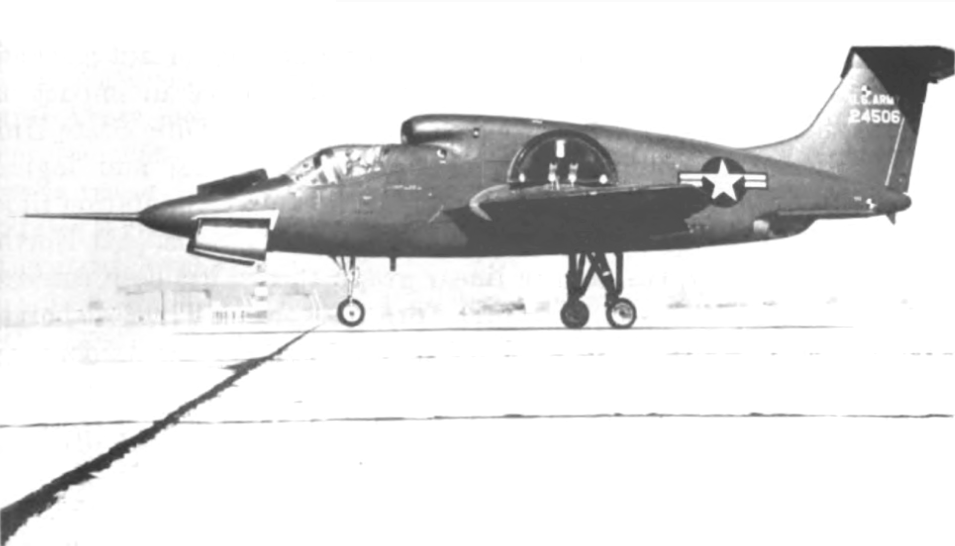
The XV-5A looked, from a distance, like a stubby delta-winged jet not unlike a Douglas A-4 Skyhawk, with a T-tail and its engine intake perched above a side-by-side cockpit. Its two General Electric J85 turbojets gave conventional thrust for cruise. The trick was what happened when the pilot wanted to hover.
Instead of driving the wheels or a rotor, the engines’ hot exhaust was diverted outward and blown against turbine blades on the rim of three large fans — one buried in each wing, and a smaller one in the nose for pitch control. Hinged covers on top of the wings snapped open, and the spinning fans sucked air down through the wing to lift the aircraft. The payoff was remarkable: the fans produced roughly 16,000 pounds of lift, nearly three times what the same engines made as ordinary jets.
The short documentary below shows the fan-in-wing system opening and lifting the aircraft.
Fast, quiet — and treacherous
In cruise the Vertifan was genuinely quick, touching around 547 mph. In the hover it was eerily quiet, its cool fan exhaust gentle enough to operate from ordinary surfaces that would have been torn up by a Harrier’s scorching jets. Contemporary magazines were captivated.
But the transition between jet flight and fan-borne flight was abrupt and difficult, and the aircraft demanded constant, precise attention. Both of those traits would prove lethal.
Two crashes, neither the fans’ fault
On 27 April 1965, during a public demonstration, Ryan test pilot Lou Everett inadvertently tripped a conversion switch mounted on the wrong control. The system dutifully programmed the horizontal stabilizer to pitch the nose down almost 45 degrees. Everett ejected near the ground, but his seat had been improperly rigged, and he was killed. The switch was afterwards moved to the instrument panel.
On 5 October 1966 the second aircraft was lost during trials as a rescue platform, when a suspended survivor sling was sucked into a wing fan. Major David Tittle ejected, but only after the aircraft struck the ground, and he did not survive. Investigators noted the grim irony: the damaged fan had kept working well enough to keep flying.
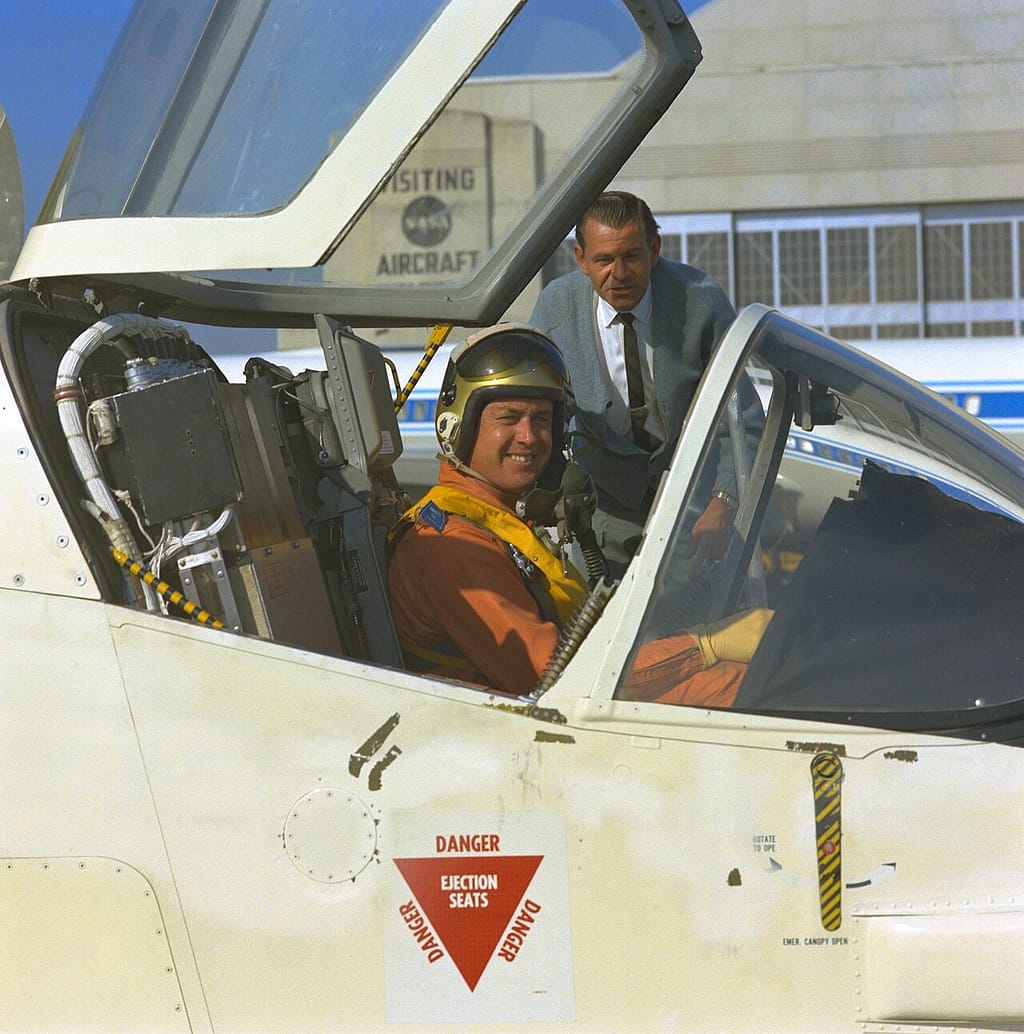
Crucially, neither accident was caused by the lift-fan system itself. The concept, the Army and NASA concluded, actually worked.
The idea that outlived the aircraft
The surviving airframe was rebuilt as the XV-5B and flew research flights for NASA until 1971; it survives today at the U.S. Army Aviation Museum. More importantly, the engineering lived on. The work on moving huge volumes of air through a tip-driven fan fed directly into General Electric’s TF39 — the first high-bypass turbofan, the engine that powers the C-5 Galaxy — and the whole notion of a lift fan buried in an airframe reappeared, decades later, in the F-35B.
The Vertifan was a dead end that led somewhere after all. Two aircraft, two lost pilots, and one very good idea that simply arrived too early.
Sources: Ryan XV-5 Vertifan (Wikipedia); Ronald M. Gerdes, “Lift-Fan Aircraft — Lessons Learned,” NASA (1993); Jane’s All the World’s Aircraft 1965–66; Popular Science (Sept 1966); Flight International (1962).
0 commentaire