

Informations clés
Aéronef: KUS-FS Medium-Altitude Unmanned Aerial Vehicle (MUAV) — South Korea’s first strategic-class reconnaissance drone
Dimensions: 13 metres long, 26-metre wingspan
Moteur: 1,200 hp turboprop
Operating Altitude: 10–12 kilometres
Radar Detection Range: 100+ kilometres
Domestic Content: 90% South Korean components
Manufacturers: Korean Air, LIG D&A, Hanwha Systems — supervised by DAPA and ADD
Delivery: Air Force acceptance tests in 2026, phased delivery beginning 2027
Why South Korea Built Its Own
South Korea could have bought American drones. It nearly did, multiple times. The RQ-4 Global Hawk — which South Korea already operates for high-altitude surveillance — and the MQ-9 Reaper were both options. But Seoul made a strategic decision: build it at home.
The North Korea Mission
The MUAV’s primary job is straightforward: watch North Korea. The Korean Peninsula is one of the most militarily dense environments on earth. North Korea maintains the world’s fourth-largest military, with over a million active-duty personnel, thousands of artillery pieces aimed at Seoul, and a nuclear arsenal of unknown but growing size. Current intelligence-gathering relies on a mix of satellites, Global Hawk flights, and manned reconnaissance aircraft. The MUAV fills a gap between them: it can fly lower and longer than a satellite, more persistently than a manned aircraft, and with more capable sensors than the smaller tactical drones currently in service. From 12 kilometres, the MUAV’s radar can detect vehicle movements, troop concentrations, and missile launcher deployments across the DMZ and deep into North Korean territory. Its electro-optical and infrared cameras can identify individual vehicles and monitor activity at known military installations in real time.
Le tableau d'ensemble
South Korea’s MUAV rollout is part of a broader Asian drone arms race. Japan is developing its own unmanned platforms. Taiwan is investing heavily in drones for asymmetric defence. And China — whose vast fleet of military drones ranges from stealthy combat platforms to expendable swarm munitions — is the reason everyone else is building. For South Korea, the MUAV is also a potential export product. Korean Air and its partners built the KT-1 trainer and participated in the KF-21 fighter programme; a proven surveillance drone could find buyers across Southeast Asia and the Middle East, where demand for MALE-class UAVs is surging. The Korean Reaper has a long road ahead — acceptance testing, operational evaluation, and the inevitable teething problems of a first-of-type platform. But the rollout in Busan marks the moment South Korea joined the small club of nations that can build a strategic drone from scratch. In the drone age, that is sovereignty. Sources: Aviation Week, Seoul Economic Daily, Army Recognition, Defence Blog, FlightGlobalQuestions connexes
What is South Korea's MUAV (the 'Korean Reaper')?
The MUAV, or KUS-FS, is South Korea's first indigenous strategic-class reconnaissance drone, unveiled in April 2026. With a 26-metre wingspan, it is designed to watch North Korea around the clock from an altitude of 10 to 12 kilometres, using sensors that detect ground targets beyond 100 kilometres.
Qu'est-ce que le MQ-9 Reaper ?
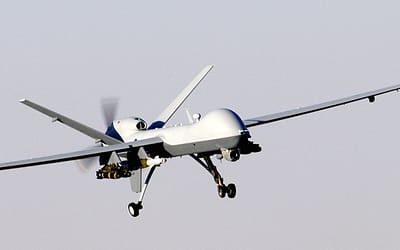
The MQ-9 Reaper is the American medium-altitude, long-endurance surveillance and strike drone that has become the global benchmark for the class. South Korea's MUAV is explicitly designed to match it, which is why defence media nicknamed the Korean machine the 'Korean Reaper.'
How big is South Korea's MUAV drone?
The MUAV is about 13 metres long with a 26-metre wingspan, powered by a 1,200-horsepower turboprop engine. It cruises at 10 to 12 kilometres altitude and carries radar able to detect ground targets at ranges exceeding 100 kilometres.
Why did South Korea build its own surveillance drone?
Seoul could have bought American MQ-1 Predator-class systems or the MQ-9, but chose to build at home for strategic independence. About 90 percent of the MUAV's components are South Korean, reducing reliance on foreign suppliers and export restrictions.
When will the Korean MUAV enter service?
The MUAV is scheduled for Air Force acceptance tests in 2026, with phased delivery beginning in 2027. It will complement the RQ-4 Global Hawk that South Korea already operates for high-altitude surveillance.
Who builds South Korea's MUAV?
The MUAV is built by Korean Air, LIG D&A and Hanwha Systems, under the supervision of South Korea's defence acquisition agency DAPA and its research body ADD. Final assembly takes place at Korean Air's Tech Centre in Busan, alongside other General Atomics drones produced abroad.
0 commentaire