
Militarily, Suez worked. In six days, Anglo-French air power destroyed the Egyptian Air Force largely on the ground, paratroops took an airfield, Royal Marines made the first helicopter assault in the history of warfare, and the invasion force held the northern end of the canal.
Then it was over, and Britain and France had lost.
Suez is the clearest demonstration in modern history that winning the air campaign and winning the war are separate questions. It was also, as it turned out, the last time a British carrier force ever conducted sustained strike operations.
Informations clés
Opération: Musketeer, the Anglo-French intervention in Egypt
Déclenchement: Nasser nationalised the Suez Canal Company on 26 July 1956
Air campaign opened: 31 October 1956
Naval force: five Royal Navy carriers and sixteen Fleet Air Arm squadrons
Strike carriers: HMS Eagle, Albion and Bulwark. HMS Ocean and Theseus carried helicopters
Aéronef: Sea Hawk, Sea Venom, Venom, English Electric Canberra, Vickers Valiant
Cibles : twelve Egyptian airfields in the Canal Zone and Nile Delta
Firsts: first operational use of the V-force, first helicopter assault in combat
Ended: ceasefire forced on 6 and 7 November 1956
How it started
On 26 July 1956, in Alexandria, in front of tens of thousands of people, Gamal Abdel Nasser announced that the Suez Canal Company now belonged to Egypt. Buried in the speech was a code word that sent Egyptian security forces to occupy the company's offices while he was still talking.
For Britain the canal was not simply infrastructure. It was the artery to India, the proof of imperial reach, and by 1956 the last major asset in a region Britain had run for seventy years. Anthony Eden, who had resigned in 1938 over the appeasement of Mussolini, reached instinctively for the analogy that had defined his career.
Hugh Gaitskell, for the opposition, called it sabre-rattling and warned that using force would be disastrous, would unite the Arab states, and might drive India out of the Commonwealth. The government won the confidence vote 321 to 251 and began planning an invasion, in secret collusion with France and Israel.
The air campaign that worked
Israel invaded Sinai on 29 October. Two days later, exactly as scripted, Britain and France issued ultimatums nobody expected to be accepted, and on the evening of 31 October the air campaign opened.
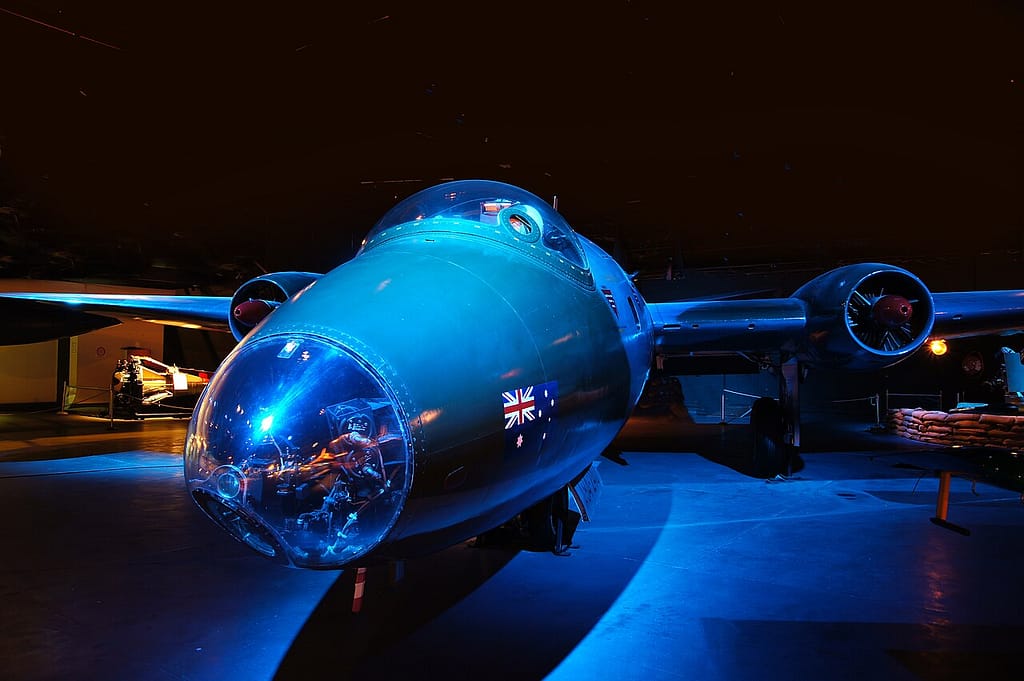
The first phase had one objective: destroy the Egyptian Air Force before it could interfere. Vickers Valiants and English Electric Canberras flying from Cyprus and Malta hit twelve airfields across the Canal Zone and the Nile Delta. It was the first operational use of the V-force, the aircraft Britain had built to deliver nuclear weapons against the Soviet Union, employed here to crater runways in the Middle East.
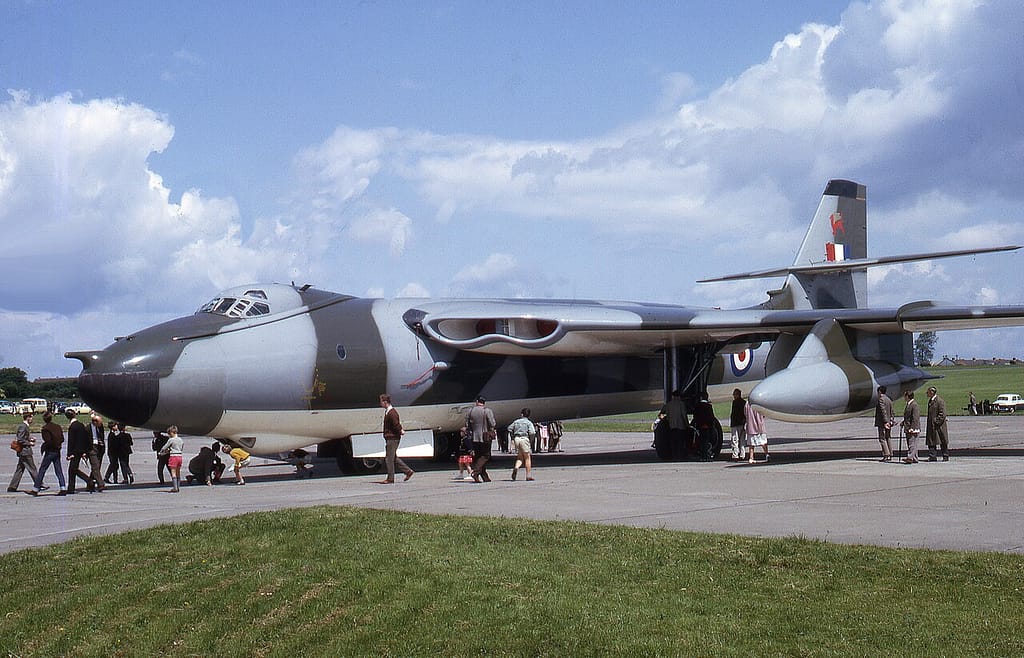
By the end of 1 November the Egyptian Air Force had been broadly neutralised. Whatever else can be said about Musketeer, that part of it was executed competently and fast.
The Fleet Air Arm's last great effort
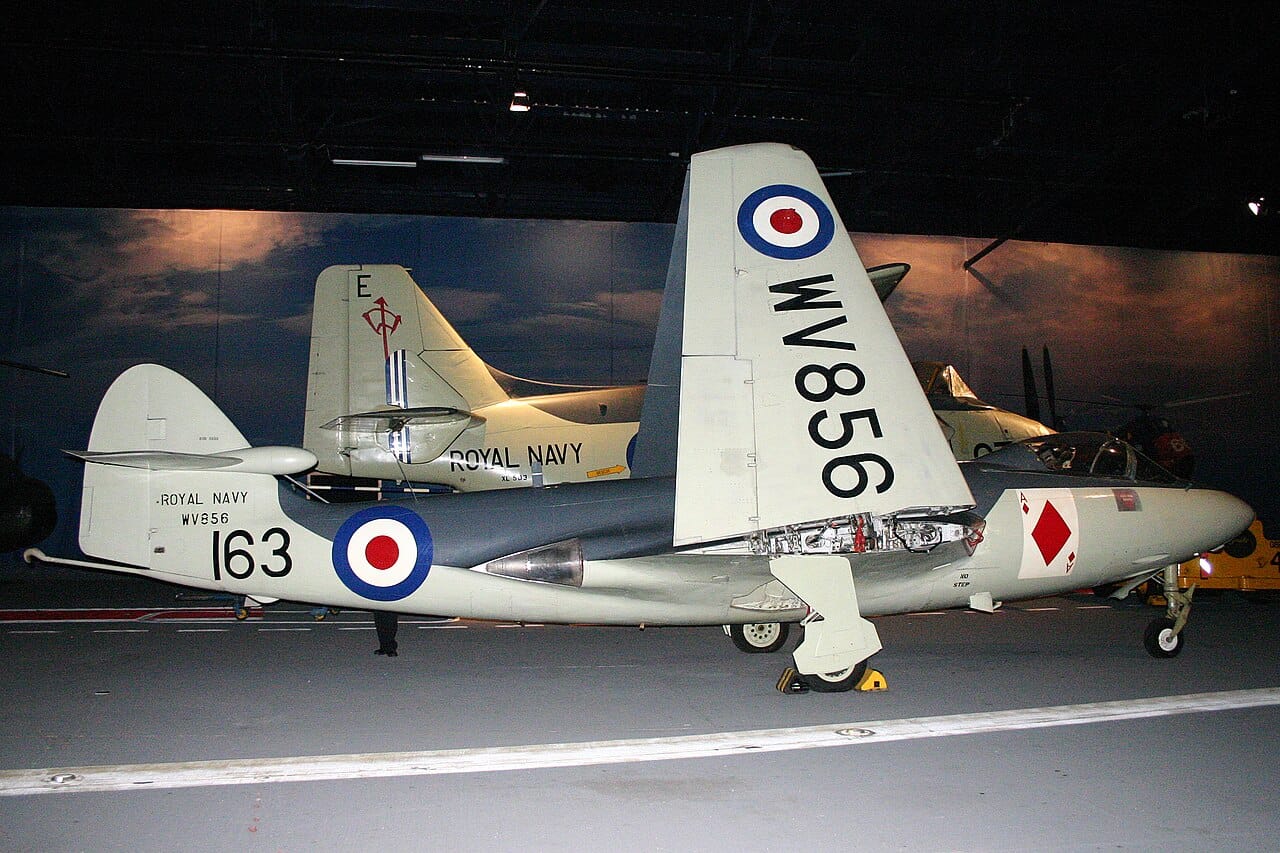
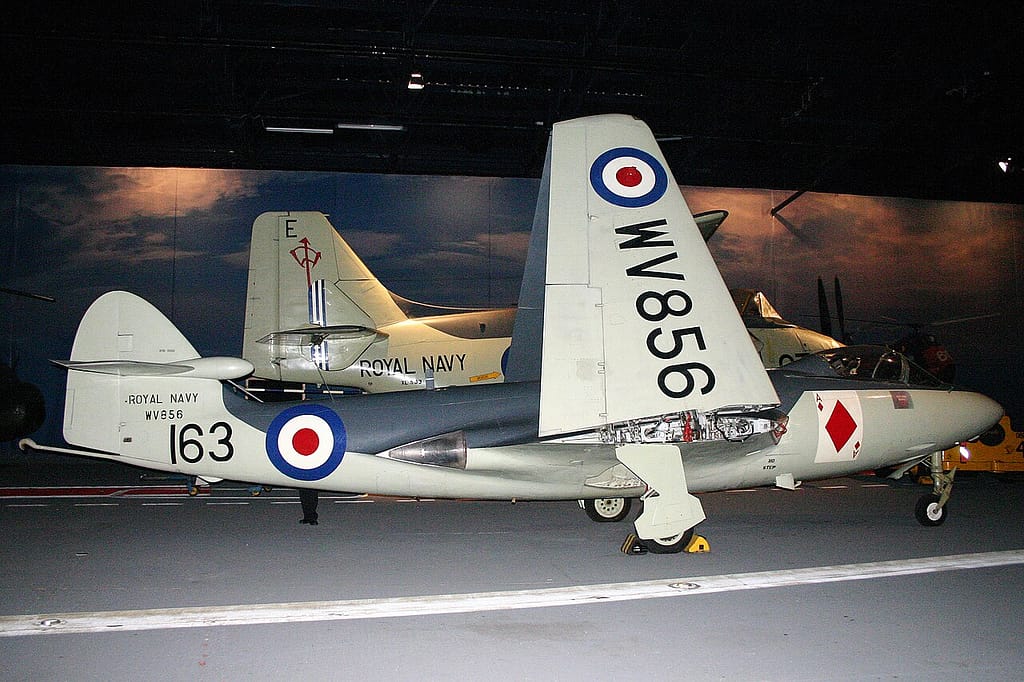
The carrier contribution was the largest the Royal Navy would ever again assemble for strike work. Five carriers, sixteen squadrons. HMS Eagle, Albion and Bulwark carried the strike aircraft, six Sea Hawk squadrons among them, two aboard Eagle and two each aboard the two light fleet carriers.
The Sea Hawk was the workhorse. It was not a remarkable aeroplane, a straight-winged first-generation naval jet already being overtaken by swept-wing designs, but it was reliable, it could carry rockets and cannon, and it could be operated intensively from small decks. Sea Hawks, Sea Venoms and Venoms went after airfields, troop concentrations, vehicles and oil facilities, frequently through heavy anti-aircraft fire.
Two firsts on the ground
At 05:15 GMT on 5 November, 688 men of A Company, 3rd Battalion the Parachute Regiment jumped onto El Gamil airfield west of Port Said. The field was held by a company of Egyptian infantry. It was secured for the cost of twelve British wounded, which allowed the rest of the battalion to be flown in.
The following day came the moment that actually changed warfare. Men of 45 Commando were landed at Port Said directly from helicopters flying off HMS Ocean. It was the first helicopter assault in combat in history. Every air assault operation since, from Vietnam to the present, descends from that morning.
And then it stopped
On 6 and 7 November, with the operation succeeding militarily, Britain and France accepted a ceasefire.
The reason was not on the battlefield. It was in Washington and in the currency markets. The United States, furious at not being consulted and unwilling to be associated with what looked unmistakably like nineteenth-century gunboat diplomacy, declined to support sterling, which was under heavy pressure. Britain faced a run on the pound it could not survive without American help, and that help was made conditional on withdrawal.
A United Nations Emergency Force replaced the invasion troops. Nasser, whose air force had been destroyed and whose territory had been occupied, emerged as the pre-eminent figure in the Arab world. Eden resigned in January.
What Suez actually taught
Three lessons came out of it, and all three still apply.
The first is that air superiority is a means, not an end. The Egyptian Air Force was destroyed within forty-eight hours and it made no difference to the outcome, because the outcome was decided by a financial mechanism entirely outside the theatre.
The second is that operations undertaken without your principal ally's consent are structurally fragile, however well executed. Britain and France had the military capability to take the canal and no capacity at all to absorb the consequences of Washington objecting.
The third is the one that reshaped European defence policy for a generation. France drew from Suez the conclusion that it could never again depend on American approval to act, and accelerated toward an independent nuclear deterrent and a foreign policy built on autonomy. Britain drew the opposite conclusion, that it must never again act without Washington, and built its defence policy around the alliance instead.
Both countries were in the same operation, flying off the same targets, and they took away directly opposite lessons. Seventy years later, you can still see both of those conclusions operating in European defence.
Sources: Imperial War Museums, The National Archives, Fleet Air Arm Officers Association, RAF Museum, Wilson Center Digital Archive, US Department of State Office of the Historian, London Gazette despatches.
0 commentaire