
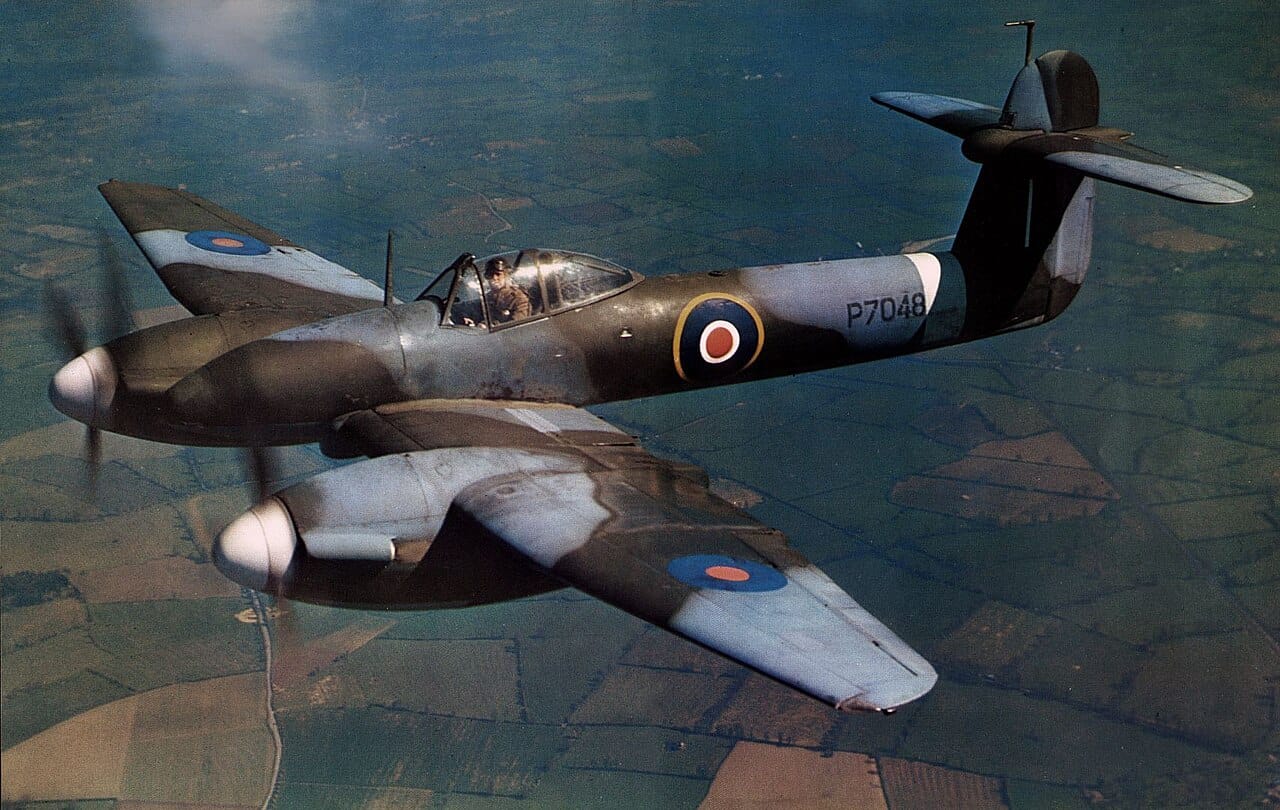
It was the fastest fighter at low level in the Royal Air Force inventory, faster than the Spitfire below 15,000 feet. It carried four 20mm cannons in its nose — twice the firepower of any other British fighter. It first flew in October 1938 and entered service in mid-1940, just in time for the Battle of Britain.
The Westland Whirlwind should have been a legend. Instead, only 116 were ever built, just two squadrons flew it operationally, and it was withdrawn from service in 1943 — destroyed not by the Luftwaffe but by the engine its own manufacturer abandoned.
Informations clés
Aéronef: Westland Whirlwind Mk I
Premier vol : 11 October 1938
Moteurs : 2× Rolls-Royce Peregrine I, 885 hp each
Vitesse maximale : 580 km/h (360 mph) at 15,000 ft
Armement: 4× 20mm Hispano cannons, all in the nose
Total construit : 116
Operational squadrons: 2 — No. 263 Squadron and No. 137 Squadron RAF
Withdrawn: November 1943
Faster Than a Spitfire — Down Low
Petter's design — Westland's W.E.W. "Teddy" Petter, the engineer who would later design the Lightning — was extraordinary for 1938. The Whirlwind had a thin laminar-flow wing, all-metal stressed-skin construction, an enclosed cockpit, and four cannons clustered in the nose where they could not be misaligned by wing flexion at high speed. The aircraft hit 360 mph at 15,000 feet on just 1,770 horsepower — a power-to-speed ratio that no Spitfire of its era could match.
It was also pleasant to fly. Whirlwind pilots reported the controls were light, the visibility excellent, and the aircraft surprisingly stable as a gun platform. The cannons hit hard. On 6 August 1941, four Whirlwinds on an anti-shipping strike were intercepted by a large formation of Bf 109s — and claimed three of them destroyed without loss.
The Engine That Killed It
The Whirlwind needed two engines for its layout. Petter chose the Rolls-Royce Peregrine, a development of the older Kestrel engine, because Rolls-Royce promised a steady supply. Then the Battle of Britain happened. Rolls-Royce decided every available engineer should be working on the Merlin — the engine that powered the Spitfire and the Hurricane. The Peregrine programme was orphaned.
By 1942 the Peregrine had stopped production altogether. The 116 Whirlwinds in service had no source of replacement engines. Every time one was lost, the airframe was scrapped because there were no engines to put in another.
Could It Have Been Re-Engined?
Yes. in January 1941 Westland proposed a Merlin-powered Whirlwind — the same airframe with two Merlin XX engines instead of two Peregrines. Westland claimed a top speed of around 410 mph — comfortably faster than the contemporary Spitfire — with twice the firepower and far greater range.
The Air Ministry said no. Production capacity was needed for Spitfires and Hurricanes. Westland's factory was redirected to license-build Spitfires. The Merlin-powered Whirlwind was never built. By 1943 the surviving Whirlwinds were retired from front-line service.
No Survivors
Not a single complete Whirlwind survives. In Britain, the Whirlwind Fighter Project has been building a full-scale reproduction from original drawings, but no original airframe exists. Most of what exists today is wreckage, fragments, and the design drawings that show, with painful clarity, exactly what the RAF threw away.
It is one of aviation history's most poignant footnotes — the fastest, hardest-hitting British fighter of 1940, killed not by combat but by the bureaucratic decision to abandon its engine. A reminder that even great aircraft are hostage to their suppliers.
Sources: Imperial War Museum, Westland Aircraft Heritage Museum, RAF Air Historical Branch.
Questions connexes
What was the Westland Whirlwind?
The Westland Whirlwind was a British twin-engine fighter that first flew in October 1938 and entered service in 1940. It was the fastest RAF fighter at low altitude - quicker than a Spitfire below 15,000 feet - and carried four 20mm cannons in its nose, twice the firepower of any other British fighter at the time.
Why did the Westland Whirlwind fail?
The Whirlwind was doomed by its engine, not the enemy. It relied on the Rolls-Royce Peregrine, which Rolls-Royce abandoned to concentrate on the Merlin. Starved of engines, only 116 Whirlwinds were built, just two squadrons flew it, and it was withdrawn in November 1943 despite its excellent performance.
How many Westland Whirlwinds were built?
Only 116 Westland Whirlwinds were ever built. Just two RAF squadrons - No. 263 and No. 137 - flew it operationally before its withdrawal in 1943. Its short career stands in sharp contrast to contemporaries like the Hawker Hurricane, which were produced in their thousands.
Who designed the Westland Whirlwind?
The Whirlwind was designed by W.E.W. "Teddy" Petter, an engineer well ahead of his time in 1938. It featured a thin laminar-flow wing, all-metal stressed-skin construction, and nose-mounted cannons. Petter later designed one of Britain’s most famous jets, the Éclairage électrique anglais.
How well-armed was the Westland Whirlwind?
The Whirlwind carried four 20mm Hispano cannons clustered in its nose - dense, concentrated firepower unmatched by any contemporary British fighter. Grouping the guns in the nose, rather than the wings, kept them from being misaligned by wing flexing at high speed and made the aircraft a hard-hitting gun platform.
0 commentaire