
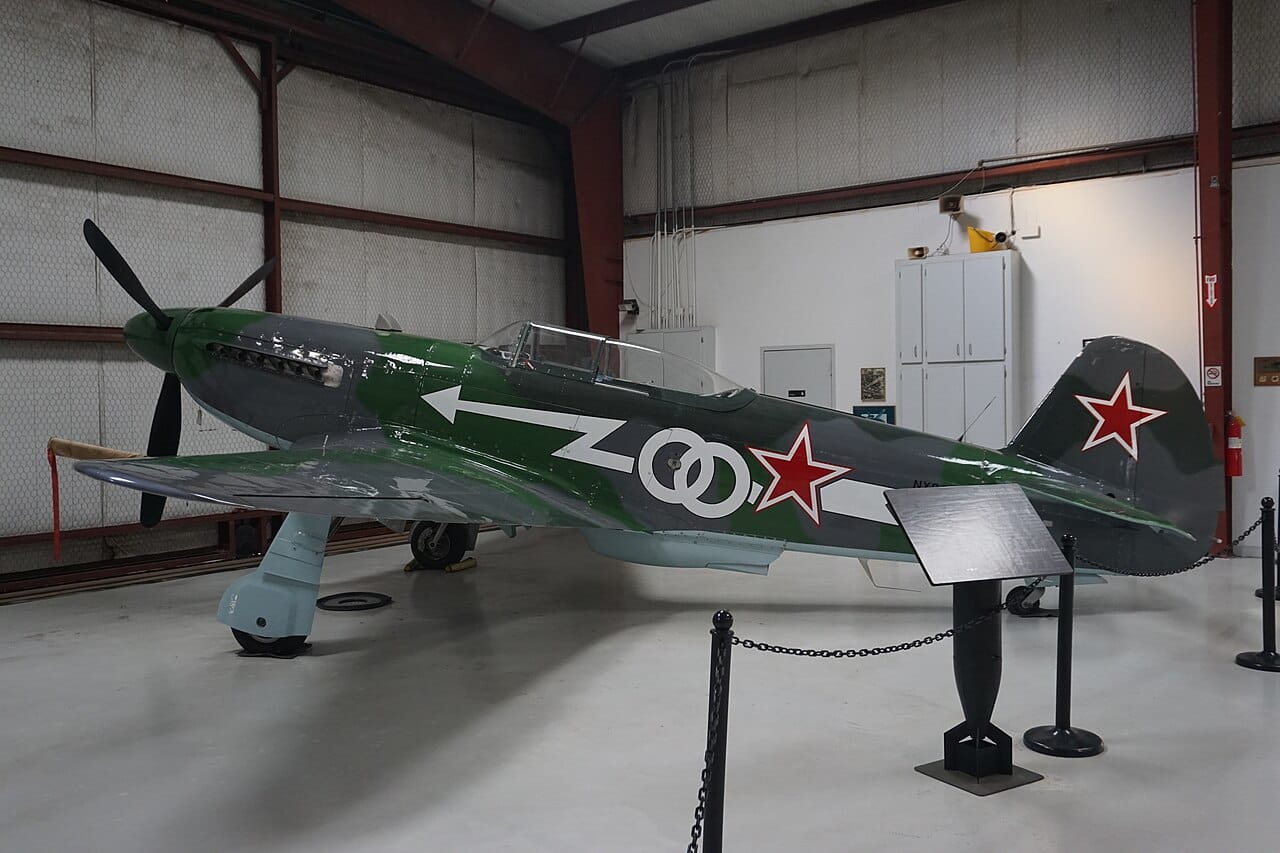
By the summer of 1944, German fighter pilots on the Eastern Front had learned to read the sky for a particular silhouette: small, blunt-nosed, impossibly nimble. When they saw it low over the battlefield, their orders were blunt. Do not fight it down here. Climb, and climb fast.
The aircraft that earned that respect was the Yakovlev Yak-3 — one of the smallest, lightest and deadliest dogfighters of the entire war. And in one of the most charming footnotes in aviation history, some of its most devoted pilots were not Russian at all, but French.
Informations clés
- Aéronef: Yakovlev Yak-3, Soviet single-seat fighter; entered service June 1944
- Character: tiny and light, with a superb power-to-weight ratio and a lethal turn below 4,000 m
- Moteur: Klimov VK-105PF2, about 1,290 hp; top speed roughly 400 mph
- Guns: a 20 mm cannon firing through the propeller hub, plus two heavy machine guns — all on the centreline
- Construit: 4,848
- French connection: the Free French Normandie-Niemen regiment flew it, and kept their Yaks after the war
Small, Light, and Lethal
The Yak-3 was the answer to a hard-won lesson. Early in the war the Soviets had been outclassed by the Messerschmitt Bf 109. So Yakovlev stripped and refined his earlier Yak-1 into something razor-sharp: smaller wings, less weight, a cleaner airframe. The result was a fighter that could out-turn almost anything at low altitude, was beloved by its ground crews for its simplicity, and forgave its pilots their mistakes.
Its firepower was concentrated where it counted. A cannon fired straight through the propeller hub and two machine guns sat in the nose, all grouped on the centreline — no need to converge wing guns at a set distance, just point and shoot. Below 4,000 metres, it was murderous.
The Terror of the Eastern Front
When the Yak-3 reached the front in mid-1944, the results were startling. In one clash on 16 June, eighteen Yak-3s took on twenty-four German aircraft and shot down fifteen for the loss of a single fighter. A month later, eight Yaks waded into a formation of sixty German aircraft and downed seven — three Stukas and four Messerschmitts — without losing one of their own. The Luftwaffe took the hint and issued a standing order.
The French Squadron That Chose the Yak
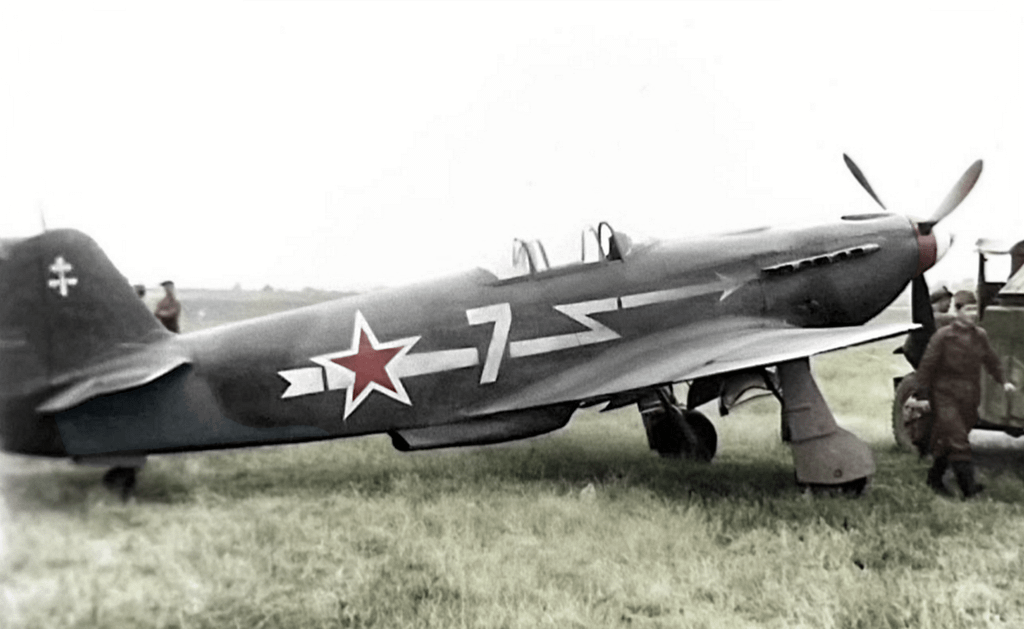
Among the Yak-3’s admirers was a unique unit: the Normandie-Niemen regiment, a group of Free French volunteer pilots who fought the whole war on the Russian front, flying and dying alongside the Soviets. When they were offered the Yak-3 in 1944, they embraced it, scoring the last hundred of their nearly three hundred victories in it.
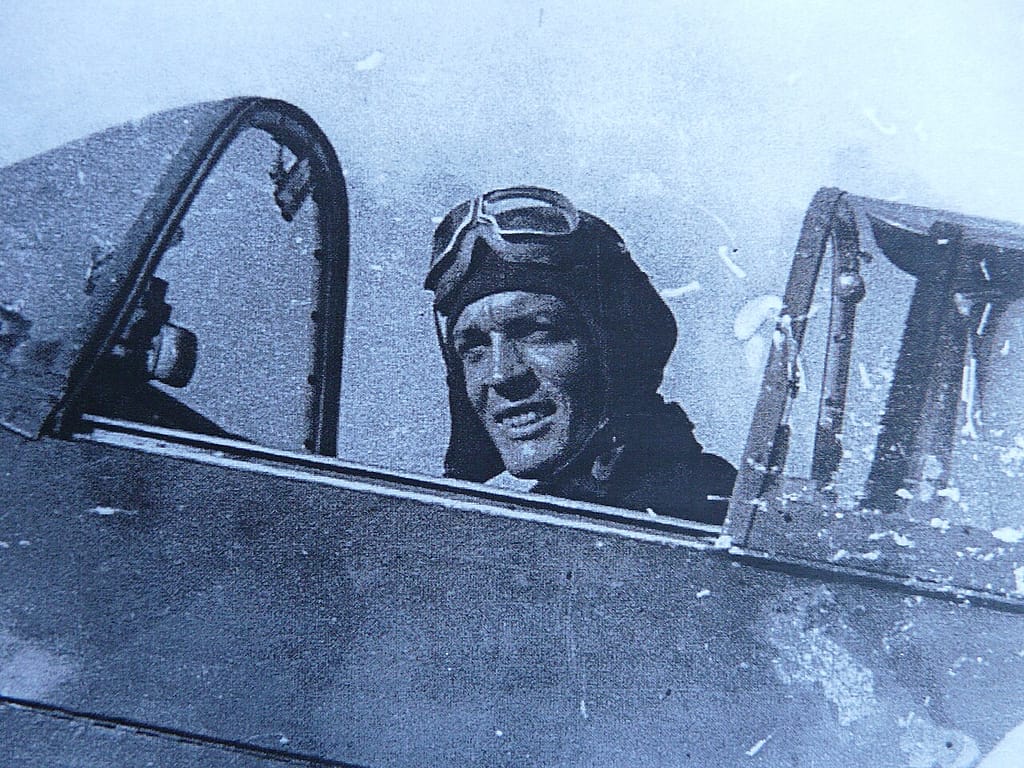
Their verdict carried weight, because these were men who had flown Western aircraft too. Marcel Albert, the regiment’s highest-scoring ace, had no doubt about where the little Soviet fighter ranked.
That admiration was returned. When the war in Europe ended, Stalin made an extraordinary gesture: he let the French pilots keep their Yak-3s and fly them home to France. It was a unique gift — a Soviet fighter regiment, transplanted whole to the West. One of those very aircraft survives today, on display at the great air museum at Le Bourget, near Paris, a small silver reminder of an unlikely brotherhood.
The Little Fighter That Earned Its Fear
The Yak-3 was not perfect — its wooden surfaces could peel in a hard dive, its range was short, and its engine could be temperamental. But as a pure instrument of the dogfight, at the altitudes where the Eastern Front was decided, it had few equals. It was the aircraft that taught the Luftwaffe to look up.
Sources: Wikipedia; William Green, Famous Fighters of the Second World War; Musée de l’air et de l’espace, Le Bourget; Osprey, Yakovlev Aces of World War 2.
0 commentaire