
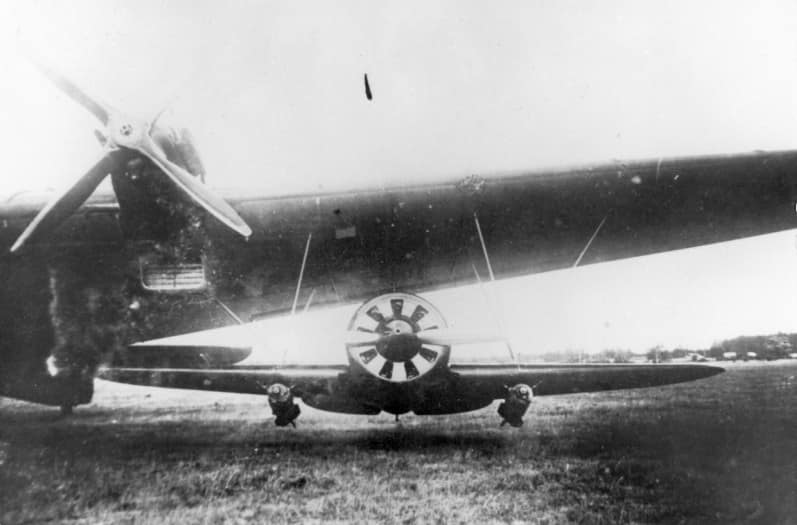
Long before anyone talked about “loyal wingman” drones flying off crewed jets, the Soviet Union built the real thing: a flying aircraft carrier. A single giant bomber would haul as many as five fighters into the sky, cut them loose in mid-air — and, in its combat form, actually fly bombing raids in the Second World War.
It was called the Zveno, and unlike almost every other parasite-aircraft scheme in history, it worked.
| Project | Zveno (“Vakhmistrov’s Circus”), USSR, 1930s |
| Mothership | Tupolev TB-1 or TB-3 heavy bomber |
| Parasites | Two to five fighters, released in flight |
| Combat version | TB-3 + two I-16s, each with two 250 kg bombs |
| débuts au combat | July–October 1941, against Romania |
Vakhmistrov’s Circus
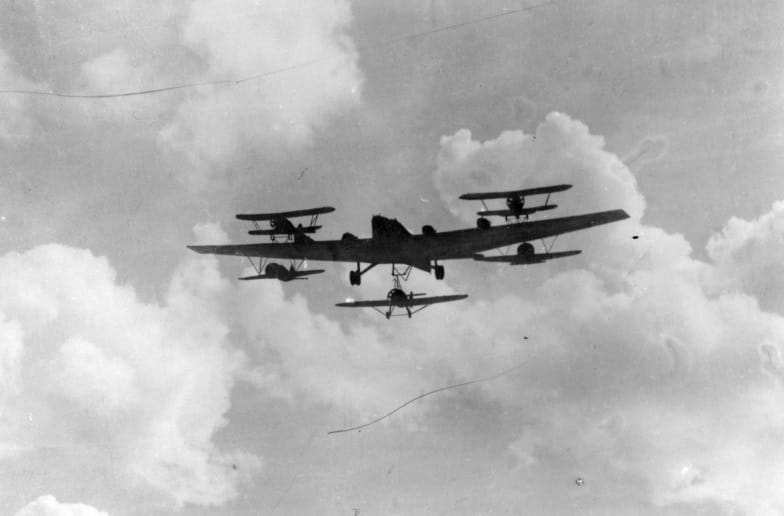
The idea came from Vladimir Vakhmistrov, a Soviet Air Force test pilot and glider designer who, from 1931, proposed bolting fighters onto heavy bombers. His programme became known, half-affectionately, as “Vakhmistrov’s Circus,” and the configurations grew steadily wilder. One version, the “Aviamatka,” saw a lumbering TB-3 carry up to five fighters at once — perched on top of the wings, slung beneath them, and hung from a trapeze under the belly. Some fighters could even hook back on and refuel from the mothership in flight.
The logic was sound. Fighters of the 1930s had cruelly short range. Carry them most of the way aboard a bomber and you extended their reach enormously — and you could also turn a nimble fighter into a precision dive-bomber that struck far beyond its normal radius.
The one that went to war
The version that mattered was the Zveno-SPB — roughly, “composite dive-bomber.” It paired a TB-3 mothership with two Polikarpov I-16 fighters, each carrying a pair of 250-kilogram bombs that the little fighters could never have lifted off a runway themselves. And in the summer of 1941, with Germany and its Romanian ally pressing hard, the Black Sea Fleet’s aviators put it into action.
On 26 July 1941, two Zveno-SPB combinations struck the oil depot at Constanța in broad daylight and came home without loss, the I-16s dropping away some 40 kilometres from the target, dive-bombing, and flying back under their own power. Then came the prize: the King Carol I bridge at Cernavodă over the Danube, which carried the Ploiești–Constanța oil pipeline. Conventional bombers had failed to hit it; on 10 August 1941, the little parasite dive-bombers did. More than thirty combat missions followed before the campaign wound down that October.
A footnote that flew
The Zveno’s career was brief. The TB-3 was slow and desperately vulnerable, and newer aircraft with the range to strike such targets directly were on the way. By the end of 1941 the flying aircraft carrier had done its work and was retired.
History is littered with parasite-aircraft schemes that never worked — America’s airship-borne carriers Akron and Macon, the tiny XF-85 Goblin that could barely hook back onto its bomber. The Zveno stands almost alone as the one that actually went to war, hit its targets, and brought most of its crews home. A circus, perhaps — but one with a genuinely serious act.
Sources: Mikhail Maslov, Vakhmistrov’s Circus; Wikipedia; Military Matters.
Questions connexes
What was the Soviet Zveno project?
The Zveno was a Soviet "flying aircraft carrier" developed in the 1930s, in which a single giant Tupolev TB-1 or TB-3 heavy bomber carried between two and five fighters aloft and released them in mid-air. Unlike almost every other parasite-aircraft scheme in history, it actually worked, and its combat version flew real bombing raids in 1941.
Who invented the flying aircraft carrier concept in the USSR?
The Soviet flying aircraft carrier was the work of Vladimir Vakhmistrov, a Soviet Air Force test pilot and glider designer who from 1931 proposed bolting fighters onto heavy bombers. His experimental programme became known, half-affectionately, as "Vakhmistrov's Circus" as the configurations grew steadily more ambitious.
What is a parasite aircraft?
A parasite aircraft is a small aircraft carried aloft and launched by a larger "mothership," extending its range or defending the carrier. The Soviet Zveno was the most successful example. Most others failed, including the U.S. Navy's airship-borne carriers Akron and Macon and the tiny XF-85 Goblin.
Which aircraft were used in the Zveno flying aircraft carrier?
The Zveno used a Tupolev TB-1 or the larger four-engined TB-3 heavy bomber as the mothership. The parasites were fighters such as the Polikarpov I-16. The main combat configuration paired a TB-3 with two I-16s, each fighter loaded with two 250 kg bombs for dive-bombing attacks.
Did the Zveno flying aircraft carrier ever see combat?
Yes. The Zveno flew more than thirty combat missions between July and October 1941, attacking targets in Romania. Its most famous success came on 10 August 1941, when its I-16 dive-bombers hit the King Carol I bridge at Cernavoda over the Danube, a target conventional bombers had repeatedly failed to destroy.
Why did the Zveno attack the Cernavoda bridge?
The King Carol I bridge at Cernavoda carried the Ploiesti-Constanta oil pipeline, making it a vital strategic target. Conventional Soviet bombers had failed to hit it, so the Zveno's parasite I-16 dive-bombers were used instead. Released about 40 kilometres out, they dive-bombed the bridge and then flew home under their own power.
Why was the Zveno retired?
The Zveno was retired by the end of 1941 because its TB-3 mothership was slow and desperately vulnerable, and newer aircraft with the range to strike distant targets directly were entering service. Its career was brief, but it remains almost the only parasite-aircraft scheme in history that actually worked in combat.
Is the flying aircraft carrier idea still used today?
The concept has re-emerged in modern form. Air forces are now developing "loyal wingman" drones that fly alongside crewed jets, echoing the Zveno's basic idea of one aircraft controlling several others. For example, studies suggest China's J-20 paired with drone wingmen becomes far more effective than fighting alone.

0 commentaire