
Quick Facts
| Nationality | Soviet 🇷🇺 |
| Aerial Victories | 12 (highest female ace of all time) |
| Aircraft Flown | Yak-1, Yak-1B |
| Wars | World War II |
| Born / Died | 18 Aug 1921 – 1 Aug 1943 (age 21) |
| Unit | 586th Fighter Aviation Regiment, 73rd Guards Fighter Aviation Regiment |

She was twenty-one years old, flew a fighter in combat, and became the most successful female fighter pilot in history. Lydia Litvyak's story is one of extraordinary courage — and of a life cut devastatingly short.
The White Rose of Stalingrad
Born on 18 August 1921 in Moscow, Lydia Vladimirovna Litvyak fell in love with aviation as a teenager, learning to fly at a local aeroclub at just fourteen. When Germany invaded the Soviet Union in 1941, she immediately volunteered for combat duty. Though initially turned away due to her youth, she falsified her flight log to show 100 more hours than she had, and was accepted into Marina Raskova's 586th Fighter Aviation Regiment — one of the famous all-female aviation regiments.
Combat Over Stalingrad
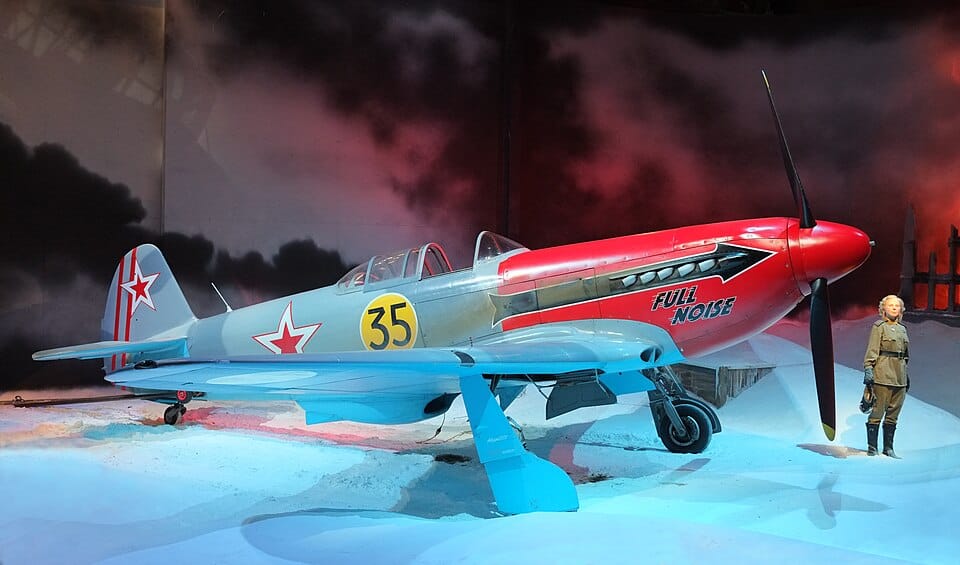
Litvyak transferred to the 437th Fighter Aviation Regiment in September 1942, becoming one of the few women to fly in mixed-gender units. Over the skies of Stalingrad she proved herself immediately — scoring her first two kills on 13 September 1942, including a veteran Luftwaffe pilot with seven victories. She was known to paint a white lily on her Yak fighter, earning her the nickname "White Rose of Stalingrad" (though some sources suggest "White Lily" is more accurate).
Record and Sacrifice
Despite being wounded twice and surviving the destruction of her aircraft, Litvyak kept flying. By the summer of 1943 she was credited with 12 individual aerial victories and 3 shared kills — a record that remains unmatched by any female pilot in history. She flew the Yak-1 and later the Yak-1B, aircraft she handled with exceptional skill and aggression.
On 1 August 1943, during her fourth sortie of the day over the Mius Front, Litvyak's Yak-1B was last seen diving into a melee of German fighters. She was twenty-one years old. Her remains were not identified until 1979, when her body was found in a mass grave near the village of Dmitrivka in Ukraine.
Recognition and Legacy
For decades Litvyak was denied the Hero of the Soviet Union title because her fate was listed as "missing in action," a status that could imply capture or defection. Only in 1990, under Mikhail Gorbachev, was she posthumously awarded the Gold Star of Hero of the Soviet Union. The delay was a bitter injustice to a pilot who had given everything for her country.
Today Lydia Litvyak is remembered around the world as a symbol of courage without boundaries — proof that exceptional skill and determination transcend gender, age, and the limits others set upon you. Her twelve victories in less than a year of combat remain the greatest achievement in the history of female aviation.
“I fly because I love the sky. And because someone must defend it.”
— Lydia Litvyak — White Rose of StalingradWatch: Lydia Litvyak Documentary
Related Questions
Who was Lydia Litvyak?
Lydia (Lidiya) Litvyak was a Soviet fighter pilot of World War II and the highest-scoring female fighter ace in history, credited with 12 aerial victories. Flying the Yak-1 over Stalingrad, she became known as the "White Rose of Stalingrad." Born in 1921, she was killed in action on 1 August 1943, aged just 21.
How many aircraft did Lydia Litvyak shoot down?
Litvyak is officially credited with 12 aerial victories, more than any other woman in aviation history. She scored them on the Eastern Front in 1942-1943, mostly around Stalingrad, flying the Yakovlev Yak-1 and the improved Yak-1B. By comparison, the top Allied ace Ivan Kozhedub was credited with dozens more.
Why was Lydia Litvyak called the White Rose of Stalingrad?
She had a white flower painted on the side of her fighter, which admirers and the press turned into the legend of the "White Rose (often called the White Lily) of Stalingrad." The nickname captured both her youth and her growing reputation as a deadly fighter pilot over the ruins of the city.
What aircraft did Lydia Litvyak fly?
She flew the Yakovlev Yak-1 and its improved Yak-1B variant, light and agile Soviet single-seat fighters built largely of wood and metal. These aircraft equipped the Soviet fighter regiments on the Eastern Front and were a match for the German Bf 109s she regularly fought.
Who is the highest-scoring female fighter ace in history?
Lydia Litvyak holds the record, with 12 confirmed aerial victories in World War II. Her friend and fellow Soviet pilot Yekaterina (Katya) Budanova ranks second. No woman before or since has matched Litvyak's tally, making her unique among the great fighter aces of history.
Did Soviet women fly fighter planes in combat during World War II?
Yes. The Soviet Union was the only major power to send women into frontline fighter combat. Litvyak served in the all-female 586th Fighter Aviation Regiment before moving to mixed Guards units. Soviet women also flew bombers and ground-attack missions, something Western air forces did not permit at the time.
When and how did Lydia Litvyak die?
Litvyak was killed in action on 1 August 1943, aged 21, shot down during heavy fighting over eastern Ukraine. Her body was not recovered for decades, which delayed official recognition. She was finally named a Hero of the Soviet Union in 1990, confirming her status as a legendary World War II ace.

0 Commenti