

The radar worked. That was the strange part. It could see aircraft, track them, and hand the picture to the operators behind it. It simply could not do so reliably, or for long, or against the one category of target the entire programme existed to detect.
On 18 December 1986, the Secretary of State for Defence stood up in the House of Commons and cancelled the Nimrod AEW3 after nine years of development and £660 million of public money. Britain then bought American.
What follows is not a story about a bad aeroplane. The Nimrod airframe was excellent, and British Aerospace delivered every one of them on contract and on time. It is a story about what happens when a country asks a 2.4-megabyte computer to fight the Cold War.
Informazioni rapide
| Aeromobili | British Aerospace Nimrod AEW3, converted from surplus Nimrod MR1 airframes |
| Origine | Hawker Siddeley HS.801, itself derived from the de Havilland Comet 4 airliner |
| Radar | GEC/Marconi pulse-Doppler with Fore Aft Scanner System (FASS): one scanner in the nose, one in the tail |
| Mission computer | GEC 4080M, ultimate data storage capacity 2.4 MB |
| centrale elettrica | 4 × Rolls-Royce Spey RB.168-200 turbofans, 12,140 lbf each |
| Programme start | Contracts placed March 1977; in service for training 1982, operational 1984 (planned) |
| Costruito | 3 development aircraft plus 8 production conversions; first flight from Woodford, 16 July 1980 |
| Annullato | 18 December 1986, after £660 million spent, just over half of it on avionics |
| Sostituito da | Boeing E-3D Sentry — six ordered, later seven; first delivered 1991 |
Why Britain Wanted Its Own
By the mid-1960s the Royal Navy’s Fairey Gannet AEW.3 was carrying an AN/APS-20 radar designed during the Second World War. When the carriers went, the radars were transplanted into elderly Avro Shackletons, which entered the airborne early warning role in 1972 as an explicitly temporary measure. Their crews called them Growlers, after the noise of four Griffon engines and contra-rotating propellers. They were meant to last a few years.
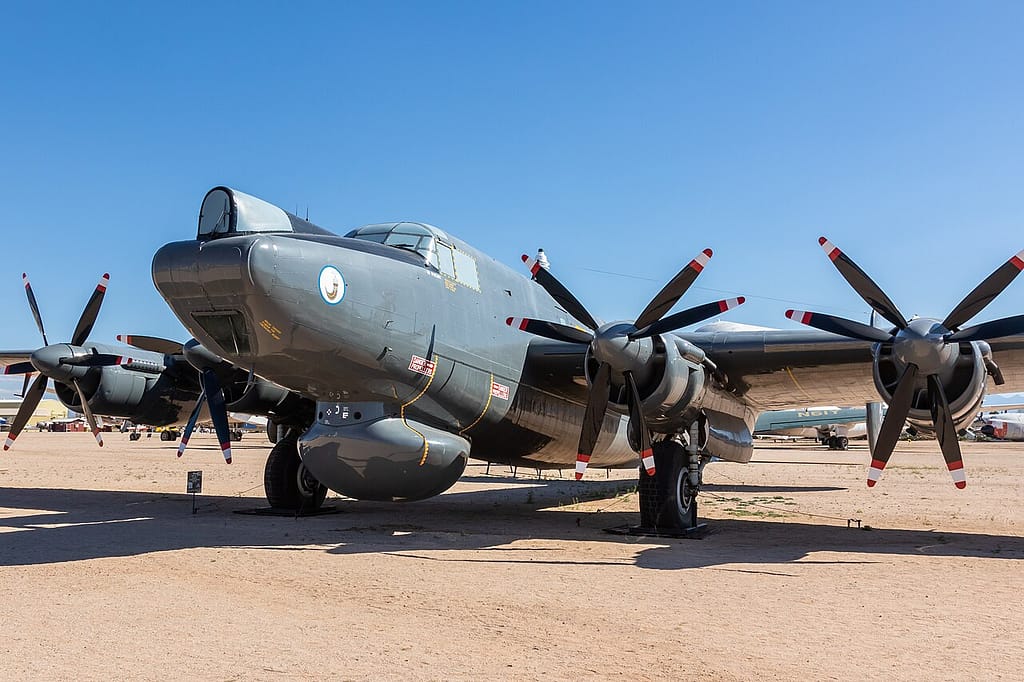
Britain had a choice. The United States was offering the Boeing E-3 Sentry, and a NATO purchase was being negotiated. London could have bought the American radar, or the American radome, or the whole aircraft.
It chose instead to build a wholly British system: a new pulse-Doppler radar and a new avionics suite from GEC Marconi, installed in the Nimrod airframe already in RAF service. The reasoning was industrial as much as military — jobs, expertise, and Britain’s standing in radar, a field it had effectively invented. In 1977 the manufacturers put the total programme cost at £200–300 million.
BBC Panorama, “A Bad Deal for Britain” (1985) — contemporary reporting on the Nimrod AEW3 programme a year before its cancellation.
The Aeroplane Was Too Small
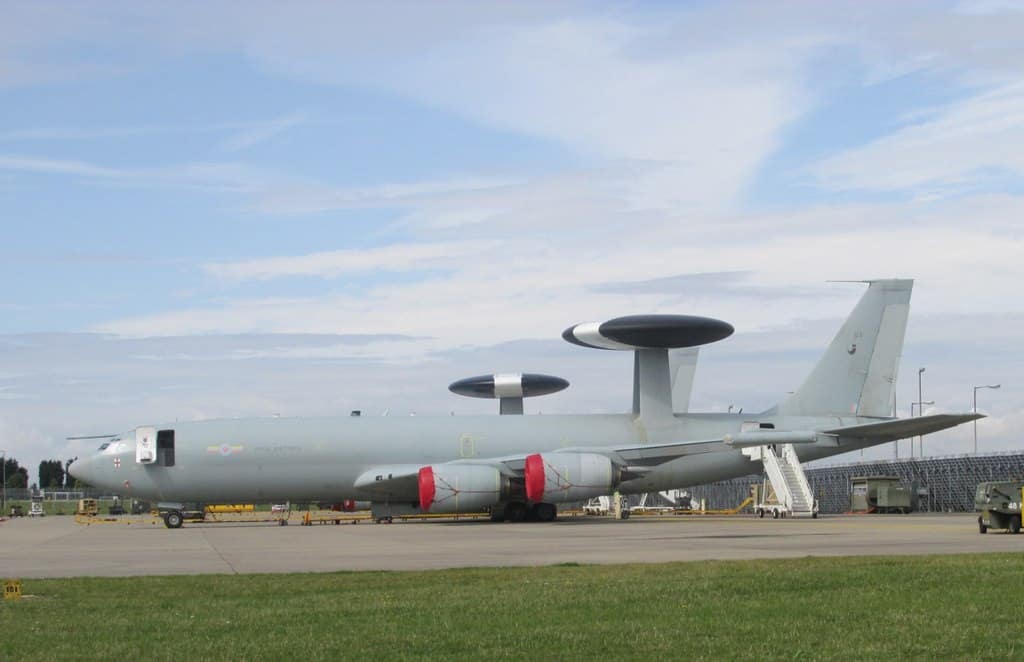
The first structural problem was geometry. The E-3 Sentry is built on a Boeing 707, and carries its radar in a rotodome above the fuselage, where the airflow cools it for free. The Nimrod is a much smaller aircraft, with roughly half the all-up weight of the American machine, and it was asked to do the same job.
There was no room for a rotodome, so GEC used the Fore Aft Scanner System: one scanner in a bulbous nose radome, another in the tail. The nose swept left to right, then handed off to the tail, which swept right to left, and together they were meant to produce 360-degree coverage. Getting the two to synchronise proved extremely difficult, and all-round surveillance suffered accordingly.
Cooling was worse. With no external airflow to use, the design dumped waste heat from the electronics into the aircraft’s own fuel. That works — provided the tanks are at least half full. Run the system at full power on a long sortie and the aircraft’s usable endurance became a function of how hot its radar was running.
The Nimrod also had six operator consoles against nine in the E-3A, and no volume in which to add more.
Two-and-a-Half Hours to Load, Two Hours to Fail
The mission system was built around a GEC 4080M computer with an ultimate data storage capacity of 2.4 megabytes. It was required to fuse returns from two radar scanners, the electronic support measures suite, the IFF interrogator and the inertial navigation system, in real time.
It could not. By the time of cancellation, mean time between failures for the mission system stood at roughly two hours — while loading the mission data from tape took about two and a half. The aircraft could, in the most literal sense, break before it was ready.
The detail that ended the programme, though, was subtler and far more damning. Performance depended heavily on the Cossor IFF interrogator. With IFF data to help it, the system could hold a track. With the transponder switched off, radar tracks decayed rapidly.
In other words: the Nimrod AEW3 could reliably follow civil airliners and friendly military aircraft, all of which squawked cooperatively. It could not reliably follow Warsaw Pact aircraft, which would not. Detecting those aircraft was the entire purpose of the project.
Beneath that sat a catalogue of integration failures. Equipment racks were earthed to different points on the airframe, producing differences in earth potential that injected phantom tracks and further loaded the computer. The radar split incoming information into upper and lower beams, each divided again into in-phase and quadrature channels; the four channels used identical components which should have been interchangeable, and were not. Trials crews flew with boxes of spares so that when the system failed they could hunt for a combination that happened to work. Nobody ever established why. The suspicion was that timing tolerances through each channel were too loose for the four streams to be correlated back into one coherent picture.
The Comet-to-Nimrod story: how Britain’s failed jet airliner became a four-decade maritime patrol aircraft.
Nobody Owned the Problem
The programme’s management structure deserves its own paragraph, because it is the part most likely to be repeated. British Aerospace and GEC Marconi were appointed joint programme leaders. There was no single prime contractor carrying end-to-end responsibility.
The predictable happened. When problems emerged at the boundary between airframe and system, each company had both the incentive and the standing to attribute them to the other. BAe met its obligations and delivered airframes. GEC could not make the avionics work. Between them, for nine years, sat a gap nobody was contractually obliged to close.
Younger acknowledged this directly in the Commons, and it is the most durable lesson in the whole affair.
The Statement
By 1986 the Ministry of Defence had put the requirement out to competition. Best and final offers came from GEC with the Nimrod and Boeing with the E-3A. GEC proposed three tiers: three aircraft in late 1987 at existing trials standard, six aircraft between mid-1989 and mid-1990 approaching final standard but without a secure data link, and eleven at full standard between October 1991 and September 1993.
Younger judged the Nimrod not against the Sentry but against Air Staff Requirement 400, the specification agreed in 1977. He was explicit that the goalposts had not moved. His scientific and military advisers were unanimous that the requirement would not be met before the mid-1990s, if at all.
The Opposition spokesman Denzil Davies called it a bad decision for Britain’s industrial base and put the eventual waste at upwards of £900 million. The Conservative MP Kenneth Warren spoke of nine years of what he called appalling mismanagement in the MoD’s procurement executive. Younger, pressed on precedent, reached for the obvious comparison — the cancellation of the TSR-2 in 1965, another British aircraft that flew and was killed anyway.
A walkaround of a preserved Nimrod, showing the airframe that BAe delivered on time and on contract.
What It Cost
Six E-3As were ordered, with an option for two more, at £860 million in 1986–87 prices — about £200 million more than finishing the eleven Nimrods would have cost. Boeing committed to spending £130 with British companies for every £100 Britain spent. The first Sentry arrived in 1991. The Shackletons, bought as a stop-gap in 1972, flew on until that year.
The airframes were stored, mined for spares to keep the Nimrod R1 and MR2 fleets flying, briefly studied as anti-ship missile carriers, and finally scrapped in the 1990s. No complete AEW3 survives. A cockpit sits at the Solway Aviation Museum; one fuselage went to Brough and was used as the fatigue test rig for the Nimrod MRA4 wing, a programme that would itself be cancelled in 2010. Another lies at Stafford.
The wider consequence outlived the aircraft. The scandal hardened Margaret Thatcher’s determination to open British defence procurement to competition, ending the assumption that a British requirement automatically meant a British supplier. Every UK defence competition since has carried the shadow of the two economists’ verdict on the affair.
There is no villain here, which is what makes it worth studying. The airframe was sound. The engineers were capable. GEC went on selling head-up displays to the United States Air Force. The ambition — that a mid-sized European power should build its own airborne radar rather than buy one — was entirely reasonable in 1977.
What defeated it was the assumption that the hard part was the aeroplane. It was not. It was the software, the integration, and the two-and-a-half hours it took to load a tape into a computer with less memory than a single photograph on the phone in your pocket.
Sources: Hansard, HC Deb 18 December 1986 vol 107 cc1351–9; Bellany and Huxley, New Conventional Weapons and Western Defence (1987); Chin, British Weapons Acquisition Policy (2004); Hirst, Air International (1983); Aeroflight; No. 8 Squadron RAF Association; BAE Systems heritage archive.

0 Commenti