
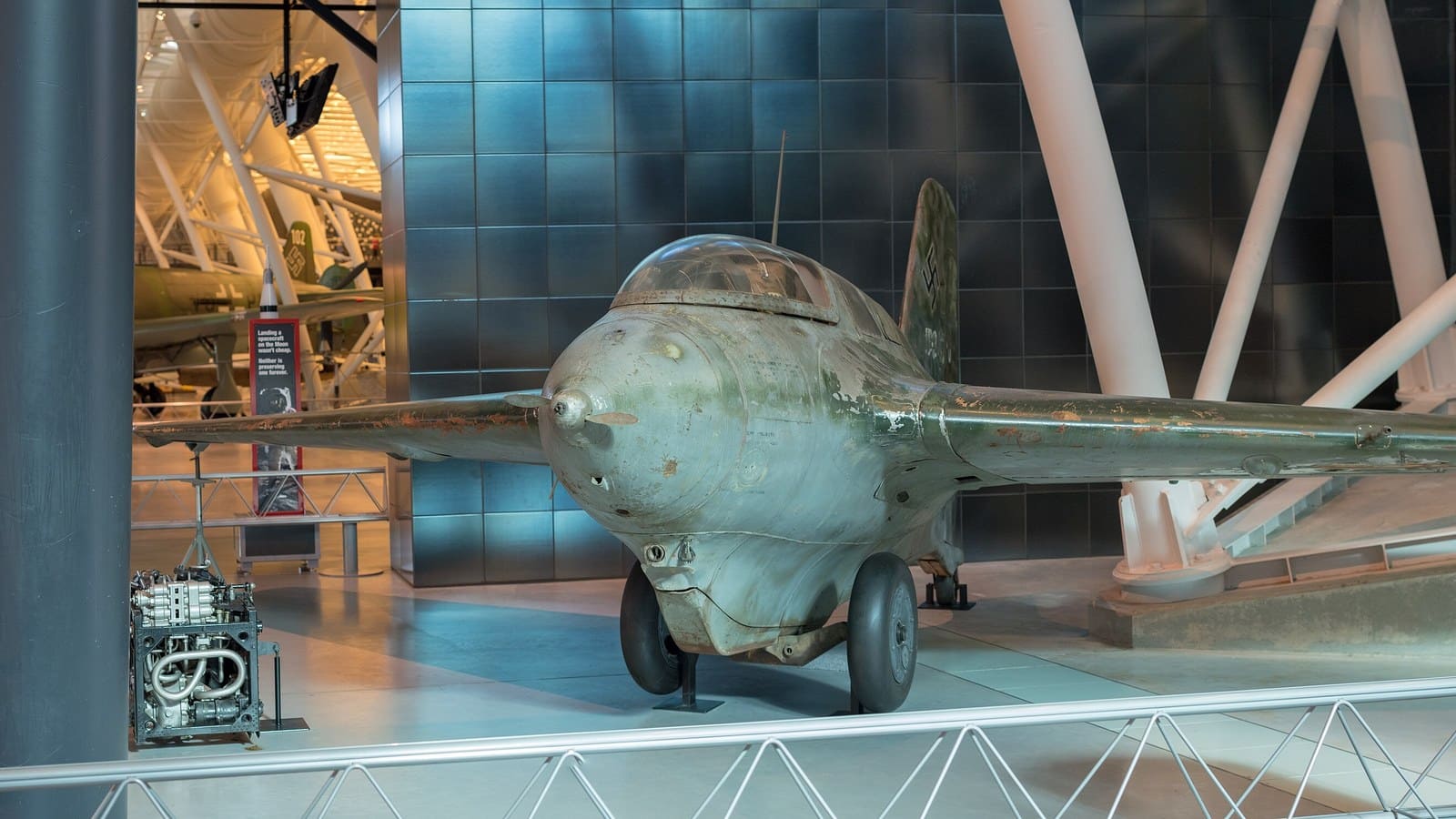
On 28 July 1944, P-51 pilots of the 359th Fighter Group were escorting B-17s away from Merseburg when someone called out contrails high at six o'clock. Two stubby, tailless shapes came slicing down through the formation faster than anything the Americans had ever seen — and then one of them stood on its tail and climbed away into the sun. The escorts could do nothing but watch.
What they had just met was the Messerschmitt Me 163 Komet, the only rocket-powered fighter ever to reach operational service. It could out-climb and out-run every aircraft in the sky in 1944, touching speeds around 1,000 km/h (620 mph) when the fastest Allied fighters struggled to reach 700 km/h.
It was also, by a comfortable margin, the most dangerous aircraft of the war to its own pilots. The Komet flew on two hypergolic chemicals that ignited on contact with each other — and one of them dissolved human tissue on contact. More Komets were destroyed by accidents, explosions and landings gone wrong than by Allied gunfire.
Quick Facts: Messerschmitt Me 163B Komet
| Ruolo | Rocket-powered point-defence interceptor — the only one ever operational |
| Primo volo | 1 September 1941 (Me 163A prototype) |
| Motore | Walter HWK 109-509A liquid-fuel rocket, ~17 kN (3,800 lbf) thrust |
| Propellants | T-Stoff (concentrated hydrogen peroxide) + C-Stoff (methanol/hydrazine) — hypergolic |
| Velocità massima | ~960 km/h (600 mph) in service; 1,130 km/h (702 mph) record flight, July 1944 |
| Powered endurance | About 7.5 minutes |
| Climb | 12,000 m (39,000 ft) in roughly three minutes |
| Armamento | 2× 30 mm MK 108 cannon |
| Costruito | ~370 |
| Combat record | Credited with 9–18 kills (commonly cited: 9 confirmed) for about 10 combat losses |
A Glider With a Rocket in Its Tail
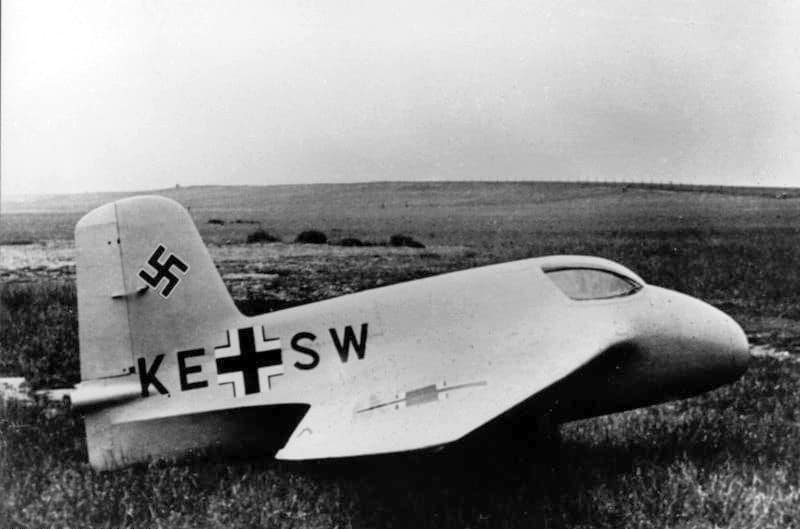
The Komet began life on the drawing board of Alexander Lippisch, Germany's apostle of the tailless aircraft. His designs evolved from record-setting gliders into the DFS 194 research aircraft, which was mated to a rocket engine developed by Hellmuth Walter that ran on concentrated hydrogen peroxide. When the airframe and engine came together at Messerschmitt, the result was unlike anything else flying: a tiny, swept-wing, tailless egg with no horizontal stabilizer, no propeller and no conventional landing gear.
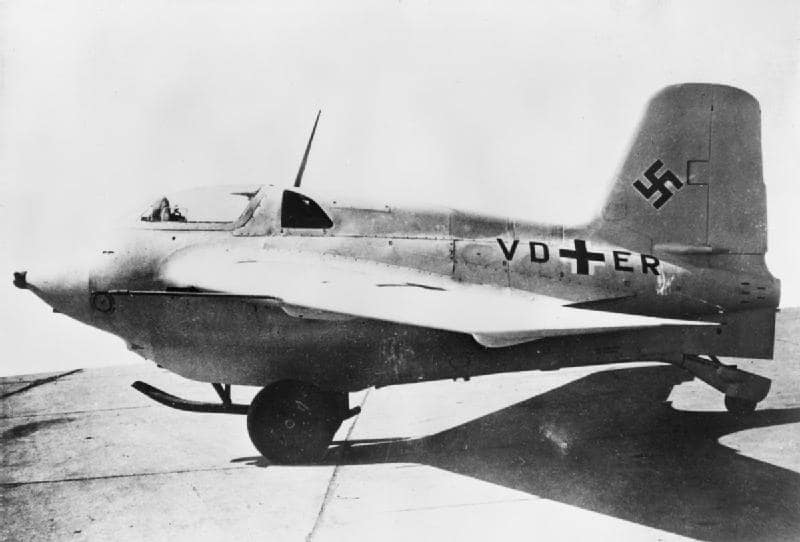
It took off from a jettisonable two-wheel dolly and came home on a retractable belly skid — features inherited straight from its glider ancestry. Everything about it was minimal, because everything about it existed to serve one number: speed.
That number arrived early. On 2 October 1941, test pilot Heini Dittmar took the Me 163A V4 prototype to 1,004.5 km/h (624.2 mph) — at a time when frontline fighters were roughly 400 km/h slower. The figure was so far beyond the state of the art that it was kept secret. On 6 July 1944, Dittmar went faster still, reaching 1,130 km/h (702 mph) in the Me 163B V18, an unofficial record that no turbojet aircraft matched until 1953. He landed that day with most of his rudder shaken away by flutter.
The A-series prototypes proved the concept; the definitive Me 163B added an armed, more producible airframe around the new Walter HWK 109-509 engine. Around 370 Komets were eventually completed.
The performance never stopped astonishing people. Wolfgang Späte, the test-unit commander who flew the first production Me 163B, described an elegant, lightning-fast, easily controllable dart that could intercept any other aircraft in the sky.
Fuel That Ate People
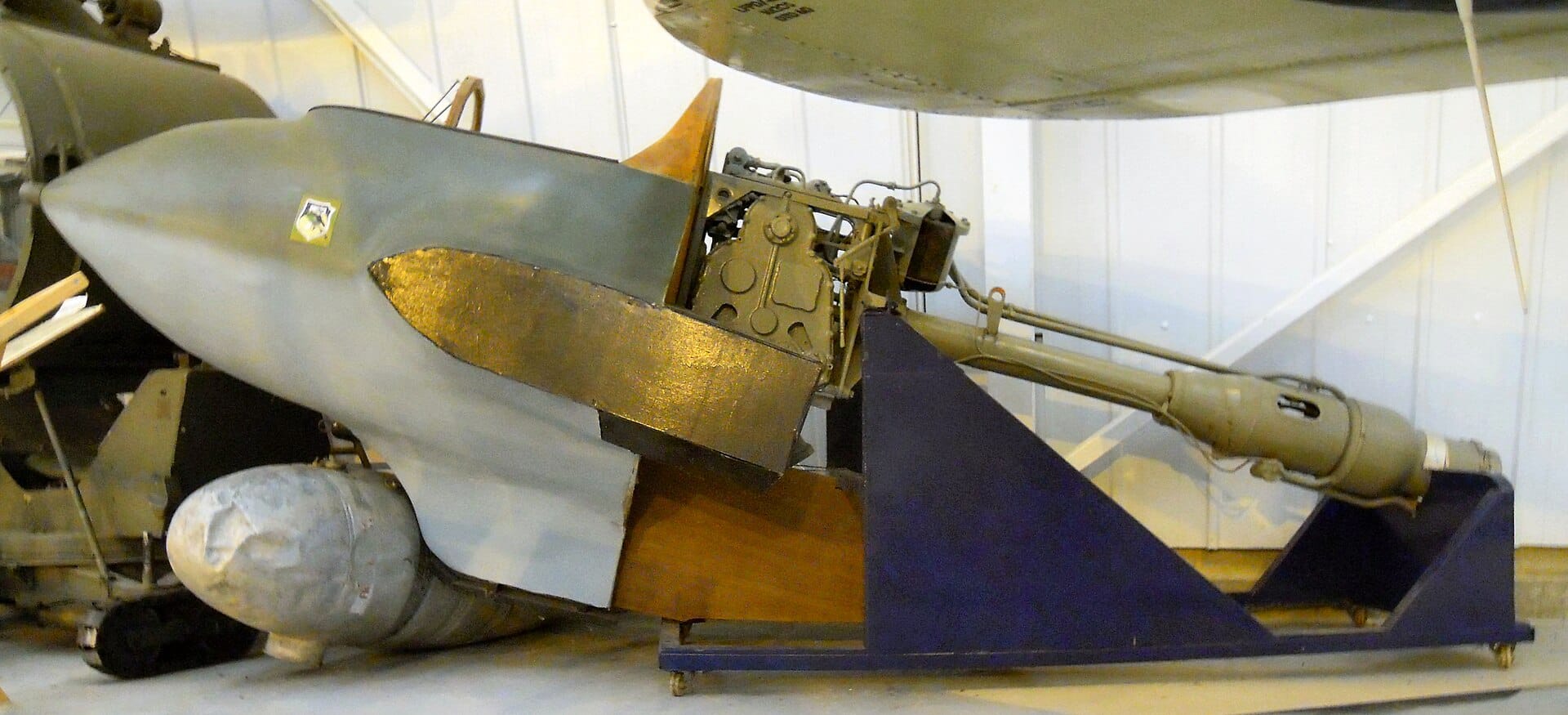
The Walter engine burned C-Stoff — a blend of methanol, hydrazine hydrate and water — in the oxygen-rich exhaust of decomposing T-Stoff, hydrogen peroxide concentrated to around 80 percent. The two liquids were hypergolic: touch them together and they ignited instantly, no spark required. Ground crews used separate, dedicated tanker trucks for each chemical, and one truck had to leave the area before the other approached. Even traces mixing in a drain could explode, and Komets were occasionally destroyed on the tarmac while simply being fuelled.
T-Stoff had a second property that gave the Komet its grim reputation: it spontaneously ignited anything organic — and dissolved flesh. Pilots flew in special protective suits of rubberized fabric, sitting between two auxiliary T-Stoff tanks holding some 120 litres (32 US gallons) of oxidizer, one on each side of the cockpit.
The warning was not theoretical. In late 1943, Luftwaffe ace Josef Pöhs was killed when a failed takeoff ruptured a fuel line; the official account attributes his death to T-Stoff exposure combined with his injuries. Hard landings on the skid were notorious for rupturing residual propellant lines, and a Komet that flipped or somersaulted with anything left in its tanks usually exploded.
The landing itself was an emergency waiting to happen. After burning its propellants the Komet became a glider — one approach, no go-around, ending on a sprung metal skid. If the skid mechanism failed or the touchdown was hard, the impact could compress the pilot's spine; back injuries were a recurring cost of flying the type.
Seven and a Half Minutes of Thunder
A combat scramble in the Komet was violent from the first second. The aircraft lifted off its dolly at over 320 km/h (200 mph), accelerated in level flight to around 676 km/h (420 mph), then pulled into a 70-degree climb that no Allied pilot could follow — 12,000 m (39,000 ft) in roughly three minutes. At altitude it levelled off and accelerated to around 880 km/h (550 mph).
Then the clock ran out. The engine's maximum powered endurance was about 7.5 minutes — far short of what its designers had projected. Everything after that was gliding: one or two firing passes through the bombers, then a long, silent, defenceless descent back to base, where Allied fighters learned to loiter and pick the Komets off in the landing pattern.
Test pilot Rudolf Opitz, who delivered one of the first combat Komets to the fighter wing, discovered that even friendly airfields were a hazard — he recalled that when he zeroed in on the field for a high-speed low pass, “long strings of tracer bullets came at me from all sides.” The flak crews had never seen anything move that fast, and assumed it had to be hostile.
Against the Bomber Streams
The Luftwaffe formed its only rocket fighter wing, Jagdgeschwader 400, at Brandis near Leipzig, positioned to defend the Leuna synthetic fuel works — one of the most heavily bombed targets in the Reich. The type's first regular combat interception came on 28 July 1944, when two Komets attacked B-17s without scoring. What the escort commander, Colonel Avelin P. Tacon Jr., reported that day set the tone for every Allied encounter that followed.
Yet the same speed that made the Komet untouchable made it nearly useless as a gun platform. Its two 30 mm MK 108 cannons had a low muzzle velocity and were accurate only at short range, and it typically took four or five hits to bring down a B-17. With closing speeds of hundreds of kilometres per hour, the firing window lasted about a blink.
The best rocket pilot of the war, Feldwebel Siegfried Schubert, solved the problem by sheer marksmanship — three bombers, including a B-17 reportedly downed with just three rounds. His end says everything about the aircraft: on 7 October 1944, hours after his final kill, his engine cut out on takeoff, a wingtip caught the grass, and his Komet somersaulted and exploded.
The final ledger is disputed at the margins but damning in every version. The Komet is credited with between 9 and 18 Allied aircraft destroyed — nine confirmed kills is the commonly cited figure — against roughly ten lost in combat. And through the end of 1944, JG 400 had lost only six aircraft to enemy action but nine to accidents and other causes. The pattern held to the end: the Komet killed more of its own than the enemy did.
The Failure That Pointed at the Future
As a weapon, the Komet was a failure — a vast engineering effort for a handful of bombers, flown by pilots who risked being dissolved, blown up or spine-crushed before ever seeing the enemy. Fuel shortages kept most of the roughly 370 aircraft grounded, and in the last winter of the war the Americans learned they could simply route their bomber streams around Brandis.
As a machine, though, it was a decade ahead of its time. Its speeds went unmatched by jets until the 1950s; Japan license-developed it as the Mitsubishi J8M; and captured Komets were studied intently by the victors — Royal Navy test pilot Eric Brown made a point of flying one under power. Germany's other last-ditch rocket interceptor, the vertically launched Bachem Ba 349 Natter, was even more radical and even less successful, while the Soviets had tried the concept as early as 1942 with the BI-1.
Today about ten Komets survive in museums, small enough to park under a bomber's wing. Standing next to one, the idea feels absurd: a wooden-winged egg, full of chemicals that eat people, built to sprint at the speed of a modern airliner and glide home in silence. In 1944, for seven and a half minutes at a time, it was the fastest thing in the sky.
Sources: Wikipedia, Aviation History / HistoryNet (Don Hollway), Smithsonian National Air and Space Museum, Warfare History Network
Domande correlate
What was the Messerschmitt Me 163 Komet?
The Messerschmitt Me 163 Komet was a German rocket-powered interceptor of World War II, the only rocket fighter ever to reach operational service. Powered by a liquid-fuel rocket, it could climb to 12,000 metres in about three minutes and reach roughly 960 km/h, far faster than any Allied fighter. Around 370 were built.
How fast was the Me 163 Komet?
The Me 163 Komet reached about 960 km/h (600 mph) in service and set a record of 1,130 km/h (702 mph) in a July 1944 test flight, at a time when the best Allied fighters struggled to reach 700 km/h. It could climb to 12,000 metres in roughly three minutes, out-running and out-climbing anything in the sky.
Why was the Me 163 dangerous to its own pilots?
The Me 163 was lethal to its pilots because it flew on two hypergolic propellants, T-Stoff (concentrated hydrogen peroxide) and C-Stoff (a methanol-hydrazine mix), that ignited on contact and could dissolve or burn a pilot. Hard landings could trigger explosions, and its unpowered glide back to base left it defenceless, making it one of the war's most hazardous aircraft, rivalling the later Caccia stellare F-104.
How long could the Me 163 fly under power?
The Me 163 Komet had only about 7.5 minutes of powered flight before its rocket fuel ran out. After that it became a glider, coasting back to base without power and landing on a skid. This tiny endurance meant it could make just one or two firing passes at Allied bombers before being forced to disengage.
What armament did the Me 163 carry?
The Me 163 Komet was armed with two 30 mm MK 108 cannon. These hit hard but had a slow rate of fire and short range, and the Komet's extreme closing speed gave pilots only a fraction of a second to aim at Allied bombers. It was credited with roughly 9 to 18 kills for about 10 combat losses.
Who designed the Me 163 Komet?
The Me 163 Komet grew from the tailless designs of Alexander Lippisch, a German pioneer of the flying-wing concept. His record-setting gliders evolved into the DFS 194 research aircraft, which was mated with a rocket engine to create the Komet. Germany's late-war desperation also produced rushed designs like the He 162 Volksjäger.
0 Commenti