

On the afternoon of 26 July 1959, Marine Lt. Col. William Rankin was cruising at 47,000 feet when his fighter’s single engine died with a grinding shudder. He reached up, pulled the ejection handles, and blew himself out of the cockpit into air nearly sixty degrees below zero — with no pressure suit and a thunderstorm boiling directly beneath him.
What happened next made him the only person known to have fallen all the way through a thunderstorm and lived.
Informazioni rapide
- Pilota: Lt. Col. William H. Rankin, U.S. Marine Corps
- Data: 26 July 1959
- Aeromobili: Vought F-8 Crusader (single-engine fighter)
- Ejection altitude: About 47,000 feet, with no pressure suit
- Time in the storm: Roughly 40 minutes — a normal descent takes under 10
- Landed: In trees near Ahoskie, North Carolina
Out of the cockpit at 47,000 feet
Rankin was leading a pair of F-8 Crusaders up the Carolina coast, climbing over a wall of cumulonimbus, when the engine let go. At that altitude, ejecting without a pressure suit is its own emergency. The instant he hit the minus-58-degree air, his body began to fail: decompression swelled his stomach and started him bleeding from his ears, nose and mouth. His left glove was ripped away, and his bare hand froze.
He fell. His parachute was set to open low, but the wild pressure swings inside the storm tripped its barometric release far too early — and instead of drifting down, Rankin was seized by the storm.
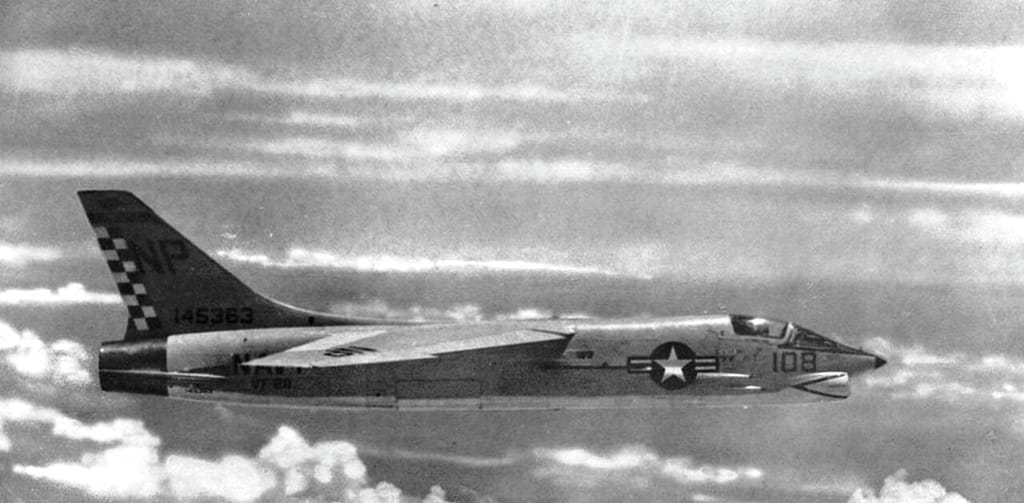
Riding the thunder
A violent updraft filled his canopy and rocketed him thousands of feet back upward at close to 100 mph. Hailstones formed in the air around him. Lightning cracked so near that it lit the parachute like a flashbulb and, for a moment, convinced him he had died.
The thunder did not so much sound as hit him. Then came the rain — so dense it fell from every direction at once.

Each updraft was followed by a downdraft that collapsed his parachute like a wet blanket and dropped him into free fall. Somehow, again and again, the canopy re-inflated. The storm tossed him up and down for some forty minutes — a descent that should have lasted less than ten.
Down in Ahoskie
At last the storm spat him out. He came down through trees near the small town of Ahoskie, North Carolina, battered, frostbitten and bleeding, and staggered to a road. A passing driver stopped, took one look at him, and drove him to a country store to call for an ambulance.
Rankin recovered from the frostbite, welts and decompression and went back to flying. He wrote a book about the day, The Man Who Rode the Thunder, and lived until 2009. No one else, before or since, is known to have survived a fall through the heart of a thundercloud.
Sources: William Rankin, “The Man Who Rode the Thunder”; Task & Purpose; Damn Interesting; kottke.org; Wikipedia.

0 Commenti