
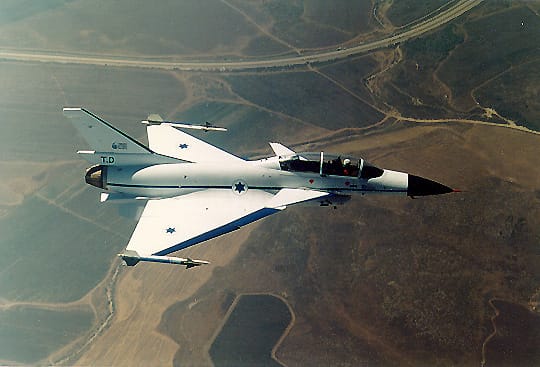
On the last day of 1986, a sleek new fighter lifted off from a runway in Israel and climbed into a clear desert sky. It handled beautifully. It was, by many accounts, world-class. Eight months later, its own government voted to kill it — by a single vote.
The story of the IAI Lavi is not really a story about engineering. It is a story about money, allies, and the painful arithmetic of a small country trying to build a great fighter with someone else's checkbook.
Informazioni rapide
- Tipo: Single-engine, canard-delta multirole fighter
- Produttore: Israel Aircraft Industries (IAI)
- Primo volo: 31 December 1986
- Annullato: 30 August 1987, by a 12–11 cabinet vote
- Cost by then: Around $1.5 billion, much of it US-funded
- Conseguenze: Israel bought 90 F-16s instead; ~1,500 program engineers affected
The little lion
Lavi means “lion cub” in Hebrew, and the ambition behind it was anything but small. Israel wanted its own front-line fighter — a single-engine, canard-delta multirole jet built around Israeli avionics and combat experience, designed to replace ageing attack aircraft and reduce dependence on foreign suppliers. The Lavi that flew in December 1986 was a genuinely modern machine, and the engineers who built it were rightly proud.
The rise and fall of the IAI Lavi.

Paid for by the people who killed it
Here was the trap. Much of the Lavi's development was financed by American military aid. As costs climbed, Washington came to a blunt realisation: it was bankrolling a jet that would compete with its own F-16 on the export market. The United States lobbied hard for cancellation, reportedly offering compensation to soften the blow.
Inside Israel, the fight was bitter. Thousands of jobs and enormous national pride were on the line against the cold economics of a program that kept getting more expensive. On 30 August 1987, the cabinet voted 12 to 11, with one abstention, to cancel the Lavi. A single vote ended Israel's home-grown fighter, and roughly 1,500 engineers on the program faced layoffs. Israel bought 90 F-16s instead.
Why Israel abandoned its own fighter.

The lion that never roared
The Lavi's legacy is tangled. The engineering talent and avionics know-how did not disappear; they flowed into Israel's world-leading defence-electronics industry, into satellites, drones and upgrades. Israeli technology has also frequently been linked to China's J-10, though the true extent of any transfer remains disputed.
What is certain is the human cost and the wound to national pride. The Lavi remains Israel's great what-if — a superb aircraft that flew, proved itself, and was grounded forever not by any flaw of its own, but by the politics of the alliance that made it possible in the first place.
Sources: Wikipedia (IAI Lavi); UPI Archives; 19FortyFive; Tablet Magazine; The Aviation Geek Club.
0 Commenti