
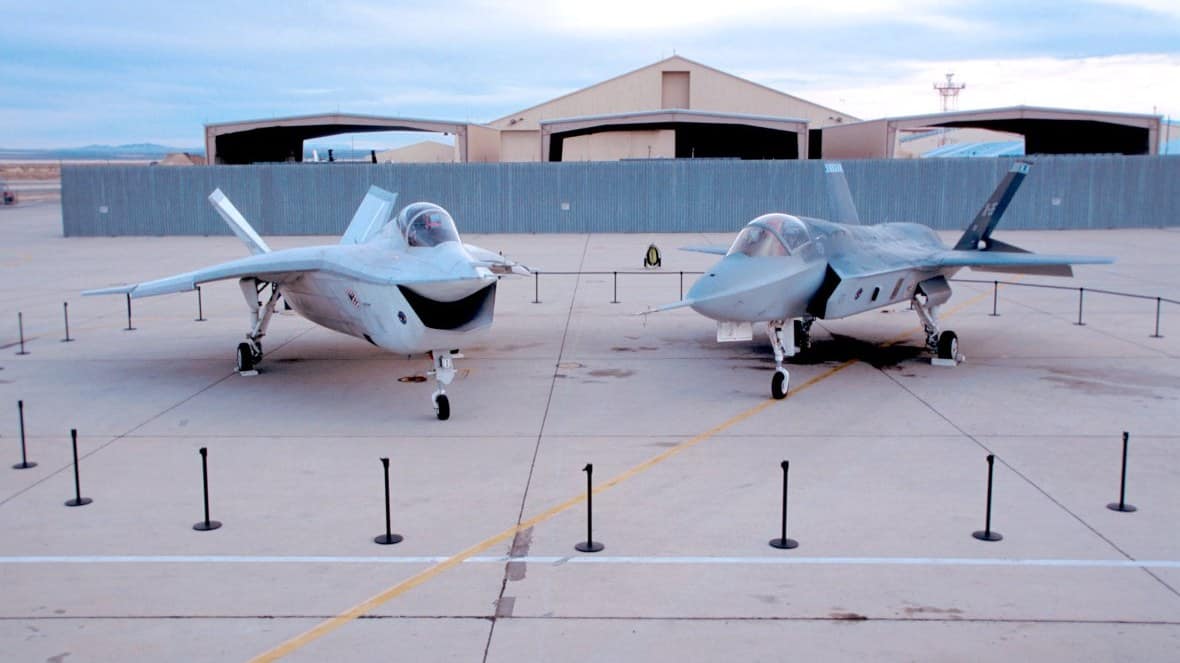
On the afternoon of Friday, 26 October 2001, the Pentagon’s acquisition chief, Edward “Pete” Aldridge, stepped up to a podium in Washington. Three thousand kilometres away, Boeing chairman Phil Condit and his Joint Strike Fighter boss, Frank Statkus, gathered around a television with their team. In Fort Worth, Texas, thousands of Lockheed Martin workers did the same. “We are here today to announce the largest acquisition program in the history of the Department of Defense,” Aldridge began. “The value of the program could be in excess of two hundred billion dollars.”
Five years of flying, fifteen years of studies and two of the strangest-looking aircraft ever built had come down to this sentence. The Joint Strike Fighter would be one aircraft, in three versions, for the US Air Force, Navy, Marine Corps and Britain’s Royal Navy and RAF — and one company would build all of it. Winner take all.
Quel pomeriggio, in una stanza, la gente piangeva di gioia. Nell'altra, un uomo pose al suo presidente una domanda di cui già conosceva la risposta. Questa è la storia dell'X-32, dell'X-35 e della più grande scommessa nella storia dell'industria aeronautica.
Dati rapidi: X-32 vs X-35
| Concorrenza | Joint Strike Fighter concept demonstration, 1996–2001 |
| Contendenti | Boeing X-32A/B contro Lockheed Martin X-35A/B/C |
| Differenza chiave | Boeing’s direct lift vs Lockheed’s shaft-driven lift fan for vertical landing |
| Primo volo dell'X-32A | 18 September 2000 — Fred Knox |
| Primo volo dell'X-35A | 24 October 2000 — Tom Morgenfeld |
| Decisione | 26 October 2001 — Lockheed Martin wins it all |
| Quindi la posta in gioco | Oltre 1.000 miliardi di dollari; circa 3.000 aerei per Stati Uniti e Regno Unito. |
| Eredità | IL F-35 Lightning II — flown today by around 20 nations |
Un combattente per tutti
The idea behind the JSF was seductive and slightly mad: replace the F-16, IL A-10, IL F/A-18 e il Harrier — four wildly different aircraft doing wildly different jobs — with variants of a single affordable stealth fighter. The Air Force needed a conventional jet, the Navy a beefed-up carrier version, and the Marines and the Royal Navy something that could land vertically like a Harrier without the Harrier’s habit of killing its pilots.
In November 1996 the Pentagon picked Boeing and Lockheed Martin to build two demonstrators each and settle it in the air. McDonnell Douglas, the company that had built the F-4 e il F-15, was eliminated — a shock that helped push it into Boeing’s arms a year later. The fly-off would be filmed from the inside by a NOVA documentary crew, which is why we know exactly what it looked like when the axe fell.
Sollevamento diretto contro ventilatore di sollevamento
The whole competition turned on a single engineering question: how do you make a supersonic stealth fighter hover? Boeing chose direct lift — point the engine’s thrust downward through swivelling nozzles, as the Harrier does. It is simple, proven and light, and it let Boeing build one airframe concept for all three variants.
Lockheed Martin gambled on something nobody had ever flown: a shaft-driven lift fan. In the X-35B, the engine drives a huge horizontal fan behind the cockpit, which blasts cool air downward while the main nozzle swivels aft — nearly doubling the lifting thrust and avoiding the searing-hot recirculating exhaust that plagues direct-lift designs. BAE test pilot Simon Hargreaves, who would fly the first hover, was frank about the risk: “Nobody’s ever tried to model a propulsion system that’s quite as complex as this … quite as integrated as this.”
Simple and proven against complex and revolutionary. On paper, Boeing’s approach should have won. In the air, physics had other ideas.

Monica e la riprogettazione di metà gioco
Let us address the intake in the room. The X-32’s enormous chin-mounted inlet and portly one-piece delta wing made it, by broad consensus, one of the least beautiful fighters ever flown — crews at Boeing itself took to calling it “Monica,” after the White House intern then dominating the news. Statkus was proud of that wing, “built as one piece from tip to tip,” and fighter pilots are not supposed to care about looks. They do, though.
The deeper problem was that Boeing was flying one aeroplane and selling another. When the Navy’s manoeuvring and payload requirements tightened mid-competition, Boeing redesigned its production aircraft with a conventional tail — but the demonstrators were already built in the old delta shape. The Pentagon would be asked to buy a fighter that existed only in briefing slides.
E il decollo diretto portava con sé la sua vecchia maledizione: i gas di scarico caldi che rimbalzavano sulla pista e tornavano indietro nel motore. Durante i test di atterraggio verticale a Patuxent River, l'X-32B dovette fare i conti con l'ingestione di gas caldi, e la Boeing rimosse pannelli e parti dal velivolo per alleggerirlo in vista delle dimostrazioni di volo stazionario. Ogni chilogrammo rimosso rappresentava un argomento che la Lockheed avrebbe poi utilizzato a proprio vantaggio.
Missione X
Lockheed’s campaign had begun with a whoop. “We’re airborne, gang, and it’s flying great,” chief test pilot Tom Morgenfeld radioed as the X-35A lifted off on 24 October 2000. But the knockout came the following summer with what the team called Mission X: on 20 July 2001, the X-35B took off in under 500 feet, dashed to supersonic speed, and returned to land vertically — the first aircraft in history to do all three in a single flight.
Hargreaves brought it down onto the pad as if he had done it for years. “That’s beautiful, no problems at all,” he called. The lift fan — the crazy, complex, never-before-flown lift fan — worked. Boeing’s demonstrators had done everything asked of them, but they had done it in pieces. Lockheed had done it in one afternoon, on camera.

La busta, per favore
Which brings us back to 26 October 2001, and two rooms in front of two televisions. After Aldridge’s preamble, Air Force Secretary James Roche read the verdict.
In Fort Worth, pandemonium. In Seattle, Statkus turned to his chairman: “Is it a winner-take-all, Phil?” “At this point the answer is yes,” Condit replied, “that this decision they’ve held to is a winner-take-all.” When Statkus tried to apologise, Boeing vice chairman Harry Stonecipher cut him off: “No, you did a great job. I don’t know what we missed.”
What they had missed, most analysts concluded, was the lift fan — the performance margin and growth potential it promised — and the confidence gap created by Boeing’s mid-competition redesign. The contract that followed was worth about 19 billion dollars for development alone, with some 200 billion projected behind it.
Il sistema "il vincitore prende tutto" era una scelta saggia?
A quarter of a century later, the question has teeth. The F-35 became everything the JSF promised operationally — and a cautionary tale industrially: years late, far over its original budget, with a lifetime cost the US government now puts above two trillion dollars. With no competing production line, there was no plan B and precious little pricing leverage. Some veterans of the programme argue a split buy would have cost more per jet but bought insurance; others note the whole point of JSF was that America could no longer afford two of everything.
The verdict also reshaped the industry itself. Boeing, shut out of the fighter business at a stroke, did not field another new manned fighter design for a generation — until March 2025, when the US Air Force chose Boeing to build the F-47, its next-generation air dominance fighter. It took 24 years, but the loser of the last great fighter fly-off finally won the rematch.
Sources: PBS NOVA “Battle of the X-Planes” transcript, Wikipedia (Boeing X-32, Lockheed Martin X-35, Joint Strike Fighter program), Lockheed Martin news release (26 October 2001), The Seattle Times, Air & Space Forces Magazine, US GAO
Domande correlate
Qual era la competizione tra l'X-32 e l'X-35?
La competizione X-32 contro X-35 fu la dimostrazione del concetto Joint Strike Fighter, condotta dal 1996 al 2001, per scegliere un singolo caccia stealth per più forze armate statunitensi e per la Gran Bretagna. L'X-32 della Boeing volò contro l'X-35 della Lockheed Martin. La Lockheed vinse nell'ottobre del 2001 e il suo progetto divenne l'F-35 Lightning II, parte di una lunga linea di Gare di volo di aerei statunitensi.
Quale aereo ha vinto la competizione Joint Strike Fighter?
Il 26 ottobre 2001, l'X-35 della Lockheed Martin si aggiudicò la competizione Joint Strike Fighter, superando l'X-32 della Boeing. La vittoria, del valore di oltre 1.420 miliardi di dollari per circa 3.000 velivoli, garantì alla Lockheed uno dei più grandi contratti di difesa mai assegnati. Il progetto vincitore entrò in servizio come F-35 Lightning II, attualmente in dotazione a circa 20 nazioni.
Qual era la differenza tra l'X-32 e l'X-35?
La differenza principale risiedeva nel modo in cui i due velivoli ottenevano l'atterraggio verticale. L'X-32 della Boeing utilizzava la portanza diretta, scaricando la spinta dei motori verso il basso, mentre l'X-35 della Lockheed impiegava una ventola di sollevamento azionata da un albero dietro la cabina di pilotaggio. L'approccio con ventola di sollevamento dell'X-35 impressionò i valutatori e contribuì alla sua vittoria. L'X-32A effettuò il suo primo volo il 18 settembre 2000 e l'X-35A il 24 ottobre 2000.
Perché l'X-32 perse contro l'X-35?
L'X-32 della Boeing perse in gran parte perché il suo sistema di sollevamento diretto per l'atterraggio verticale era considerato meno performante e con un potenziale di crescita inferiore rispetto alla ventola di sollevamento azionata dall'albero della Lockheed. L'X-35 dimostrò prestazioni di decollo corto e atterraggio verticale più fluide. La posta in gioco riecheggiava altre competizioni di alto valore come la Guerra delle petroliere KC-X, dove sia l'ingegneria che la politica contavano.
Che fine ha fatto l'X-35?
L'X-35 è diventato l'F-35 Lightning II, una famiglia di caccia stealth in tre versioni per operazioni convenzionali, imbarcate e a decollo corto/atterraggio verticale. È ora in uso presso circa 20 nazioni e costituisce la spina dorsale della potenza aerea tattica occidentale, mentre sforzi più recenti come programmi di caccia di sesta generazione puntare al successo.
Quanto valeva il contratto per il Joint Strike Fighter?
Il contratto Joint Strike Fighter, assegnato nel 2001, aveva un valore superiore a 1.442 miliardi di dollari e prevedeva la fornitura di circa 3.000 velivoli agli Stati Uniti e al Regno Unito. Fu descritto come il più grande programma di acquisizione nella storia del Dipartimento della Difesa statunitense, una portata tale da rendere il confronto aereo tra l'X-32 e l'X-35 di portata insolitamente rilevante.
0 Commenti