
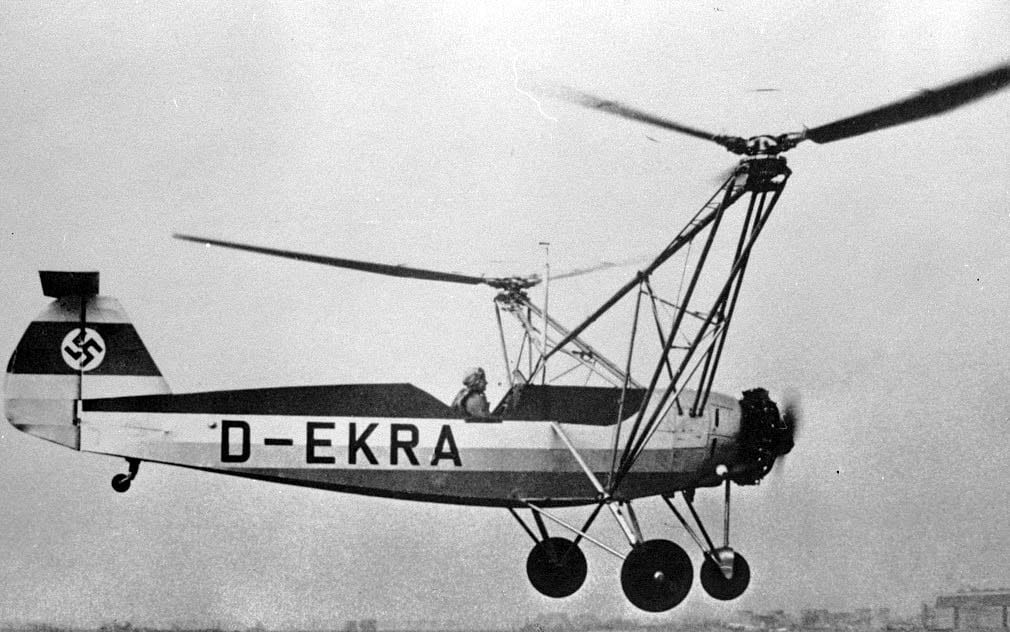
Picture the Deutschlandhalle in Berlin in February 1938. The arena is packed. Down on the floor sits a contraption that looks like a light trainer that has lost its wings and grown two enormous three-blade fans on outrigger struts. A slight young woman climbs into the open cockpit. The engine note rises, the rotors bite the air, and the machine simply lifts — straight up, no run, no ramp. It pivots on the spot, drifts backward and forward, and circles the hall before settling gently onto the boards.
That woman was Hanna Reitsch, and the machine was the Focke-Wulf Fw 61. What the crowd was watching was not a stunt in the ordinary sense. It was the first public proof that a helicopter could be flown with the same casual authority a pilot expects from an aeroplane. The engineering behind it, however, was anything but improvised.
- First free flight: 26 June 1936 at Bremen, test pilot Ewald Rohlfs
- Configuration: two three-blade rotors side-by-side on outriggers, turning in opposite directions to cancel torque
- Powerplant: one Bramo (Siemens) Sh 14A radial of about 160 hp; the small nose propeller only cooled the engine
- Designer: Professor Henrich Focke, whose firm Focke-Achgelis gave the machine its alternate name Fa 61
- Public sensation: flown indoors by Hanna Reitsch inside Berlin’s Deutschlandhalle in February 1938
- Records: it reached an altitude of 3,427 m and a straight-line distance of 230 km before the war
From autogyro licences to a powered rotor
The Fw 61 did not appear from nowhere. Professor Henrich Focke — Henrich, not Heinrich — had built Cierva autogyros under licence in Bremen, and from that work he drew a firm conclusion: the autogyro was a dead end. Its rotor was unpowered, freewheeling in the airflow, so it could not truly hover or climb vertically. The only way forward was a rotor driven directly by the engine. That is the definition of a helicopter, and Focke set out to build one.
A free-flying scale model flew successfully in 1934 and rose to some 18 metres; it survives today in the Deutsches Museum in Munich. On the strength of that promise the Reich Air Ministry ordered a full-size prototype in 1935. Rather than design a fuselage from scratch, Focke borrowed the well-proven airframe of the Focke-Wulf Fw 44 Stieglitz trainer and hung his rotor system onto it.
How the Fw 61 actually worked
This is the point most casual accounts get wrong, so it is worth stating plainly. The Fw 61 is a helicopter. Its lift came entirely from the two large rotors, each with three articulated blades, mounted on tubular-steel outriggers to the left and right of the fuselage. A single radial engine drove both of them through a system of gears and shafts. The rotors turned in opposite directions, and that counter-rotation cancelled the torque reaction that would otherwise have spun the whole aircraft around.
There is a second propeller, a small one, sitting conventionally in the nose. It is easy to assume that this is what pushed the machine along. It did not. Cut down to little more than the diameter of the engine cylinders, it existed purely to blow cooling air over the radial engine during the slow-speed and hovering flight where a nose radiator gets no natural airflow. Its forward thrust was negligible. Control came from the rotors alone.
First flight and the record book
With Ewald Rohlfs at the controls, the first prototype made its first free flight on 26 June 1936. It lasted under a minute, but it was enough. A second machine followed, and in May 1937 the type made its first landing by autorotation with the engine cut, a critical safety demonstration.
Then the records began. In June 1937 Rohlfs took the Fw 61 above 2,400 m and stayed aloft for well over an hour. In October 1937 Reitsch flew it 109 km in a straight line from Bremen to Berlin. The programme ultimately reached a straight-line distance of 230 km and an altitude of 3,427 m, comfortably eclipsing the earlier Soviet figures. These were genuine helicopter flights: Focke had to confirm as much, because sceptics abroad suspected the machine was secretly an autogyro.
Hanna Reitsch inside the Deutschlandhalle
The indoor flights were the idea of Ernst Udet, head of the Air Ministry’s technical branch, and the goal was legitimate: to prove before an international audience that the helicopter was completely controllable. Flying inside a closed hall leaves no margin. There is no wind to help, the air is turbulent and recirculating, and the walls are always close. Only a machine that answered its controls instantly, and a pilot who trusted it absolutely, could manage it.
Reitsch did, repeating the demonstration on successive evenings before audiences of many thousands, and newsreel footage of the little helicopter circling the arena travelled around the world. She herself was faintly embarrassed by the theatre of it, yet she grasped its reach only much later — a reminder that this quiet piece of engineering had become, for a moment, one of the most famous aircraft in the world.
What the Fw 61 was, and what came after
It is important not to confuse the Fw 61 with the machines that followed it. Only two were ever built, and both were pure experiments — single-seat testbeds for Focke’s ideas, not service aircraft. The promise of the design instead led to the much larger Focke-Achgelis Fa 223 Drache, a genuine transport helicopter of an entirely different scale. The side-by-side rotor layout that Focke proved on the Fw 61 ran straight through all of them.
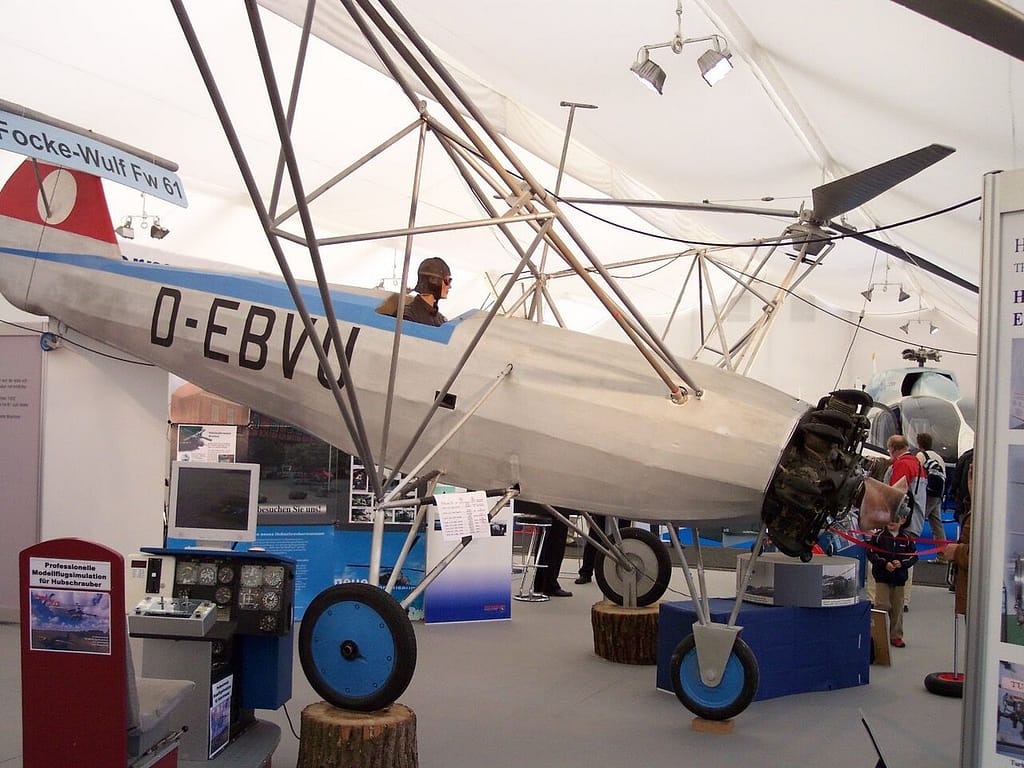
Neither original Fw 61 survived the war; a full-scale replica stands today in the German helicopter museum at Bückeburg. Before Igor Sikorsky’s VS-300 had properly left American soil, a German professor from Bremen had already built a helicopter that could hover, climb, land dead-stick, break records — and be flown, deliberately and calmly, between the walls of a crowded arena.
Sources: Wikipedia (Focke-Wulf Fw 61); Defense Media Network; aviastar.org; Hanna Reitsch, The Sky My Kingdom. (Context videos: Focke-Achgelis Fa 223 and Sikorsky R-4.)
0 Commenti