

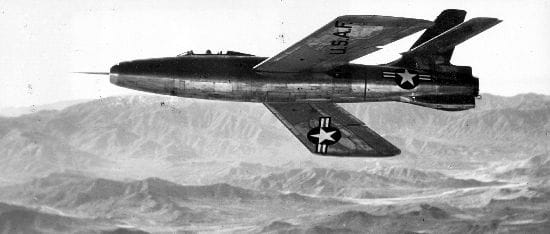
Picture a desert morning at Edwards in 1949: dust, sagebrush, and a fighter that looks like someone bolted the wings on the wrong way round. Most aircraft wings are fat where they meet the fuselage and slim to a graceful point at the tip. The Republic XF-91 Thunderceptor did the exact opposite. Its wings were narrow at the root and flared out toward the tips, like a paper dart drawn by an engineer with a grudge against convention. And that was before you noticed it carried a rocket in its belly.
This is the story of an interceptor built to do one job — get up high, very fast, and ruin a Soviet bomber's morning — and the brilliant, bizarre engineering Republic threw at the problem. It is also, gently, a story about timing, because the XF-91 was beaten not by a rival aircraft but by the calendar.
Informazioni rapide
| Tipo | Mixed-propulsion prototype interceptor (1 crew) |
| Primo volo | 9 May 1949, Carl Bellinger at the controls |
| centrale elettrica | 1× GE J47 turbojet + 1× Reaction Motors XLR11 rocket (~6,000 lbf) |
| Ala | Inverse-taper, variable-incidence — wider at the tip than the root |
| Velocità massima | Mach 1.49; up to ~Mach 1.71 with jet and rocket together |
| Costruito | 2 prototypes (46-680, 46-681); never entered production |
Why on earth build the wings backwards?
The XF-91 grew out of Republic's F-84 Thunderjet line, under chief designer Alexander Kartveli, who had been studying captured German research into rocket-boosted interceptors — the Me 163 Komet and the rocket-augmented Io 262 variants. The problem he was wrestling with was a nasty one: swept wings of the era tended to stall at the tips first. When that happens, the center of lift jumps forward, the nose pitches up uncommanded, and the aircraft can tumble out of the sky.
Kartveli's fix was audacious. Make the wing wider in chord at the tip than at the root, so the tips generate more lift and stall last rather than first, letting the whole wing let go smoothly like an old straight-wing trainer. As a bonus, the fat tips had room to swallow the main landing gear, which retracted outward into the wingtips on clever tandem twin wheels.
Then came the second trick: the entire wing could pivot. Tilt the incidence up for takeoff and landing, level it off for high-speed cruise — so the fuselage stayed roughly horizontal while the wing did the heavy lifting, giving the pilot a far better view over the nose.

Dark Skies tells the full story of the inverse-tapered interceptor.
A jet for the commute, a rocket for the kill
The other half of the Thunderceptor's personality lived in the tail. A General Electric J47 turbojet handled normal flying; for the climb and the firing pass, the pilot lit a Reaction Motors XLR11 — the same four-chamber liquid-fueled rocket family that pushed the Bell X-1 through the sound barrier — for roughly 6,000 pounds of additional thrust, with each chamber switchable on its own.
The numbers were genuinely startling for 1949. With the afterburning jet and the rocket both lit, the National Museum of the U.S. Air Force records a climb rate of nearly 30,000 feet per minute, and the aircraft could reach around Mach 1.71 in a dash. This was a machine designed to leap, not to loiter.
It is worth pausing on how strange the original concept was. The very first design even fed the rocket on liquid oxygen and water-alcohol, plumbing a research-rocket's fuel system into a fighter that was supposed to scramble at a moment's notice.
The Mach 1 claim — said carefully
Here is where you have to choose your words like a flight engineer. The first prototype, 46-680, rolled out on 24 February 1949 and made its maiden flight on 9 May with Republic test pilot Carl Bellinger at the controls, initially on jet power alone. Reheat and rocket flights followed, and in December 1951 it punched past the speed of sound.
The often-repeated headline is that the XF-91 was “the first American combat-type aircraft to exceed Mach 1 in level flight.” Treat that as a qualified claim, not gospel. The National Museum of the U.S. Air Force phrases it as America's first rocket-powered fighter to fly faster than sound; Wikipedia hedges it to “the first American fighter to exceed Mach 1 in level flight”; and historians note the milestone landed before the North American F-100 Super Sabre did the same on jet thrust alone. The honest summary: it was a genuine first, but the asterisk — rocket-assisted, prototype, level flight — matters.
It was not all triumph. In the summer of 1951 the second prototype suffered an engine failure on takeoff from Edwards; Bellinger got clear just as the tail burned away barely 90 seconds into the flight, and by the time the crash crew had driven across the dry lakebed, the tail section was ash.

Beaten by the calendar, not a dogfight
For all its cleverness, the Thunderceptor had a fatal, unglamorous flaw: it ran out of usefulness faster than it ran out of fuel. With a dash endurance measured in minutes, a point-defense interceptor like this could protect an airfield, not a continent. The U.S. Air Force did the math and decided to wait for the all-weather, radar-equipped, missile-armed interceptors coming out of the 1954 interceptor program — aircraft that beat the XF-91 on speed, range, and loiter time while it sat on the ramp.
So only two were ever built, and neither went to war. The second airframe was rebuilt with a butterfly V-tail, flew on as a test mule, then ended its days as a crash-crew training prop before being scrapped. The first prototype, 46-680, survived — and you can still find it today.
A walk through the Thunderceptor’s design and flight-test career.
The wing that lost the argument but won the legend
The XF-91 belongs to a special category of aircraft: the ones that were brilliantly, fearlessly wrong. The inverse-taper wing solved a real problem, and the legacy of that swept Republic wing carried straight into the production F-84F Thunderstreak. But the answer the Air Force actually wanted — long-legged, all-weather, missile-toting interceptors — made the whole rocket-fighter idea a beautiful dead end almost overnight.
And yet here we are, three-quarters of a century later, still talking about it. The Thunderceptor never shot anything down, never entered service, and never had to. Sometimes the aircraft that fails most interestingly is the one we remember best — the fighter that wore its wings on backwards, lit a rocket in the desert, and dared the future to catch up.
Sources: National Museum of the U.S. Air Force; Wikipedia; The Aviation Geek Club (Dario Leone), citing David Baker, “US Air Power 1945-1990 Vol. 1”.
Domande correlate
What was the Republic XF-91 Thunderceptor?
The XF-91 Thunderceptor was an experimental 1950s American interceptor with mixed propulsion — a jet engine plus a rocket motor — and unusual wings that were wider at the tip than at the root. It was the first US fighter to exceed the speed of sound in level flight.
Why did the XF-91 have backwards wings?
Its inverse-taper wing, wider at the tip than the root, was meant to cure the tip-stall problems of swept wings at low speed; the wing's angle could also be varied in flight. The unusual shape kept the tips flying when a conventional swept wing would have stalled.
How fast was the XF-91 Thunderceptor?
It reached about Mach 1.49 on its jet engine alone, and up to roughly Mach 1.71 with the jet and rocket firing together — making it the first US fighter to go supersonic in level flight.
What engines did the XF-91 use?
It combined a General Electric J47 turbojet with a Reaction Motors XLR11 rocket of around 6,000 lbf thrust. The jet gave normal cruising power while the rocket added a short, dramatic burst of speed and climb for intercepting bombers.
Why was the XF-91 never mass-produced?
It remained an experiment — only two prototypes were built. The mixed jet-and-rocket approach was complex and was quickly overtaken by more practical pure-jet interceptors, so the Thunderceptor never entered production.

0 Commenti