
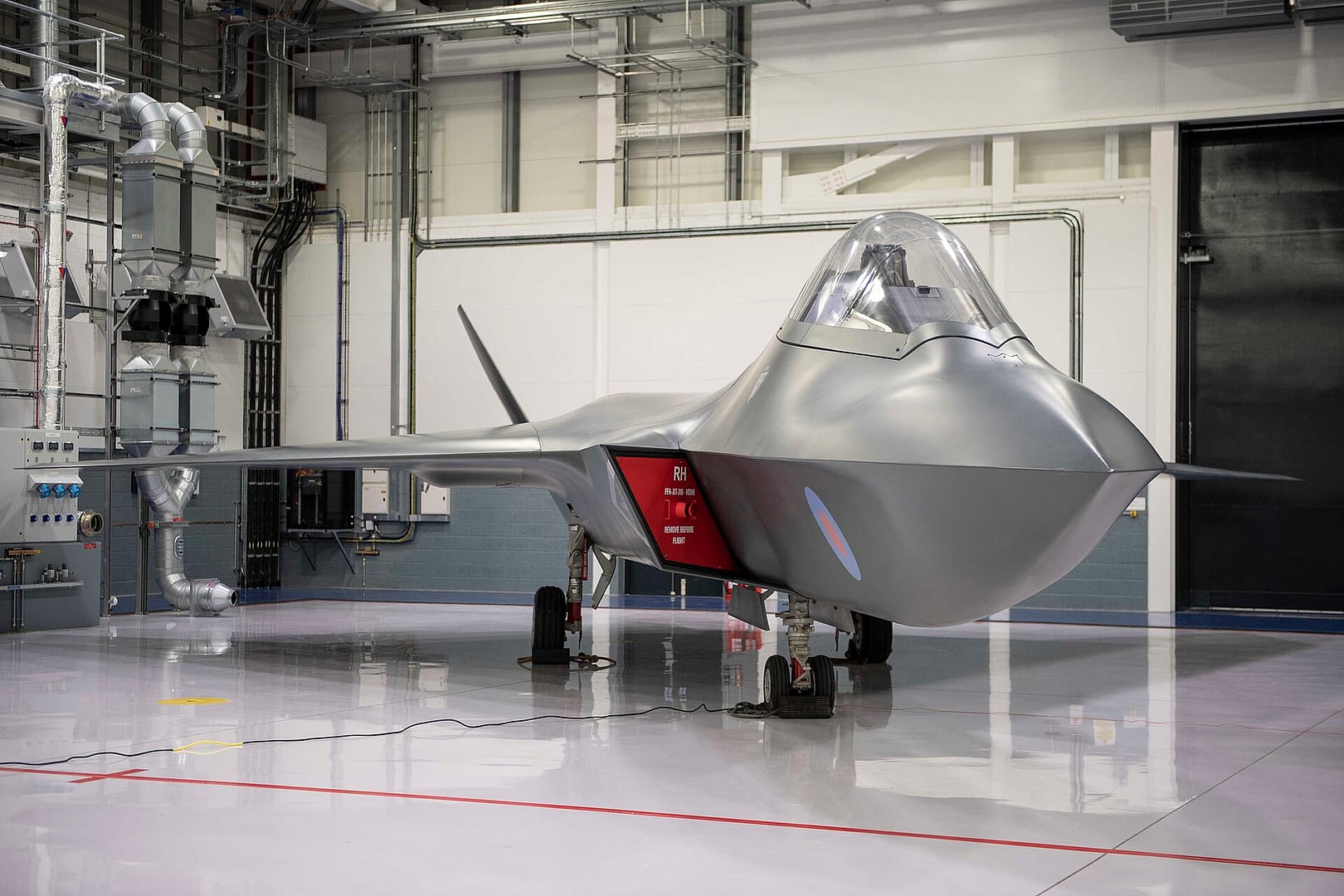
Parte di Ali di guerra: dagli Zeppelin alla sesta generazione, la nostra serie sui grandi punti di svolta dell'aviazione militare.
In August 2020, an experienced United States Air Force fighter pilot strapped into a simulator to dogfight an opponent he could not see, in a contest run by the Pentagon’s research agency. His opponent was not another pilot. It was a piece of artificial-intelligence software, built by a small company, that had taught itself air combat by fighting itself billions of times.
The machine destroyed him. Across five rounds, the AI shot the human down five times and was never once hit, flying with a cold, precise aggression — taking head-on gun shots no human would risk — that the pilot simply could not match. Four years later, the descendants of that software were no longer in a simulator at all: they were flying real dogfights in a specially modified F-16, with the Secretary of the Air Force riding in the cockpit to watch. The sixth generation of air power had announced itself — not as a new aircraft, but as a new kind of mind in the cockpit.
INFORMAZIONI RAPIDE
| Che cosa | The sixth-generation fighter — the most advanced combat aircraft now being built |
| Defining feature | Teaming with AI-piloted drones, and possibly flying with no pilot at all |
| The U.S. answer | The Boeing F-47, chosen in 2025; first flight expected around 2027–28 |
| The allies | Britain, Italy and Japan’s joint GCAP / Tempest, aimed at 2035 |
| The challenger | China, which has flown sixth-generation prototypes since 2024 |
| The casualty | Europe’s rival FCAS project, which collapsed in 2026 |
What makes a generation “sixth”
Fighter aircraft are sorted into “generations,” each a leap over the last. The fourth gave us agile jets like the F-16; the fifth added all-aspect furtività and sensor fusion in the F-22 and F-35. The sixth generation goes further in every direction — even deeper stealth, vast range, adaptive engines, and sensors woven into a single battle picture — but its truly revolutionary feature is not about the aircraft itself. It is about what flies alongside it, and who, if anyone, sits inside.
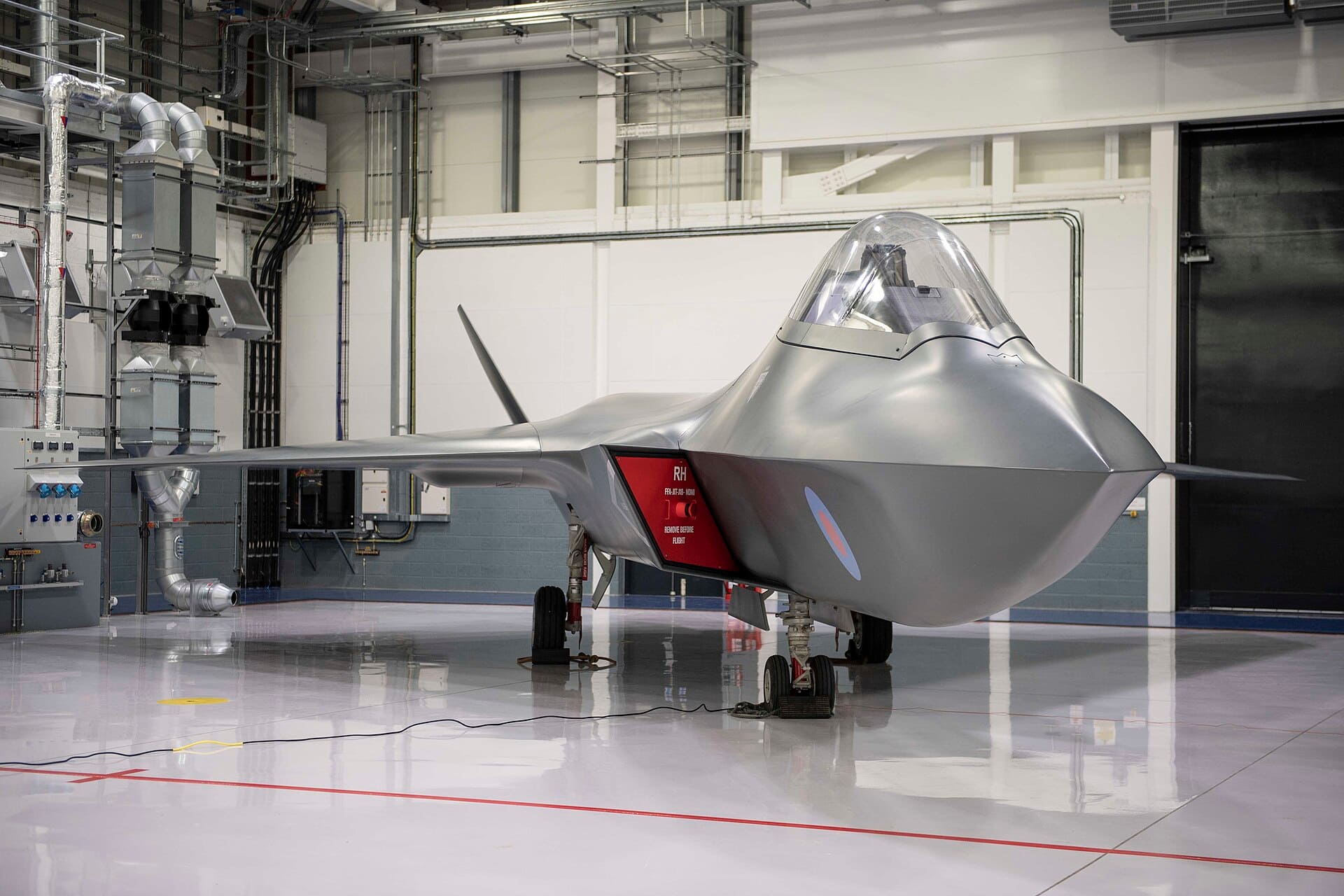
The man-machine team
The central idea of the sixth generation is teaming. A single crewed fighter acts as a quarterback, flying at the back of the fight and directing a flock of cheap, expendable, AI-piloted drones — called “collaborative combat aircraft” — into the most dangerous places. The drones scout, jam, soak up missiles and shoot, while the human makes the decisions. It multiplies one expensive pilot across many robot aircraft, and it changes the pilot’s job from flying the plane to commanding the mission.
This is no longer a sketch on a drawing board. The United States has already chosen companies to build the first batch of these “collaborative combat aircraft” — jet-powered, semi-autonomous drones meant to be cheap enough to lose, smart enough to fight, and built in far larger numbers than crewed fighters could ever be. The vision is a single piloted jet leading a small swarm of them into battle, the way a quarterback directs a team — and whoever masters that teamwork first may hold the same kind of edge that the synchronised gun once gave the Eindecker.

I contendenti
The race is global, and the field is already sorting itself out. The United States leads: in 2025 it chose Boeing’s design for its Next Generation Air Dominance fighter, naming it the F-47, with billions committed and a first flight targeted for the late 2020s — while the U.S. Navy pursues its own carrier-based sixth-generation jet.
Much of the design is being driven by geography. A future war in the vast distances of the Pacific would demand fighters that can fly much farther than today’s short-legged jets, carry more fuel and weapons, and operate from scattered, makeshift bases. That is pushing the sixth generation toward large, long-range aircraft — closer in size to a small bomber than to a nimble dogfighter — a very different animal from the fighters of the past century.
Close behind is a remarkable alliance: Britain, Italy and Japan have merged their efforts into a single programme, GCAP — known in Britain as Tempest — aiming for service around 2035, with a flying demonstrator already under construction. Europe’s other great hope, the Franco-German-Spanish FCAS, became a cautionary tale: torn apart by industrial rivalry between France and Germany, the project collapsed in 2026.
And then there is China, which stunned Western observers by flying not one but two large, tailless sixth-generation prototypes in late 2024, with more sightings since. After decades of catching up, China is now, by some measures, racing alongside the United States toward the next frontier — a long way from its current front-line stealth fighter, the J-20, shown below.

Will anyone be in the cockpit?
The deepest question the sixth generation raises is the oldest one in this series, turned inside out. For more than a century, the story of air power has been the story of pilots — from the Zeppelin-hunters to the aces to the astronauts of the SR-71. Now, for the first time, the aircraft may not need them. Sixth-generation fighters are being designed to be “optionally crewed”: able to fly with a pilot, or with no one at all. Europe is already rolling out its own robot wingmen, and every major power is wrestling with the same uneasy question — how much of the killing should be handed to a machine. For now, the stated rule almost everywhere is that a human must stay “in the loop” for any decision to take a life. But the pressure runs the other way: in a fight where missiles close in seconds and communications can be jammed, the side willing to let its machines decide for themselves may simply be faster. The most important contest of the sixth generation may turn out to be not between nations at all, but between human judgement and the speed of the machine.
That is where a century of military aviation has led: from a hydrogen airship drifting over England in the dark, to an artificial intelligence that out-flies its human teacher. The combattente that began with a gun fired through a propeller in 1915 is becoming something its inventors could never have imagined — and the next great turning point of air power may be the one in which the pilot finally steps out of the cockpit altogether.
POWERS COMPARED — THE SIXTH-GENERATION RACE
| Stati Uniti | The Boeing F-47 (Air Force) and a separate Navy fighter — the current front-runner |
| UK / Italy / Japan | GCAP / Tempest — a strong three-nation partnership aiming for 2035 |
| Cina | Tailless J-36 and J-50 prototypes flying since 2024 — a genuine surprise |
| Europe (FCAS) & Russia | FCAS collapsed in 2026; Russia’s effort lags well behind |
Sources: U.S. Air Force; DARPA; UK Ministry of Defence; standard reporting on the NGAD/F-47, GCAP, FCAS and Chinese sixth-generation programmes as of 2026.
| 1. | Il dirigibile in guerra | Come lo Zeppelin portò per la prima volta la guerra nei cieli |
| 2. | Il primo incarico: la ricognizione. | Gli occhi che vinsero la Marna e salirono in orbita |
| 3. | Il combattente | La centenaria ricerca del controllo dell'aria |
| 4. | Folkestone, 1917 | Il giorno in cui nacque il bombardamento strategico |
| 5. | La rivoluzione della precisione | Quando bombe e missili impararono a puntare da soli |
| 6. | La guerra dei maghi | Come la guerra elettronica ha imparato ad accecare il nemico |
| 7. | Occhi in orbita | Come lo spionaggio si è spostato nello spazio |
| 8. | furtività | Come gli aerei hanno imparato a scomparire dai radar |
| 9. | L'ascesa dei droni | Guerra senza pilota nella cabina di pilotaggio |
| 10. | La sesta generazione | Quando il caccia imparò a volare da solo |
0 Commenti