
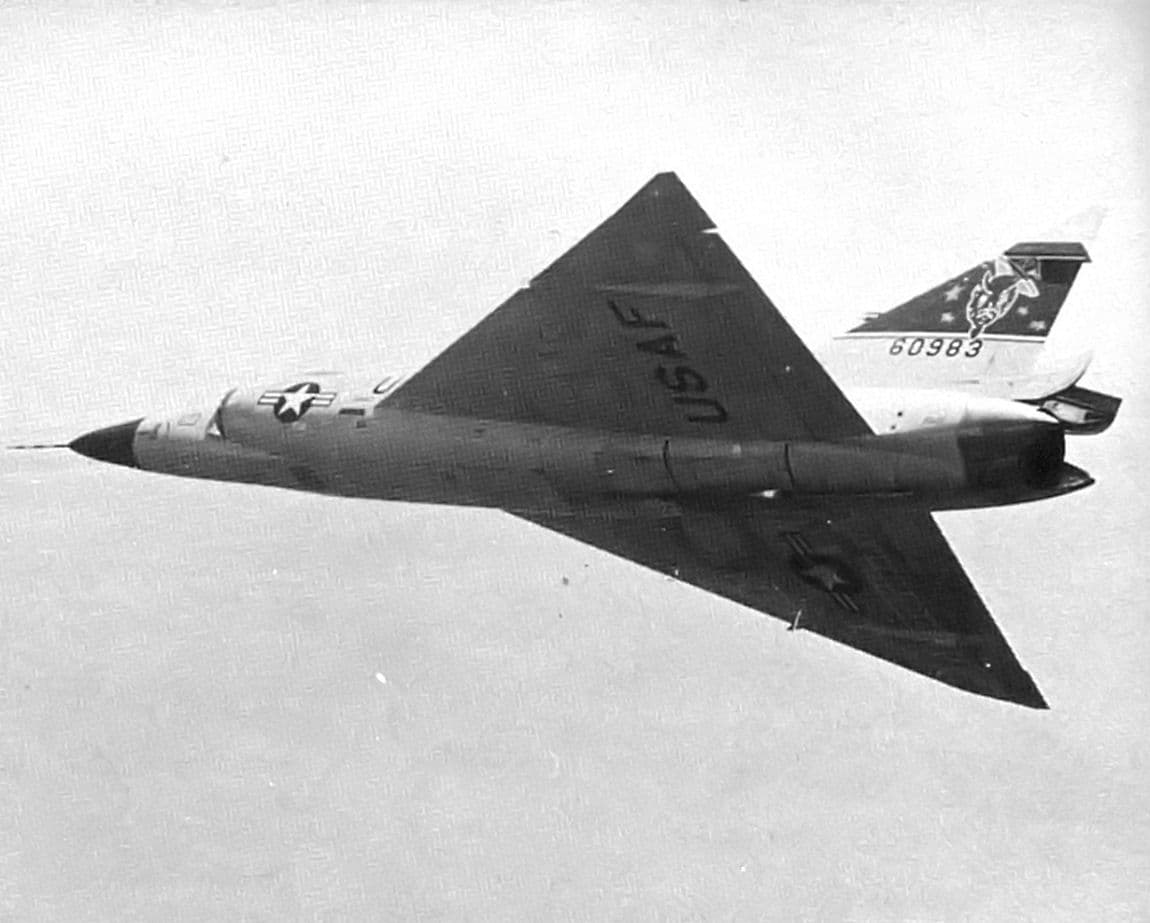
In the early 1950s, the newest, fastest jets in the world kept running into an invisible wall. They would accelerate beautifully — and then, just short of the speed of sound, a surge of drag would swallow their engines’ power and stop them dead. Brand-new fighters that looked supersonic on paper simply could not get there.
The fix came from a quiet NACA engineer named Richard Whitcomb, and it looked faintly ridiculous: pinch the fuselage in at the middle, so the aircraft is narrow-waisted, like a Coke bottle. It is one of the most important — and most counter-intuitive — ideas in the history of flight.
Chi: Richard T. Whitcomb, NACA Langley
Quando: 1952
The look: A pinched, “Coke-bottle” or “wasp-waist” fuselage
First proof: The Convair F-102 — which couldn’t go supersonic until it was area-ruled
Reward: Whitcomb won the 1954 Collier Trophy
The Wall at Mach 1
As an aircraft approaches the speed of sound, shock waves begin to form on its surfaces and a brutal kind of drag — wave drag — spikes upward. In the early 1950s this caught designers out. The Convair YF-102, a sleek new delta-winged interceptor meant to be supersonic, hit that wall and stuck stubbornly below Mach 1. It was an expensive embarrassment.
Whitcomb’s Insight
In 1952, working at NACA’s Langley laboratory, Whitcomb realised something subtle. The air rushing past a transonic aircraft does not really care about the fuselage and the wings as separate things — it responds to the total cross-sectional area of the whole machine, slice by slice along its length. To cut drag, that total area should grow and shrink as smoothly as a perfectly streamlined teardrop.
And that leads to the strange conclusion: where the wings suddenly add a lot of area, you have to take area away from the fuselage to keep the curve smooth. You pinch the waist. Hence the Coke bottle.

This short explainer shows the idea in motion:
The F-102 Proof
Convair rebuilt the F-102 to Whitcomb’s rule — a longer, area-ruled fuselage with the tell-tale wasp waist and added fairings near the tail. When the reworked YF-102A returned to Edwards in late 1954, it slipped past Mach 1 on its way to test altitude. Area ruling had effectively added around 25% more speed to the same airframe. For that, Whitcomb received the 1954 Collier Trophy, American aviation’s highest honour.
A Shape That Defined an Era
Once the secret was out, the Coke-bottle look spread across the supersonic generation — the F-106, the B-58 Hustler, the F-11 Tiger and many more wore the pinched waist with pride. The styling even bled into the car world, inspiring the “Coke-bottle” curves of 1960s muscle cars. Whitcomb, meanwhile, went on to give aviation two more gifts: the supercritical wing and the winglet.
It is a perfect engineering parable. The breakthrough that let aircraft finally beat the sound barrier did not come from more power or sleeker lines. It came from a man who looked at a jet and decided it needed a narrower middle — and was right.
Sources: NASA History (SP-4219); Air & Space Forces Magazine; Smithsonian Air & Space; Wikipedia (Area rule; Richard Whitcomb).
Domande correlate
What is the area rule in aircraft design?
The area rule is a design principle for cutting drag near the speed of sound. It says an aircraft's total cross-sectional area should change smoothly along its length, which often means pinching the fuselage where the wings join — giving a "Coke-bottle" or wasp-waist shape.
Why do some jets have a Coke-bottle shape?
The pinched, wasp-waist fuselage comes from the transonic area rule. Narrowing the body where the wings attach keeps the aircraft's total cross-section changing smoothly, which sharply reduces the wave drag that builds up as a plane approaches the speed of sound.
Who invented the area rule?
The transonic area rule was developed by Richard T. Whitcomb at NACA Langley in 1952. His insight let aircraft punch through the sound barrier far more easily, and he was awarded the 1954 Collier Trophy for it.
How did the area rule help break the sound barrier?
As aircraft near Mach 1, shock waves form and wave drag spikes. By reshaping the fuselage so total cross-sectional area varies smoothly, the area rule slashes that drag. The Convair F-102, which couldn't go supersonic at first, only succeeded once redesigned to the area rule.
What was the first plane to use the area rule?
The Convair F-102 Delta Dagger was the first practical proof. In its original form it couldn't break the sound barrier; after its fuselage was reshaped to the area rule with a pinched waist, it became supersonic — vindicating Whitcomb's theory.
0 Commenti