
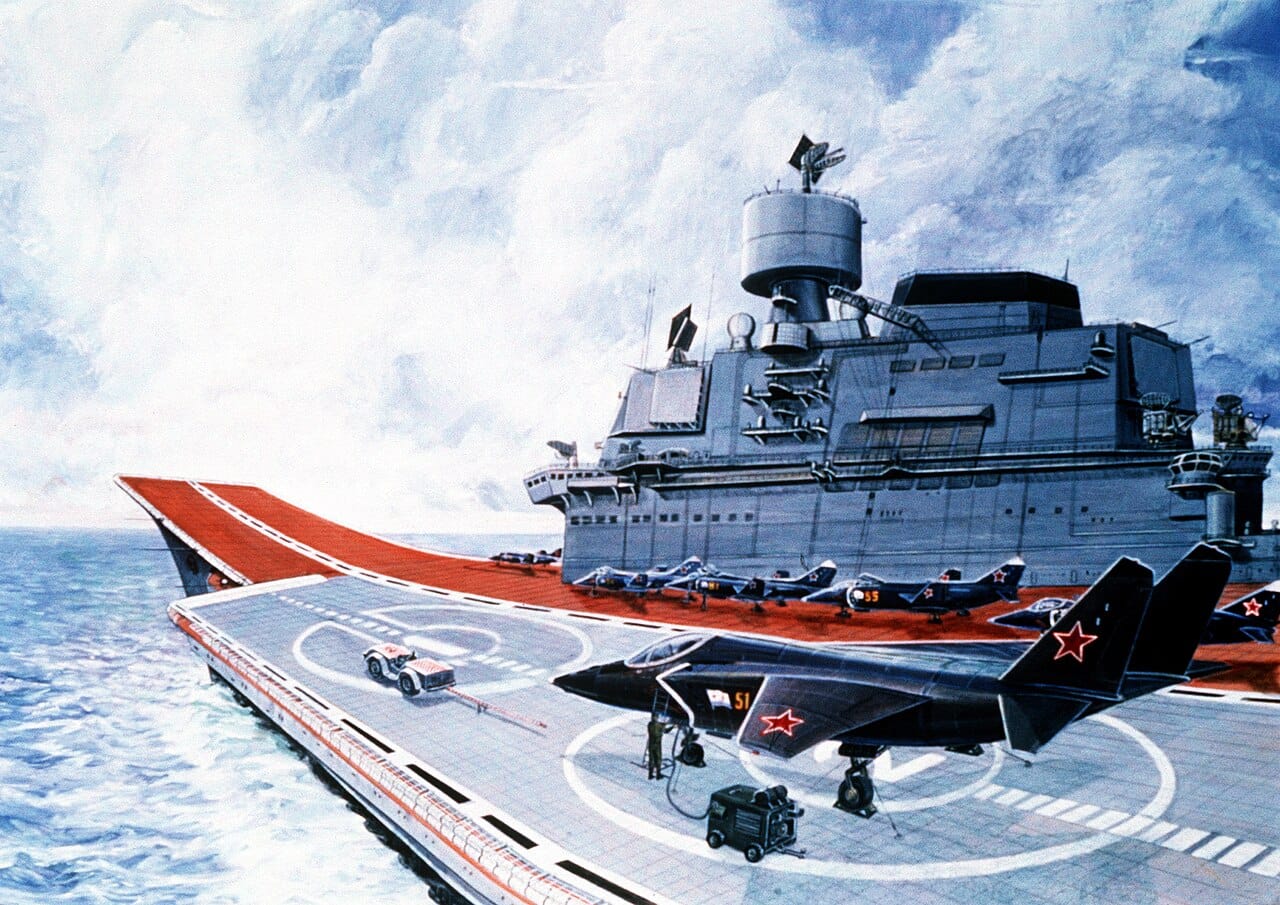
On a carrier deck in the northern autumn of 1991, a fighter unlike anything in the West rose straight up on pillars of flame, rotated its tail nozzle back to level, and accelerated away past the speed of sound. This was the Yakovlev Yak-141, NATO codename Freestyle: the world's first supersonic vertical-takeoff fighter, and a machine the collapsing Soviet Union could no longer afford.
The Freestyle was meant to replace the mediocre Yak-38 Forger. Where the Forger was slow and short-legged, the Yak-141 was built to fight: a single Tumansky R-79V-300 turbofan with a swivelling rear nozzle for thrust and cruise, plus two dedicated RD-41 lift jets tucked behind the cockpit to hoist the nose during vertical work.
INFORMAZIONI RAPIDE
| Tipo | Supersonic VTOL fleet-defence fighter |
| Primo volo | 9 March 1987 (first hover 1989) |
| centrale elettrica | 1 x R-79V-300 vectoring turbofan + 2 x RD-41 lift jets |
| Velocità massima | ~1,800 km/h (Mach 1.7) |
| Numero costruito | 4 prototypes |
| Records | 12 world records for its class |
| Destino | Cancelled 1991; nozzle tech influenced the F-35B |
Three engines, twelve records
That layout gave the aircraft three engines in total, digitally controlled, with puffer jets at the wingtips and nose for balance in the hover. It first flew conventionally in March 1987, first hovered in December 1989, and made its first full transition from vertical to horizontal flight in June 1990. Along the way it set a dozen world records for its class.
Then the money ran out. After a hard landing ruptured a fuel tank aboard the carrier in October 1991, the aircraft caught fire and the pilot ejected. Weeks later the cash-starved program was suspended for good, with only four prototypes ever built.
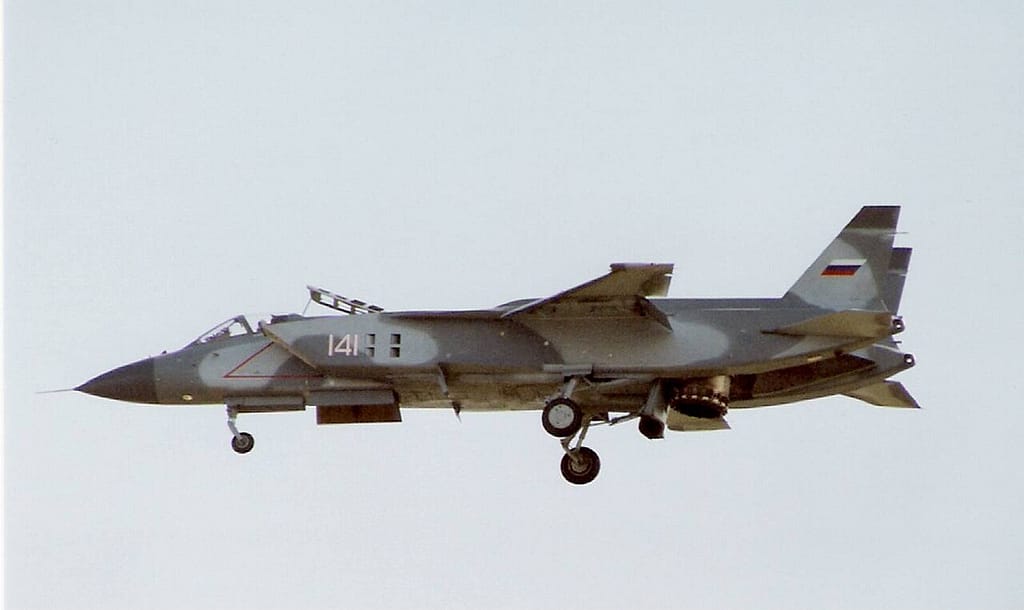
A second life in the West
Here the story takes its famous turn. With the Soviet Union gone, Yakovlev needed hard currency, and Lockheed needed VTOL know-how for the American Joint Strike Fighter contest. The two signed a partnership, and the surviving Freestyle was paraded at Farnborough in 1992.
The swivelling three-bearing exhaust nozzle that the Yak-141 pioneered found echoes in Lockheed's X-35, the aircraft that became the F-35B. The F-35 is emphatically not a copy, and it uses a shaft-driven lift fan rather than lift jets, but the Russian data mattered.
Today two Freestyles survive in Russian museums, olive-and-grey ghosts of a jet that was too advanced for the country that built it, and quietly influential in the country that beat it to the punch.
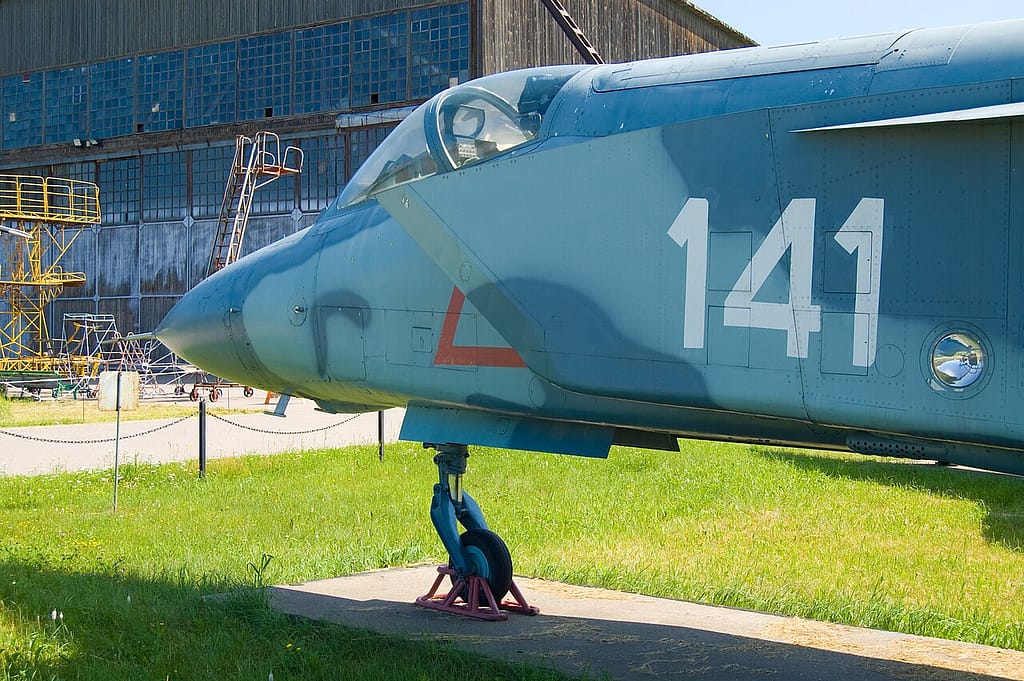
How a cancelled Soviet jump jet ended up shaping the F-35B:
Sources: Task & Purpose; Air Force Magazine (1998); Wikipedia.
0 Commenti