

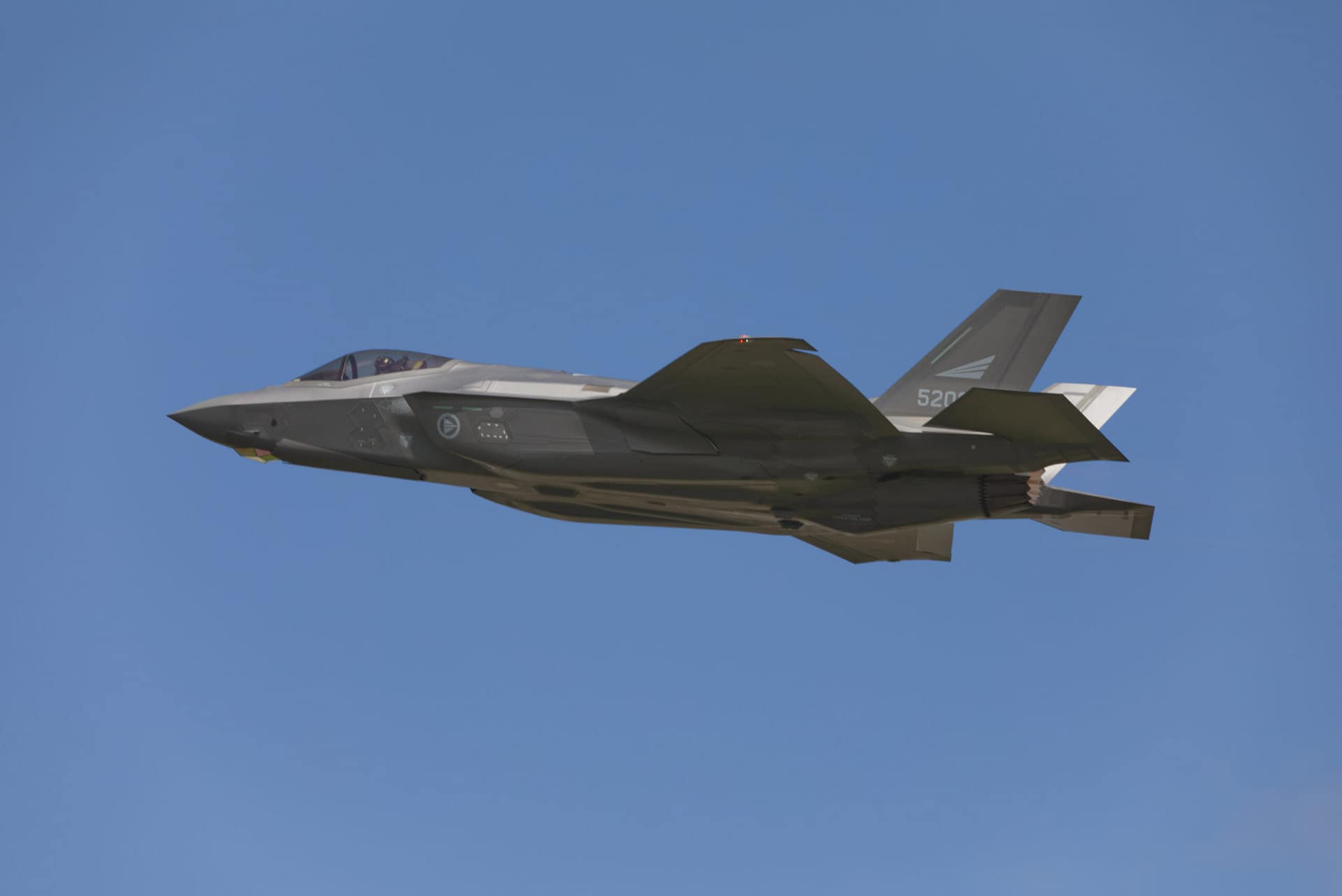
For all its sophistication, the F-35 has carried an awkward secret: it could not sink a ship without compromising the one thing it is famous for. Any missile big enough to threaten a modern warship had to hang under the wings — and the moment it does, the stealth fighter stops being stealthy. On 6 June 2026, the U.S. Air Force put real money behind the fix.
The Air Force awarded Norway’s Kongsberg a $240.9 million contract for a second production batch of the Joint Strike Missile — the AGM-184 — a weapon designed around a single, demanding constraint: it has to fit inside the F-35.
- The deal: the U.S. Air Force has awarded Norway’s Kongsberg a $240.9 million Lot 2 production contract for the Joint Strike Missile (JSM, designated AGM-184), announced 6 June 2026
- The trick: the JSM is the only long-range anti-ship/land-attack missile that fits entirely inside the F-35’s internal weapons bay — preserving its stealth
- Size: about 13 ft (4 m) long and 917 lb (416 kg)
- Range: more than 217 miles (350 km) at high subsonic speed
- Targets: both ships and land targets
- Built: in Norway, with production running through November 2028
A missile shaped by a bomb bay
Most missiles are designed for performance first and worry about how to hang them later. The JSM was designed the other way around. At about four metres long and 416 kilograms, every dimension is dictated by the internal weapons bay of the F-35A. It is the only long-range anti-ship and land-attack missile that the jet can swallow whole.
That restraint buys a genuine capability. With the JSM tucked inside, an F-35 can slip toward a hostile fleet without announcing itself on radar, release from beyond 350 kilometres, and let the missile do the dangerous part — a low, sea-skimming, weaving run that is designed to defeat a warship’s defences. The aircraft never has to trade away its stealth to make the shot.
A Norwegian answer to a Pacific problem
There is a neat irony here. The weapon that may matter most in the wide-open ranges of the Pacific was born in the fjords of Norway, evolved from Kongsberg’s Naval Strike Missile. Norway flew it first; Japan and Australia signed up for their own F-35 fleets; and now the U.S. Air Force is buying its second production lot, with manufacturing in Norway booked through late 2028.
It is a quiet, unglamorous procurement line in a defence budget — no new jet, no dramatic unveiling. But it removes one of the F-35’s most-discussed gaps. The stealth fighter can now hunt ships the way it was always meant to fight: from far away, and without ever being seen.
Sources: U.S. Air Force; Kongsberg Defence & Aerospace; FlightGlobal; The War Zone.
Related Questions
What is the Joint Strike Missile (JSM)?
The Joint Strike Missile, designated AGM-184, is a stealthy, long-range cruise missile made by Norway's Kongsberg. It can strike both ships and land targets, flies at high subsonic speed to ranges beyond 350 km, and is roughly 4 metres long and 416 kg — sized specifically to fit inside the F-35's weapons bay.
Why is it important that the JSM fits inside the F-35?
Because the F-35's stealth only works when its weapons are carried internally. Anything hung under the wings dramatically increases its radar signature. The JSM is the only anti-ship missile that fits entirely inside the F-35A's bay, so the jet can attack a warship from long range while staying stealthy — something it previously could not do with an internal weapon.
What did the June 2026 contract cover?
The U.S. Air Force awarded Kongsberg a $240.9 million Lot 2 production contract, announced on 6 June 2026. It covers operational missiles, their launch containers, test hardware and support equipment, with production continuing in Norway through November 2028.
How far can the JSM fly?
Kongsberg and the U.S. Air Force cite a range of more than 217 miles (350 km) at high subsonic speed. That lets an F-35 launch from well outside the reach of many shipborne air-defence systems, then let the missile fly a low, sea-skimming, evasive profile to its target.
Which countries use the JSM?
Norway developed it and is a launch operator, and Japan and Australia have selected it for their F-35 fleets. The June 2026 Lot 2 order brings the U.S. Air Force's own F-35A fleet firmly into the programme.
0 Comments