
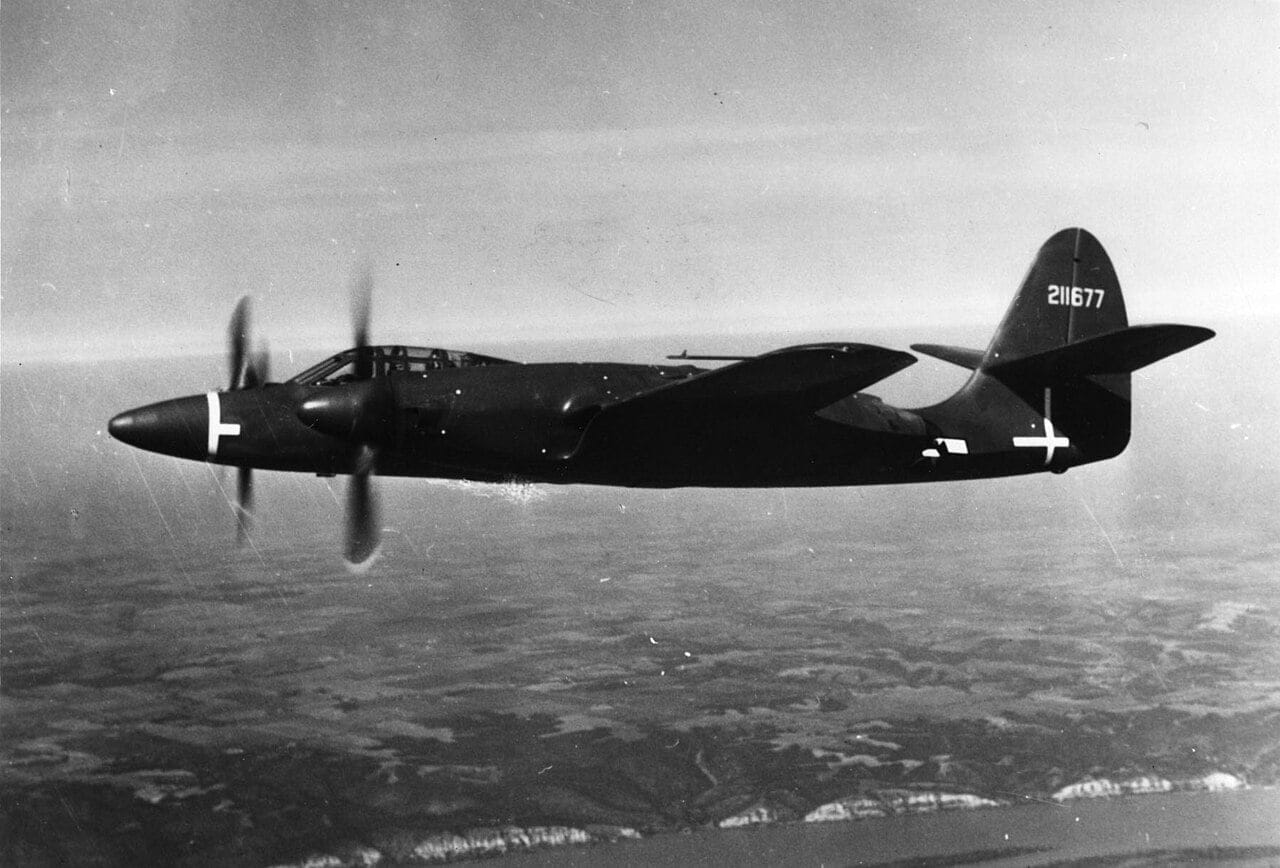
Some aircraft are remembered for what they did. The McDonnell XP-67 is remembered for how it looked. Sleek, sculpted, every line flowing into the next, it was one of the most beautiful fighters of the Second World War — and one of the most tragic, because its gorgeous body was chained to a pair of engines that simply would not work.
They called it the Moonbat. Only one was ever built, it flew for barely a handful of minutes across its whole life, and it ended in flames. Yet it was the first aircraft ever built by a company that would go on to shape the jet age.
Quick Facts
- Aircraft: McDonnell XP-67, nicknamed the “Moonbat” (or simply “Bat”)
- Distinction: the very first aircraft McDonnell ever built — and the only piston-engine one
- Design: a radical blended wing-body, every surface faired smoothly into the next
- Engines: two Continental XI-1430 inverted V-12s — troubled “hyper” engines that never made their promised power
- Intended armament: six 37 mm cannon (never actually fitted)
- First flight: 6 January 1944 — cut short to six minutes by engine trouble
- Fate: the sole prototype burned after an engine fire on 6 September 1944; the programme was cancelled
- Legacy: McDonnell went on to build the F-4 Phantom II and, later, the F-15 Eagle
McDonnell’s first, and strangest
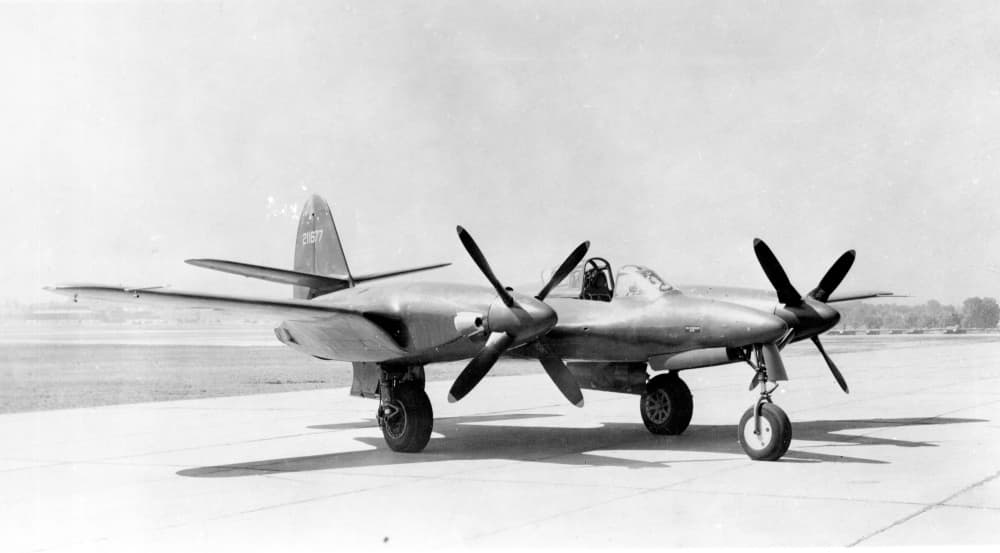
In the early 1940s, a young engineer named James McDonnell had a fixation: what if you could make almost every part of an aircraft help it fly? Not just the wings, but the fuselage, the engine nacelles, even the joints between them — all blended into one continuous lifting shape. When he founded his own company, the XP-67 was where he tried it.
The result was extraordinary to look at. From the tail forward, the Moonbat was all curves, its nacelles and fuselage melting into the wing so smoothly that it barely looked assembled at all.
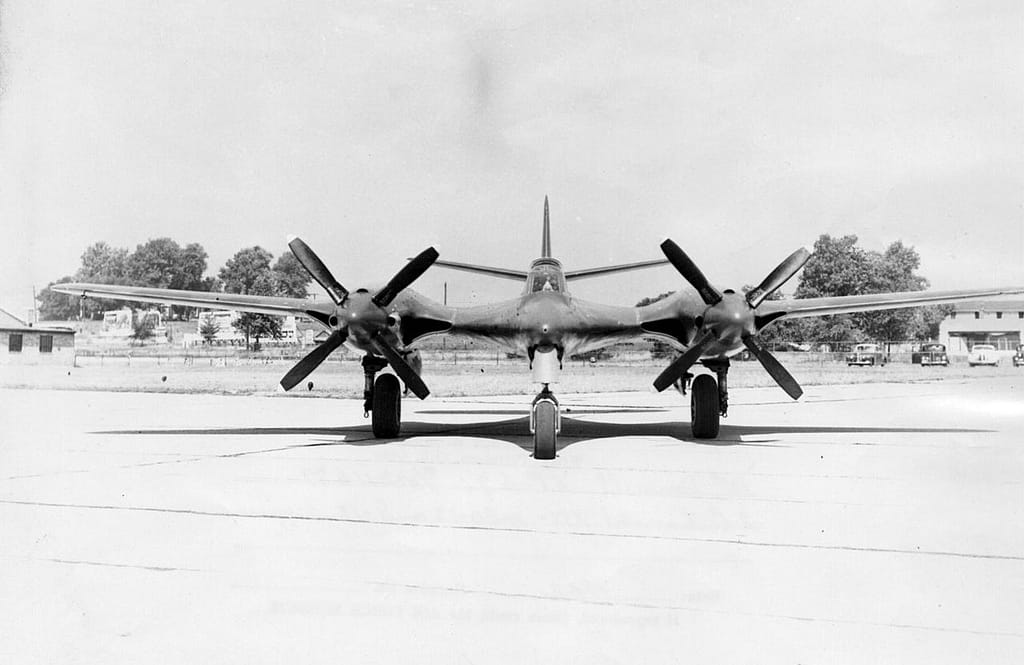
The McDonnell XP-67 “Moonbat,” profiled by the Palm Springs Air Museum.
Those damned Continental engines
The beauty was real. The problem was under the skin. The Moonbat was built around the Continental XI-1430, a compact “hyper” engine the Army had been developing since the 1930s. It was supposed to make 1,600 horsepower. It never made much more than 1,000 — even with a turbocharger bolted on — at a time when serious fighters needed closer to 2,000. Worse, it ran ferociously hot. During the very first taxi tests, both engines caught fire.
McDonnell begged to be allowed to fit proven Allison or Rolls-Royce Merlin engines instead. The Army refused: work with what you have. And so the most beautiful airframe of the war was shackled to the one component guaranteed to hold it back.
The XP-67 — the experimental fighter that kept catching fire.
Six minutes, and a war that had moved on
The XP-67 finally lifted off on 6 January 1944. Six minutes later, engine trouble forced it straight back down. It hardly mattered, because the aircraft had already lost its reason to exist. It had been conceived to shred formations of long-range German bombers with a battery of six heavy 37 mm cannon — but by 1944, neither Germany nor Japan had any such bombers left to shred, and the six cannon were never even installed.
It was a bomber-destroyer with no bombers to destroy, too heavy and underpowered to ever win a dogfight. The most graceful fighter of the war had become an aircraft in search of a mission.
The fire, and the empire it left behind
The end came on 6 September 1944. In flight, an engine caught fire once more, and this time the flames spread to the rear fuselage and a nacelle. The test pilot got down; the aircraft did not survive. With it went the whole programme. Only the one Moonbat had ever been built, and now there were none.
It would have been easy to write McDonnell off as a company that produced one beautiful failure. Instead, the very next design to leave the drawing board was a jet — the FH-1 Phantom — followed by the Banshee, the Voodoo, and the legendary F-4 Phantom II. The firm that built the doomed, lovely Moonbat would go on to build some of the most successful fighters in history. Its first aircraft simply flew too beautifully, and burned too soon.
McDonnell’s first aircraft went down in flames — the story of the XP-67 Moonbat.
Sources: Stephan Wilkinson, “Too Hot to Handle: McDonnell XP-67 Moonbat,” Smithsonian Air & Space; Vintage Aviation News; Wikipedia.

0 Comments