
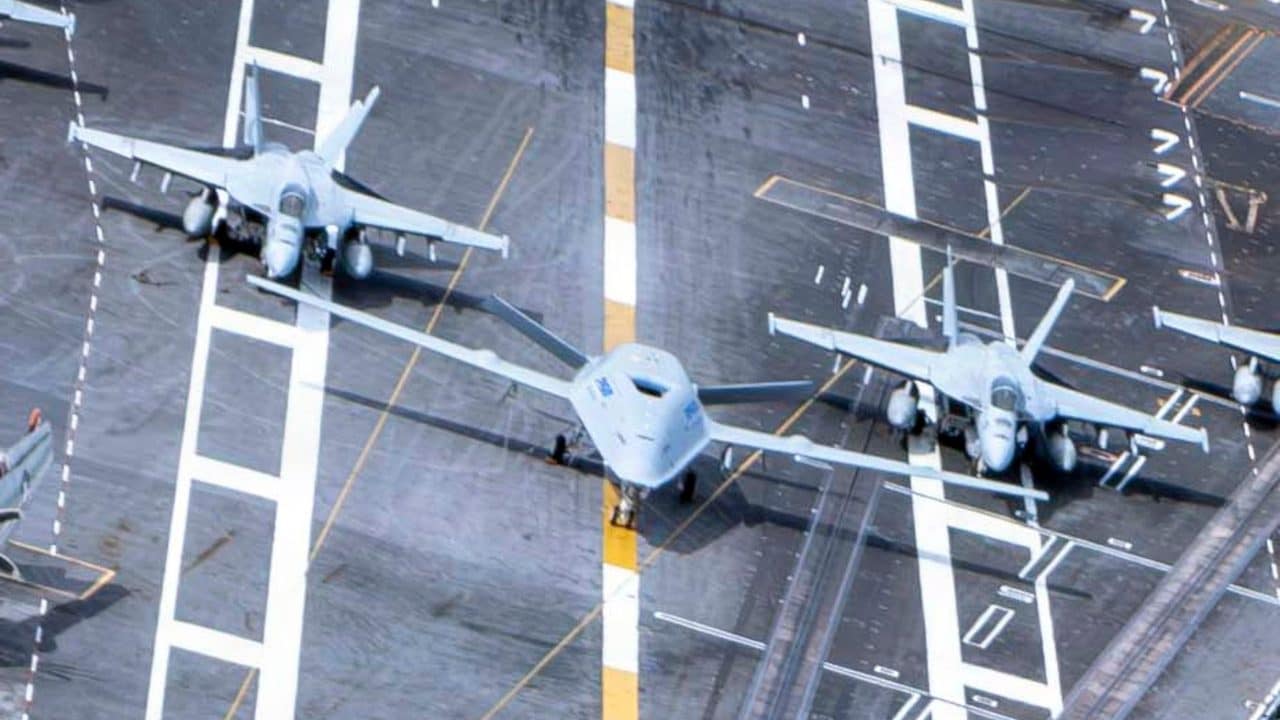
Among the tall ships and grey hulls that filled New York Harbor for America’s 250th birthday, the strangest silhouette wasn’t a ship at all. Lashed to the flight deck of USS Nimitz, between rows of Super Hornets, sat a windowless grey machine with folded wings and no cockpit: the MQ-25 Stingray — the drone that will refuel the US Navy’s fighters, and the first hard evidence most spectators have ever seen of the robot carrier air wing that’s coming.
According to Stars and Stripes, the Navy opened International Naval Review 250 in New York Harbor on July 4 with Nimitz at its heart — fresh from a multinational fleet exercise in the Atlantic, and with the Stingray demonstrator riding along as a very deliberate show-and-tell.
Quick Facts: MQ-25 Stingray T-1 Demonstrator
| What it is | Boeing-owned MQ-25 demonstrator (“T-1”), flying since 2019 |
| Where | Aboard USS Nimitz for FLEETEX 250 and the 250th anniversary naval review in New York |
| Size | Production MQ-25: 75 ft wingspan (31.3 ft folded), 51 ft long — wider than a Super Hornet |
| Mission | Aerial refueling for the carrier air wing, plus built-in ISR capability |
| Status | First production-representative MQ-25 flew April 2026; Navy aims for initial operational capability next year |
A Very Big Drone on a Very Famous Deck
The Navy confirmed to The War Zone what deck photos had suggested: “We do indeed have a Boeing-owned T-1 prototype currently onboard,” a spokesperson said. T-1 is the original Stingray demonstrator — it has been flying since 2019 and made history by refueling a crewed aircraft in flight, but it has never launched from or landed on a carrier. It was craned aboard, just as it was for deck-handling trials on USS George H.W. Bush in December 2021.
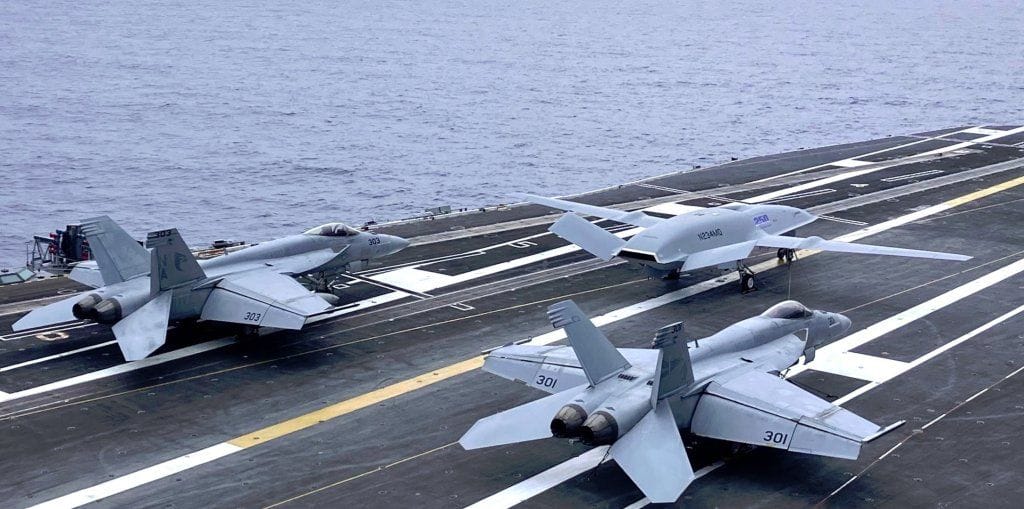
What the photos really communicate is scale. The production Stingray spans 75 feet — thirty feet more than the Super Hornets parked beside it — and even with wings folded it occupies more than 31 feet of precious deck space. Maneuvering something that size, with nobody in it, through the choreographed chaos of carrier deck operations remains one of the program’s hardest problems.
Twenty-Six Warships and a Birthday Party
Nimitz spent late June leading Fleet Exercise 250, a large multinational training event in the Atlantic with participants including the United Kingdom, France, Germany, Spain, Brazil, Canada and Turkey. In a group-sail photo exercise on June 25, the carrier led 25 other warships from 13 of the participating nations — the kind of formation navies stage once a decade.

From there the carrier turned north for New York and the International Naval Review, where the Blue Angels led a parade of aircraft over the Hudson on July 4 — joined, in a neat diplomatic touch, by France’s Patrouille de France trailing red, white and blue smoke over the harbor, as Stars and Stripes reported.
The Air Wing of the Future, Sooner or Later
Behind the pageantry is a program the Navy badly needs. The Stingray’s first job is unglamorous but critical: taking over the tanker mission from F/A-18F Super Hornets, which currently burn airframe life passing gas to other jets. Every operational Stingray frees up a strike fighter and extends the reach of the whole air wing — which matters enormously in a Pacific where anti-ship missiles keep pushing carriers further from their targets.
The program is years late. The original goal was initial operational capability in 2024; the first production-representative Stingray only flew this April. The Navy now hopes to declare IOC next year, with drone control centers already installed aboard George H.W. Bush, Carl Vinson, Theodore Roosevelt and Ronald Reagan.
Nimitz herself will almost certainly never operate a Stingray for real — the Navy has extended the 51-year-old carrier’s service life only into next March. Which makes the image oddly fitting: the fleet’s oldest active flattop, on her farewell tour, carrying the future on her back into New York Harbor. Navy officials want future air wings to be 60 percent or more uncrewed. The strange grey shape on Nimitz’s deck is what that future looks like, parked next to the present.
Sources: The War Zone (TWZ), Stars and Stripes, Boeing, US Navy
Related Questions
What is the MQ-25 Stingray?
The MQ-25 Stingray is an uncrewed carrier-based aircraft built to refuel the U.S. Navy's fighters in flight. Windowless, with folded wings and no cockpit, it is the first piece of the Navy's planned robot carrier air wing. A Boeing-owned demonstrator known as T-1 has been flying since 2019 and appeared aboard USS Nimitz in 2026.
What is the MQ-25's primary mission?
The MQ-25 Stingray's primary mission is aerial refuelling: topping up Navy fighters like the F/A-18 Super Hornet so they can fly farther and stay airborne longer, freeing crewed jets from the tanker role. It is also the Navy's stepping stone toward operating uncrewed aircraft from carrier decks more broadly.
Who makes the MQ-25 Stingray?
Boeing builds the MQ-25 Stingray. The company owns the T-1 demonstrator that has been flying since 2019 and which was displayed aboard USS Nimitz during International Naval Review 250. The program is intended to give the Navy its first operational carrier-based drone, integrated alongside crewed aircraft in the air wing.
When and where was the MQ-25 shown to the public?
The MQ-25 demonstrator rode aboard USS Nimitz for International Naval Review 250, which opened in New York Harbor on 4 July 2026 as part of America's 250th-birthday events. Parked among rows of Super Hornets, it offered many spectators their first look at the drone that will refuel the Navy's fighters.
Why is the MQ-25 significant for aircraft carriers?
The MQ-25 matters because it is the first hard evidence of the robot carrier air wing that is coming: a future in which uncrewed aircraft operate routinely from flight decks alongside crewed jets. Starting with the refuelling role reduces risk while proving the concept, and it complements debates over the Navy's next-generation fighter.
What is a carrier air wing?
A carrier air wing is the complete set of aircraft embarked on a U.S. Navy aircraft carrier, including fighters, early-warning and support aircraft. The MQ-25 Stingray is set to become part of that mix, adding an uncrewed tanker and pointing toward air wings that blend crewed jets with robotic aircraft.
0 Comments