
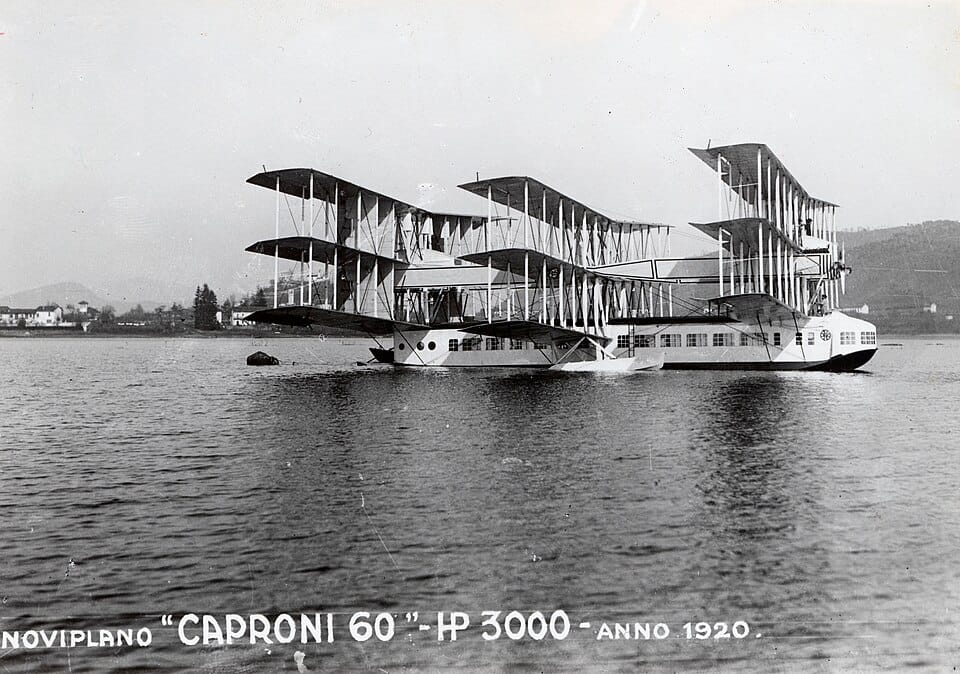
Quick Facts — Caproni Ca.60 Transaereo
Designer: Giovanni Battista "Gianni" Caproni
Built: 1919–1921, Sesto Calende, Lake Maggiore, Italy
Configuration: Nine wings (three tandem triplanes), eight Liberty L-12 engines, flying boat hull
Power: 8 × 400 hp Liberty L-12 V-12s = 3,200 hp total
Wingspan: 30.5 m (100 ft)
Length: 22.6 m (74 ft)
Wing area: 750 m² (8,100 ft²)
Max takeoff weight: 26,000 kg (57,320 lb)
Capacity: 100 passengers + 8 crew
First flight: 12 February or 2 March 1921 (sources disagree)
Status: Destroyed on second flight, 4 March 1921
Survivors: Hull fragments at Museo dell’Aeronautica Gianni Caproni (Trento) and Volandia (Varese)
A Bomber-Builder Dreams of Airlines
Gianni Caproni had made his name building heavy bombers for the Italian military during the First World War. His Ca.3 biplanes and Ca.4 triplanes were among the largest aircraft of the conflict — multi-engine beasts that dropped ordnance on Austrian trenches while their crews froze in open cockpits. When the war ended and the military contracts evaporated, Caproni faced a choice every arms manufacturer knows: pivot or perish. He pivoted toward the sky. As early as 1913 — aged just 27 — Caproni had told the Italian sports newspaper La Gazzetta dello Sport that "aircraft with a capacity of one hundred and more passengers" would soon become a reality. Now, with hangars full of surplus bombers and a workforce of skilled carpenters and riggers, he decided to prove it. The idea was radical. In 1919, no airline carried more than a handful of passengers. Converted bombers served as airliners, their bomb bays refitted with wicker seats. Caproni's vision was different: a purpose-built airliner, designed from the keel up for civilian comfort and transatlantic range. He patented the concept on 6 February 1919. Reality intervened. The lake was too low for the slipway. Thirty wing ribs broke and needed emergency repair. A starter motor failed. Caproni, furious, kept his workers up all night. On 9 February the Transaereo finally touched water, its engines running, test pilot Federico Semprini at the controls. Semprini was a good choice: a former military instructor famous for having once looped a Caproni Ca.3 heavy bomber — a feat roughly equivalent to barrel-rolling a school bus. The initial taxi tests went well. The aircraft was responsive, manoeuvrable, stable on the water. It did tend to pitch up at the bow, so Caproni loaded 300 kilograms of ballast forward. On 12 February (or possibly 2 March — sources disagree), Semprini pushed the Transaereo to 80 km/h and it lifted off the lake. The flight was brief but stable. Caproni was satisfied.Ninety Seconds of Glory, Then the Lake
The second flight came on 4 March 1921. The weather was clear. Semprini opened the throttles. At 100 km/h the Noviplano hauled itself into the air — and immediately pitched up into a dangerously steep climb. Semprini cut power. The tail dropped. The nose rose further. The aircraft stalled, hung for a sickening moment, then slammed tail-first into the surface of Lago Maggiore. The front third of the hull shattered on impact. The forward wing set collapsed into the water. The central and rear sections stayed afloat. Semprini and both flight engineers scrambled out, unhurt. The Ca.60 also lives on in an unexpected place: Hayao Miyazaki's 2013 film The Wind Rises, where Caproni appears as a recurring dream figure, encouraging the young protagonist to build beautiful aircraft regardless of how they might be used. Miyazaki — an aviation obsessive — clearly saw something in the Transaereo that went beyond its failure. Something about the scale of the ambition, the refusal to think small, the willingness to put nine wings on a houseboat and dare it to fly.Beautiful Disaster
Was the Ca.60 a failure? Obviously. It flew for under two minutes and was destroyed. Its pitch-control system was fundamentally flawed. The sandbag problem was a rookie oversight. No transatlantic flight was ever going to happen. But calling the Transaereo a failure misses the point. In 1921, the idea that an aircraft could carry 100 people anywhere was science fiction. The world's airlines were flying biplanes with four seats. Caproni was designing for a future that would not arrive until the Boeing 707 — thirty-seven years later. He got the engineering wrong. He got the vision right. The path of progress is, as he said, strewn with suffering. And occasionally, with nine wings floating in a lake. Sources: Gregory Alegi, "The castle door, the mooring pylon and the Transaereo" (WW1 Aero, 2006); Rosario Abate, Gregory Alegi & Giorgio Apostolo, Aeroplani Caproni (Museo Caproni, 1992); Enzo Angelucci & Paolo Matricardi, Guida agli aeroplani di tutto il mondo (Mondadori, 1976); Museo dell’Aeronautica Gianni Caproni; Smithsonian National Air and Space MuseumRelated Questions
What was the Caproni Ca.60?
The Caproni Ca.60 Transaereo was a giant Italian flying boat of 1921, designed as an early transatlantic airliner. Astonishingly, it had nine wings arranged as three tandem triplanes and eight engines, and was meant to carry 100 passengers — a wildly ambitious vision of mass air travel.
How many wings did the Caproni Ca.60 have?
Nine. They were arranged as three sets of triplane wings — front, middle and rear — giving the enormous flying boat a total of nine lifting surfaces, an extraordinary configuration unlike almost any other aircraft ever built.
How many passengers was the Caproni Ca.60 designed to carry?
It was designed to carry 100 passengers plus eight crew — an enormous capacity for 1921, when most aircraft carried only a handful of people. Caproni envisioned it as the first true mass-transport airliner for transatlantic routes.
Did the Caproni Ca.60 ever fly?
Barely. The huge flying boat managed only brief hops on Lake Maggiore in 1921 before crashing on takeoff during an early flight and breaking apart on the water. The wreck was then destroyed, and the over-ambitious design was abandoned.
Who designed the Caproni Ca.60?
It was designed by the pioneering Italian aircraft builder Giovanni Battista "Gianni" Caproni and built between 1919 and 1921 at Sesto Calende on Lake Maggiore. It remains one of the most ambitious and unusual aircraft in aviation history.
Related Posts
The 10 Ugliest Aircraft Ever Built (That Actually Flew)
0 Comments