
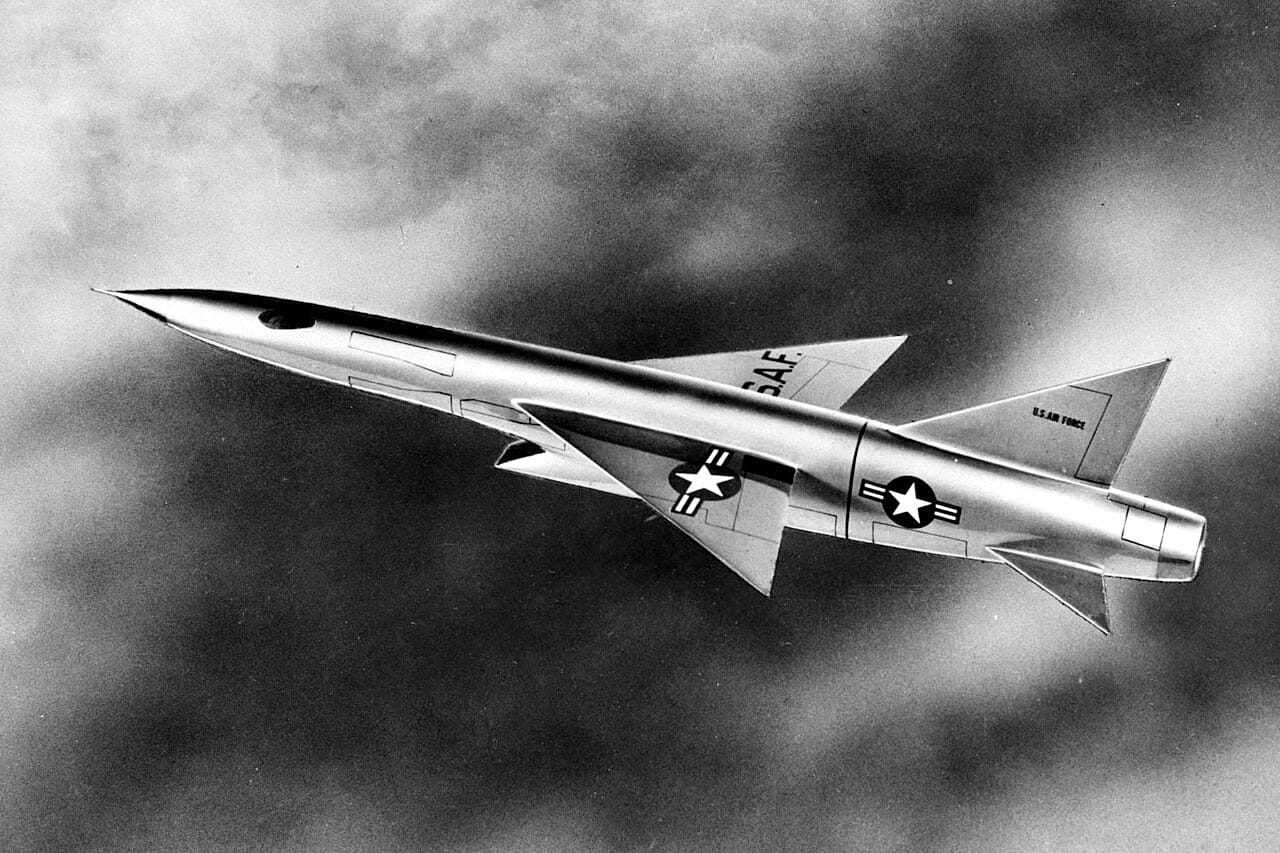
The Republic XF-103 was meant to do something no fighter of the early 1950s could: cruise at Mach 3 — three times the speed of sound — at the edge of the stratosphere, run down a Soviet bomber, and kill it with missiles. To get there, its designers made a series of radical decisions, starting with the fact that the pilot would not be able to see straight ahead.
It was to be built entirely of titanium, powered by a hybrid engine that was part turbojet and part ramjet, and fitted with a periscope where the windscreen should be. No XF-103 ever flew. Only a full-scale wooden mock-up was ever finished.
Quick Facts
| Type | Proposed Mach 3 interceptor (USA) — never built beyond a mock-up |
| Designer | Alexander Kartveli, Republic Aviation |
| Structure | All-titanium airframe |
| Power | Wright XJ67 turbojet combined with an XRJ55 ramjet (~37,000 lbf / 165 kN total) |
| Design performance | About Mach 3 at ~75,000 ft (24,000 m) |
| Cockpit | Periscope instead of a windscreen; downward-ejecting escape capsule |
| Fate | Contract signed 1954; cancelled 1957 |
Built for Mach 3
Sustained flight at Mach 3 produces airframe temperatures that ordinary aluminium alloys cannot survive. Republic’s answer, from the outset, was to build the entire aircraft from titanium — a material that in the early 1950s was punishingly difficult to machine and form, and which became one of the programme’s central problems. The shape was long, slender and sharply pointed, the work of chief designer Alexander Kartveli, the same engineer behind the P-47 Thunderbolt and the F-105.
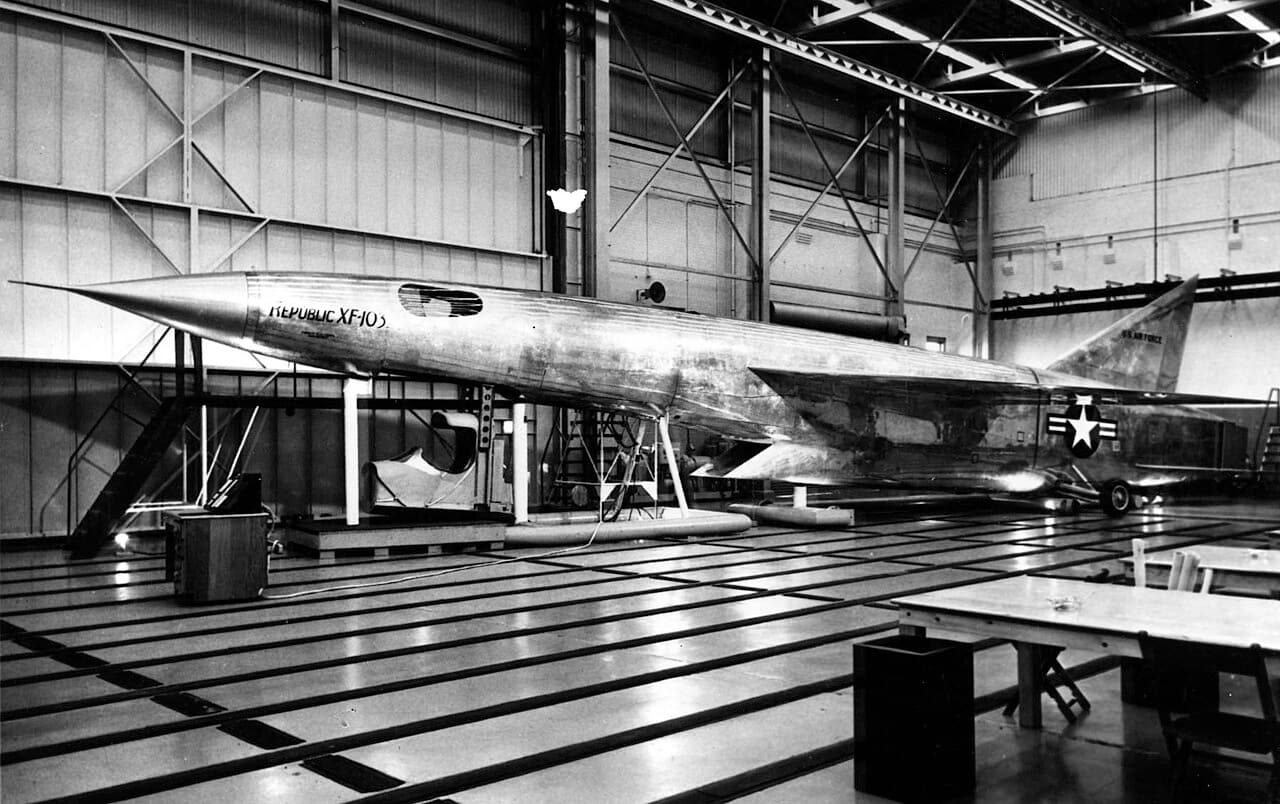
An engine that turned into a ramjet
The propulsion was the cleverest and most troublesome part. A Wright XJ67 turbojet — a licence-built relative of the British Bristol Olympus — sat ahead of an XRJ55 ramjet. At low speed the turbojet ran conventionally; at high speed, its exhaust was routed into the ramjet duct, and the combined “turbo-ramjet” was projected to produce around 37,000 pounds of thrust — enough to hold Mach 3. It was elegant on paper and extraordinarily hard to realise in metal.
A pilot who could not look out of the front
At Mach 3, a conventional canopy was seen as both a heat problem and a drag problem, so the Air Force insisted on a periscope and small side windows instead of a windscreen. Kartveli argued for a real canopy and lost. The pilot sat in a downward-ejecting escape capsule: at those speeds, firing a man up into the airstream would kill him, so the entire capsule was designed to drop clear of the aircraft.
In the end it was metallurgy, money and missiles that finished the XF-103. Titanium fabrication remained difficult and expensive, the engine lagged, and the rise of the intercontinental ballistic missile made a dedicated bomber-interceptor look less essential. The programme was cancelled in 1957 with only the mock-up built.
The XF-103 was not a failure of imagination. It was a Mach 3 idea a decade ahead of the materials and engines that could build it — and almost everything it attempted, from titanium structures to combined-cycle propulsion, would later reappear on the SR-71. The XF-103 simply asked the question first.
Sources: Wikipedia; Defense Media Network.
Related Questions
What was the Republic XF-103?
The Republic XF-103 was a 1950s American project for a Mach 3 interceptor designed to destroy Soviet bombers at high altitude. It featured an all-titanium structure, a combined turbojet-ramjet engine, and a periscope instead of a windscreen. It never advanced beyond a full-scale mock-up.
How fast was the XF-103 designed to fly?
The XF-103 was designed to cruise at about Mach 3 \u2014 three times the speed of sound \u2014 at altitudes around 75,000 feet (24,000 m).
Why did the XF-103 have a periscope instead of a windscreen?
At Mach 3, a conventional canopy was considered a heat and drag liability. The U.S. Air Force required a periscope and small side windows for forward vision instead of a windscreen, over the objections of designer Alexander Kartveli.
What engine did the XF-103 use?
It was to use a Wright XJ67 turbojet \u2014 a licensed derivative of the Bristol Olympus \u2014 combined with an XRJ55 ramjet. At high speed the turbojet fed the ramjet, with the combined unit projected to produce about 37,000 pounds of thrust.
Did the XF-103 ever fly?
No. The XF-103 never flew. Only a full-scale mock-up was completed before the programme was cancelled.
Why was the XF-103 cancelled?
The programme was cancelled in 1957 because of the difficulty and cost of titanium fabrication, problems with the engine, and the shifting strategic focus toward intercontinental ballistic missiles, which reduced the need for a dedicated bomber-interceptor.
Related Posts

0 Comments