
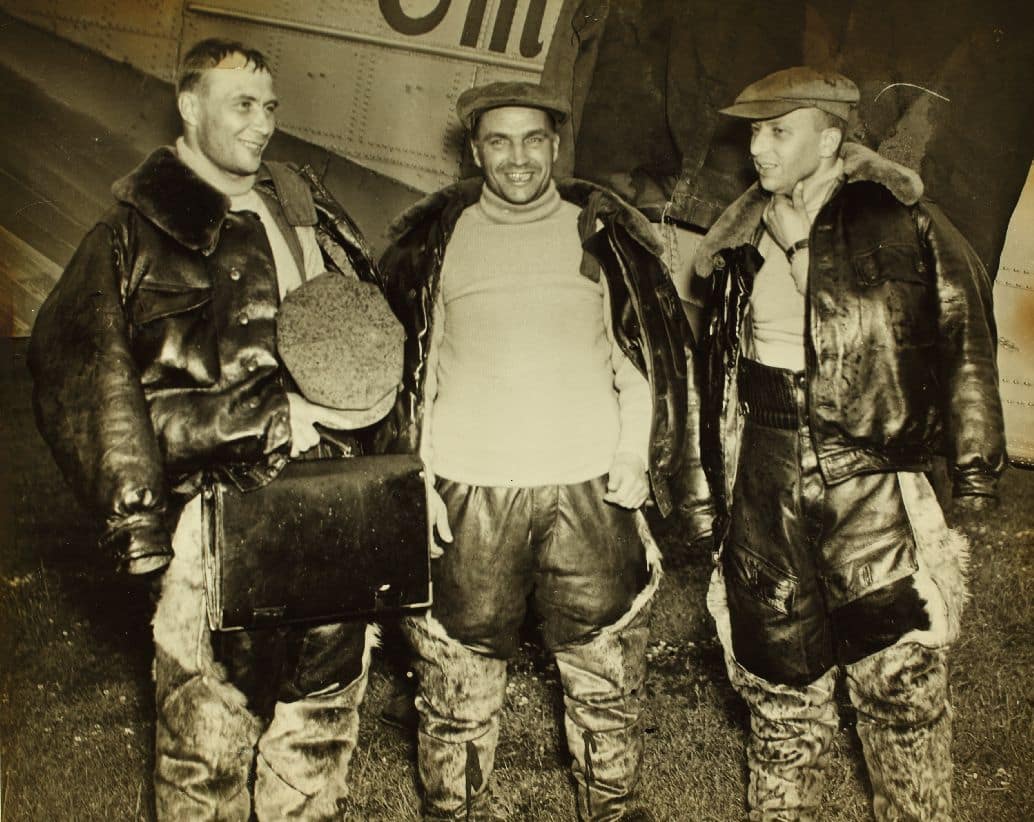
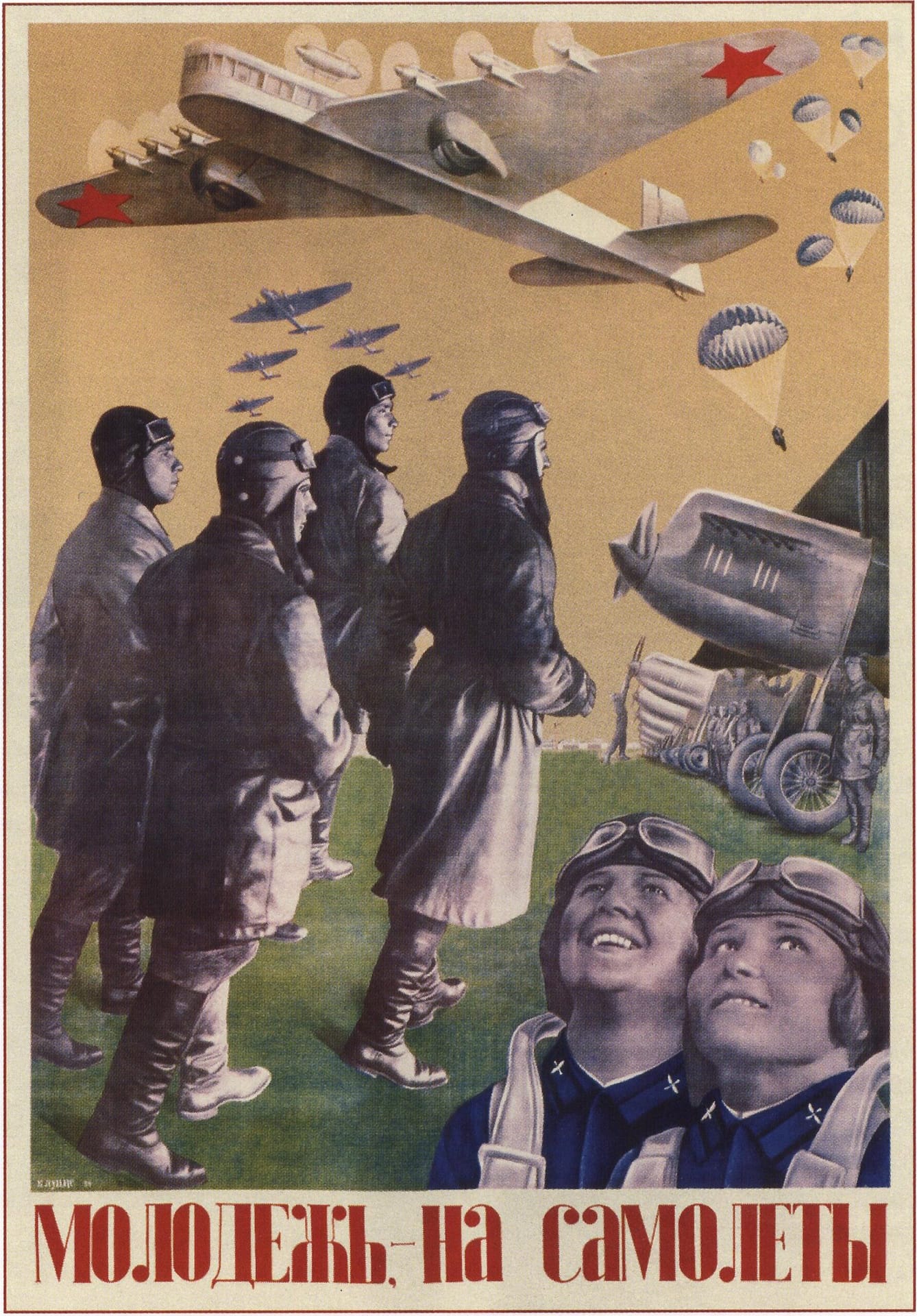
The 1930s were the decade Stalin made aviation a state religion. The propaganda machinery he inherited from the 1920s — Khayt’s Aviamarsh, the Dobrolyot postal posters, the early Osoaviakhim mass-membership organisation — was, by the time the first Five-Year Plan ended in 1932, a fully formed apparatus capable of turning a single piloted aircraft into a national mythology.
What the propaganda needed was achievements. Stalin’s regime gave it three of them, back to back: the ANT-20 Maxim Gorky propaganda flagship in 1934, Chkalov’s transpolar flight to Vancouver in June 1937, and Grizodubova’s all-female Rodina flight to the Far East in September 1938. By the end of the decade the Soviet pilot — the sokol, the falcon — was the most recognisable figure in Soviet visual culture. Painters painted him. Poets wrote odes to him. The press hailed the Chkalov crew as bogatyri, the mythic knights of medieval Russian folklore, reborn in flying helmets.
Quick Facts
Propaganda anthem: Aviamarsh (“Higher, Higher, Higher”) — pre-existing, now sung at every air parade
Flagship aircraft: Tupolev ANT-20 Maxim Gorky (1934) — 63 m wingspan, 8 engines, on-board printing press
Headline flight 1: Chkalov / Baidukov / Belyakov, ANT-25, Moscow → Vancouver USA, 18–20 June 1937 (transpolar, 9,130 km)
Headline flight 2: Gromov / Yumashev / Danilin, ANT-25, Moscow → San Jacinto CA, 12–14 July 1937 (new world distance record)
Headline flight 3: Grizodubova / Osipenko / Raskova, ANT-37 “Rodina,” Moscow → Far East, 24–25 Sep 1938 (women’s distance record)
Flagship film: Lyotchiki (“The Pilots”) — Yuli Raizman, 1935
Flagship painting: Aleksandr Deyneka, “Future Pilots” — Sevastopol, 1938
The ANT-20 Maxim Gorky: a flying printing press
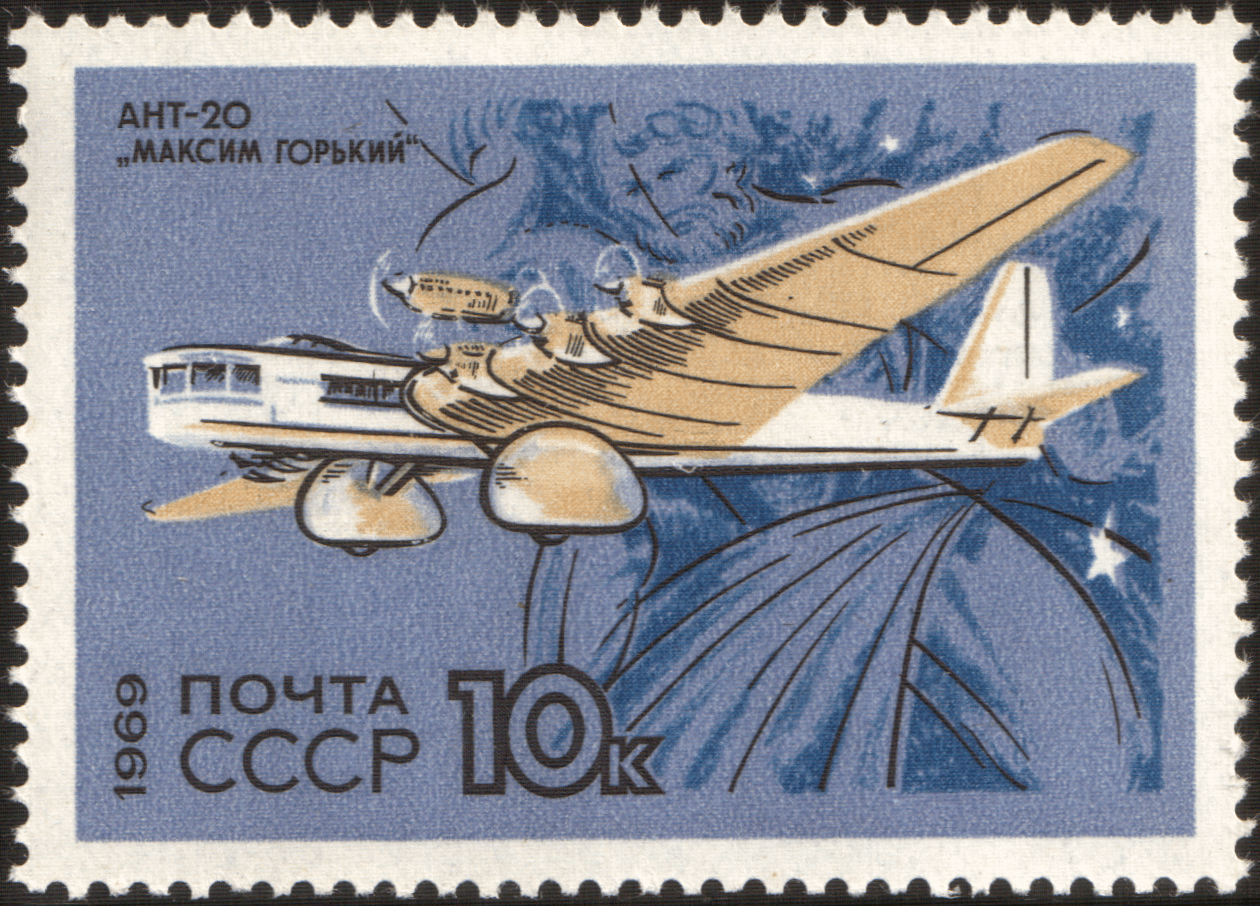
The Tupolev ANT-20 Maxim Gorky, first flown over Moscow in May 1934, was the largest aircraft in the world. Eight engines — six on the wings, two more above the fuselage in a tandem nacelle. A wingspan of 63 metres, nearly a third larger than that of Germany’s Dornier Do X flying boat. And the entire interior was a propaganda machine in the literal sense.
Inside the ANT-20 sat a movie projector, a darkroom, a photographic studio, a radio broadcast station, and a printing press capable of producing 10,000 four-page leaflets per hour. The aircraft was the flagship of the “Maxim Gorky Propaganda Squadron” — Agiteskadril’ — and its job was to fly over remote Soviet settlements, broadcast propaganda from external loudspeakers, drop printed leaflets, and project Soviet propaganda films on inflatable screens set up below.
It crashed on 18 May 1935. A small Polikarpov I-5 escort biplane piloted by Nikolai Blagin, attempting an unauthorised aerial display alongside the Maxim Gorky for the benefit of a film crew, struck the giant aircraft on his third loop. Both aircraft fell on the suburbs of Moscow. Forty-nine people died — eleven crew, thirty-eight engineering staff and family members aboard the ANT-20 — plus Blagin himself in the I-5.
The propaganda apparatus responded by building a second ANT-20bis, slightly modified, which flew Aeroflot routes between Moscow and Mineralnye Vody until it too was lost, more prosaically, in a 1942 crash. But the original Maxim Gorky was already an icon.
June 1937 — Stalin’s Route
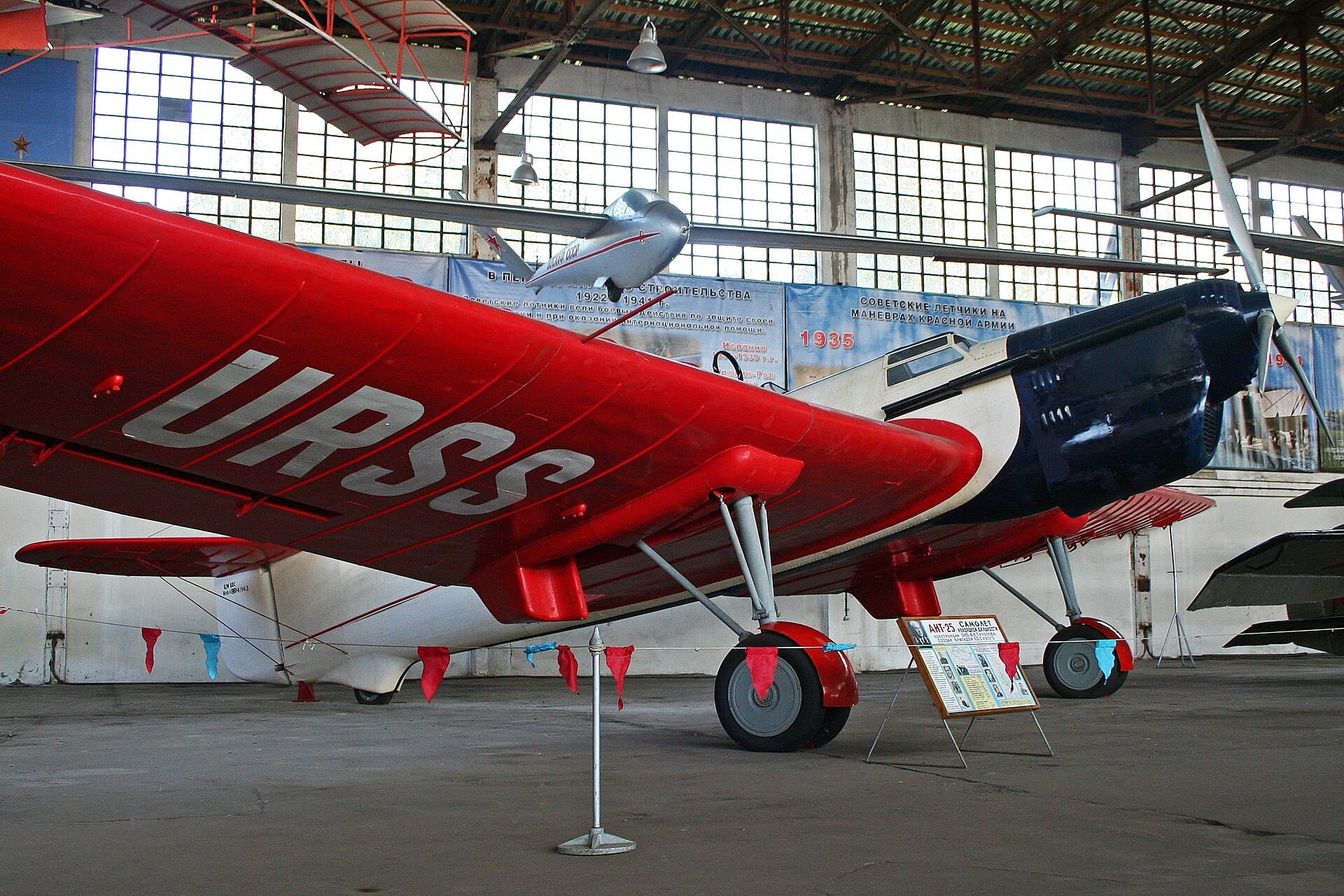
If the Maxim Gorky was the propaganda flagship, the Tupolev ANT-25 was the propaganda missile. The aircraft was a single-engine long-range monoplane designed by Andrei Tupolev’s team specifically for record-setting distance flights. Its 34-metre wingspan housed enormous internal fuel tanks. Its single Mikulin AM-34 engine sipped fuel at a rate that gave it an unrefueled range of 13,000 kilometres. There was almost nothing it could do except fly very far in a very straight line. That was precisely the point.
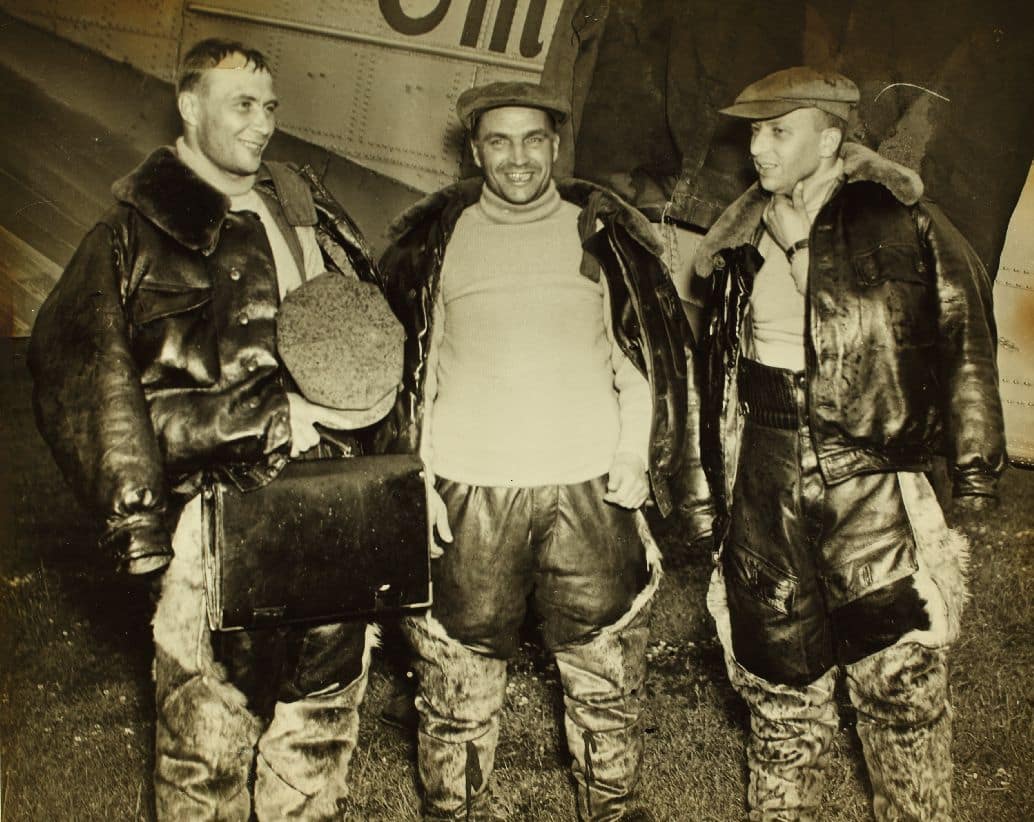
On 20 July 1936 Valery Chkalov, Georgy Baidukov and Alexander Belyakov flew the ANT-25 from Moscow to Udd Island in the Soviet Far East, an open-water leg of 9,374 kilometres. The crew were named Heroes of the Soviet Union, and the aircraft was painted with the name “Сталинский маршрут” — Stalin’s Route — in red letters along the fuselage.
On 18 June 1937 Chkalov’s crew took the same aircraft north. They crossed the North Pole 26 hours into the flight. They emerged over the Canadian Arctic, crossed the Yukon, descended into worsening weather along the Pacific coast, and landed 63 hours and 16 minutes after departure at Pearson Field, Vancouver, Washington — the first transpolar flight in history. The crew were welcomed by the local commanding general, George Marshall, who happened to be at Vancouver Barracks. Three weeks later Mikhail Gromov flew the second ANT-25 on the same route, continued south for another 1,000 kilometres, and set a new world distance record at San Jacinto, California.
Stalin and the Soviet leadership sent the crew a triumphant greeting telegram, published across the Soviet press, hailing the flight as the first in history from Moscow across the North Pole to America and as proof of what the Bolshevik-raised Soviet pilot could do.
September 1938 — three women, one aircraft
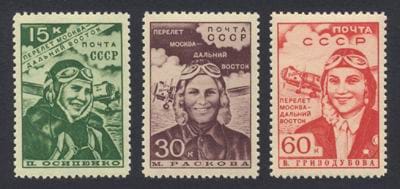
The third great propaganda achievement of the decade was the all-female crew of the ANT-37 “Rodina” (Motherland). Valentina Grizodubova as captain, Polina Osipenko as co-pilot, and Marina Raskova as navigator flew 6,450 kilometres nonstop from Moscow to the Soviet Far East between 24 and 25 September 1938 — setting the FAI women’s world record for straight-line distance: 5,908.61 kilometres.
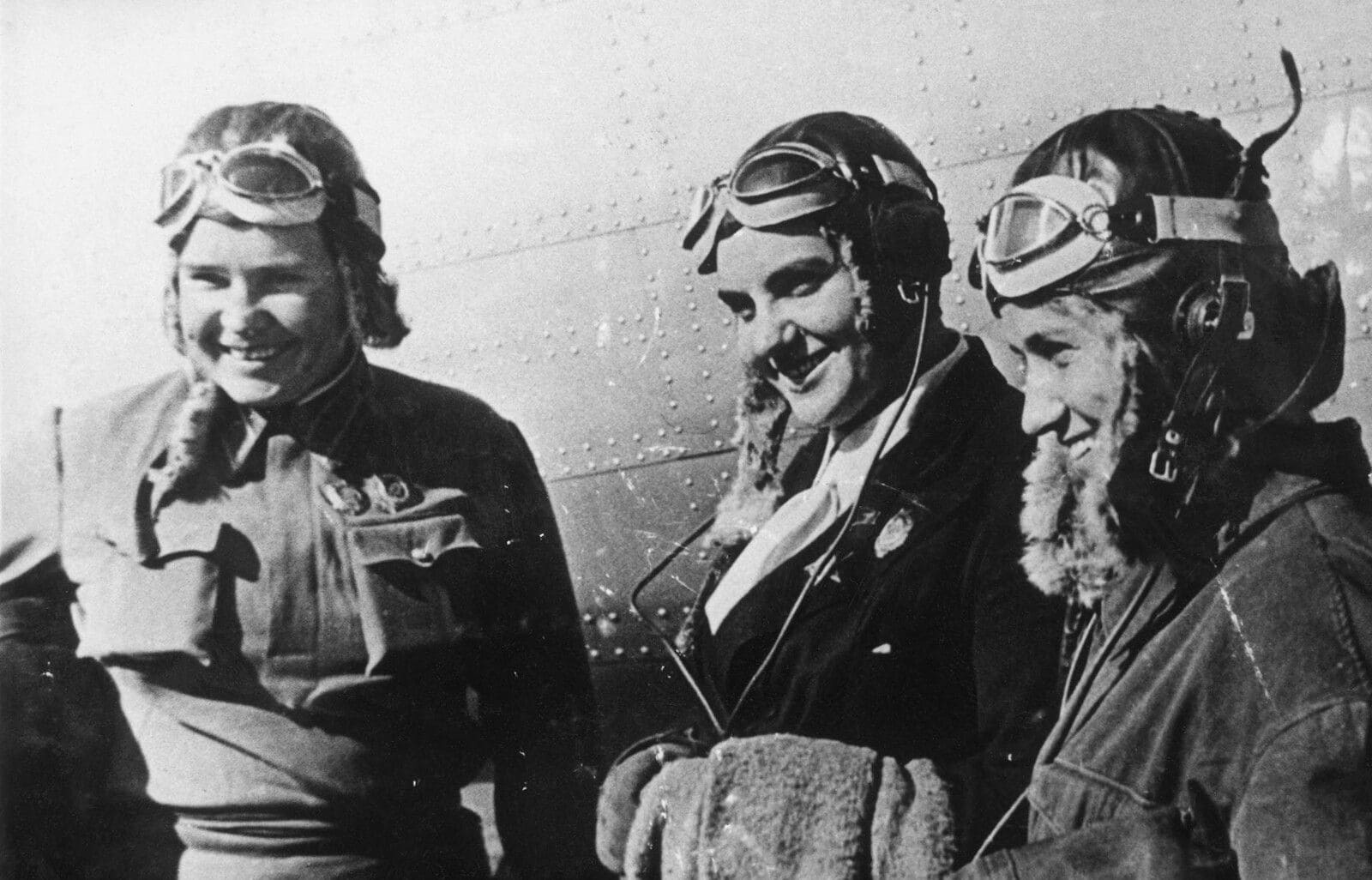
The propaganda value of three women pilots in a single airframe — at a moment when the Soviet Union was actively presenting itself as the world’s most progressive society — was incalculable. All three were named Heroes of the Soviet Union on 2 November 1938, the first women ever to receive the title. The streets of Moscow, Leningrad and Khabarovsk acquired Rodina Boulevards, Grizodubova Squares and Osipenko Lanes. Marina Raskova would, in October 1941, organise the all-female aviation regiments that would become the Night Witches — a story for the 1940s piece in this series.
The art and the film
The visual culture of 1930s Soviet aviation propaganda produced two genuinely lasting works. The first was Aleksandr Deyneka’s painting Future Pilots (1938), shown at the Exhibition for the Twentieth Anniversary of the Red Army and Navy. The painting depicts three boys on the Sevastopol seafront, watching a seaplane disappear into a bright sky. It is in every Soviet socialist-realism survey published since 1945 and remains, in 2026, in the permanent collection of the Tretyakov Gallery.
The second was Yuli Raizman’s 1935 film Lyotchiki (“The Pilots”) — released in the United States as “Men on Wings.” Shot on location at a Voronezh military airfield, the film follows a flying-school commander and his star pupil through a series of training accidents, romantic complications, and an eventual heroic rescue. The lyrical aerial cinematography — long tracking shots of biplane trainers in stacked formation — became a visual template for Soviet aviation cinema for the next fifty years.
What it all added up to
By the end of 1938 the Soviet propaganda apparatus had spent a decade making aviation the visible symbol of the Soviet project. Chkalov was elected a deputy of the Supreme Soviet. Gromov had been a Hero of the Soviet Union since 1934. Grizodubova, Osipenko and Raskova had streets named after them. The Maxim Gorky flying-press flagship was dead, but the second one was running an Aeroflot service. OSOAVIAKhIM mass-membership clubs had trained 121,000 Soviet pilots — the future cadres of the VVS in the war that would arrive in three years’ time.
And on 15 December 1938, in the middle of all of it, Valery Chkalov was killed in a flight-test accident at Khodynka airfield in Moscow. He was 34. His funeral filled Red Square. Stalin himself was an honorary pallbearer. The crash was later attributed to a rushed test schedule on a prototype Polikarpov I-180 fighter; Chkalov’s wife always believed her husband had been deliberately exposed. The propaganda machine, of course, did not allow that question to be asked. Chkalov was buried in the Kremlin Wall. His hometown of Vasilyovo was renamed Chkalovsk in his honour. Every Soviet schoolchild born after 1937 learned the name.
Three months later, the Soviet aviation propaganda apparatus had its next task: preparing the country for the world war that the people who built it could see coming.
Sources: Scott W. Palmer, “Dictatorship of the Air”; National Park Service, “A Red Bolt from the Blue: Valery Chkalov and the World’s First Transpolar Flight”; Russia Beyond; Tretyakov Gallery archive; Aviamarsh historical references at lyricstranslate.com.
Aviation in Soviet Propaganda — Series Index
→ The 1930s: Stalin’s Falcons (you are here)
→ The 1940s: The Great Patriotic War
→ The 1960s: The Cult of the Cosmonaut

 English
0 Comments