

In the spring of 1923, in Moscow, a young Jewish composer named Yuli Khayt wrote a tune that would haunt Soviet history for the next seventy years. The lyrics, by Pavel Herman, were three verses long and told the story of the Soviet airman climbing into the future. The chorus, sung in three-part harmony by every Komsomol choir from Leningrad to Vladivostok, had a single line so blunt that nobody in the country who had ever heard it could ever forget it: vyshe, i vyshe, i vyshe — higher, and higher, and higher.
The song was called Aviamarsh — “March of the Aviators.” It became the official anthem of the Soviet Air Fleet in 1933 and remained the soundtrack of Soviet aviation until the day the flag came down over the Kremlin in December 1991. And in those sixty-eight years it accompanied every public moment when the Soviet Union wanted to remind itself, and the world, that it had built the most ambitious aviation programme in human history.
This series — eight pieces covering the decades from the 1920s through the 1990s — is about how the Soviet state used aviation to tell itself who it was. It is about the cult of the pilot, the propaganda flagship aircraft, the cosmonaut posters, the films, the songs, the paintings, the statues, and the airshows. It is also about the moments when reality and propaganda diverged so far that even the loudest brass band could not paper over the gap. By the end of the series the Soviet Union itself is gone. The aircraft and the songs are still there.
Quick Facts
Anthem: Aviamarsh (“March of the Aviators”) — Yuli Khayt, Pavel Herman, 1923
Famous chorus: “Higher, and higher, and higher” (Все выше, и выше, и выше)
Mass-membership aviation society: OSOAVIAKhIM (1927) → DOSAAF (1951)
State propaganda flagship: Tupolev ANT-20 “Maxim Gorky” (1934)
Symbolic terms for aviators: sokoly (falcons), orly (eagles), bogatyri (warriors)
950 of 2,785: Soviet Heroes of the Soviet Union pilots trained in OSOAVIAKhIM air clubs


Why aviation, specifically
It is worth pausing on the question of why the Soviet propaganda apparatus fastened so hard on aviation in particular. The answer is geographical, ideological and theatrical.
Geographically, the Soviet Union was the largest contiguous land mass any state had ever administered. Its population was scattered across eleven time zones. Aviation was the only technology that could promise to unify the country in real time. Aeroflot’s route maps of the 1930s made the point graphically: a journey from Moscow to Vladivostok that took more than a week by rail could be cut to a few days by air. Aviation was a promise of cohesion.

Ideologically, aviation embodied everything Marxist-Leninist modernism wanted to claim about itself. It was technological, collective, mass-produced, internationalist, scientific, and visibly opposed to gravity — which is a useful metaphor when your political project insists on the inevitability of historical progress. Early-1930s Soviet orators liked to claim that where the bourgeois aircraft fell when its engine failed, the socialist aircraft flew on the collective strength of its people. The line is rhetorical nonsense. It also captures exactly what the propaganda wanted aviation to mean.
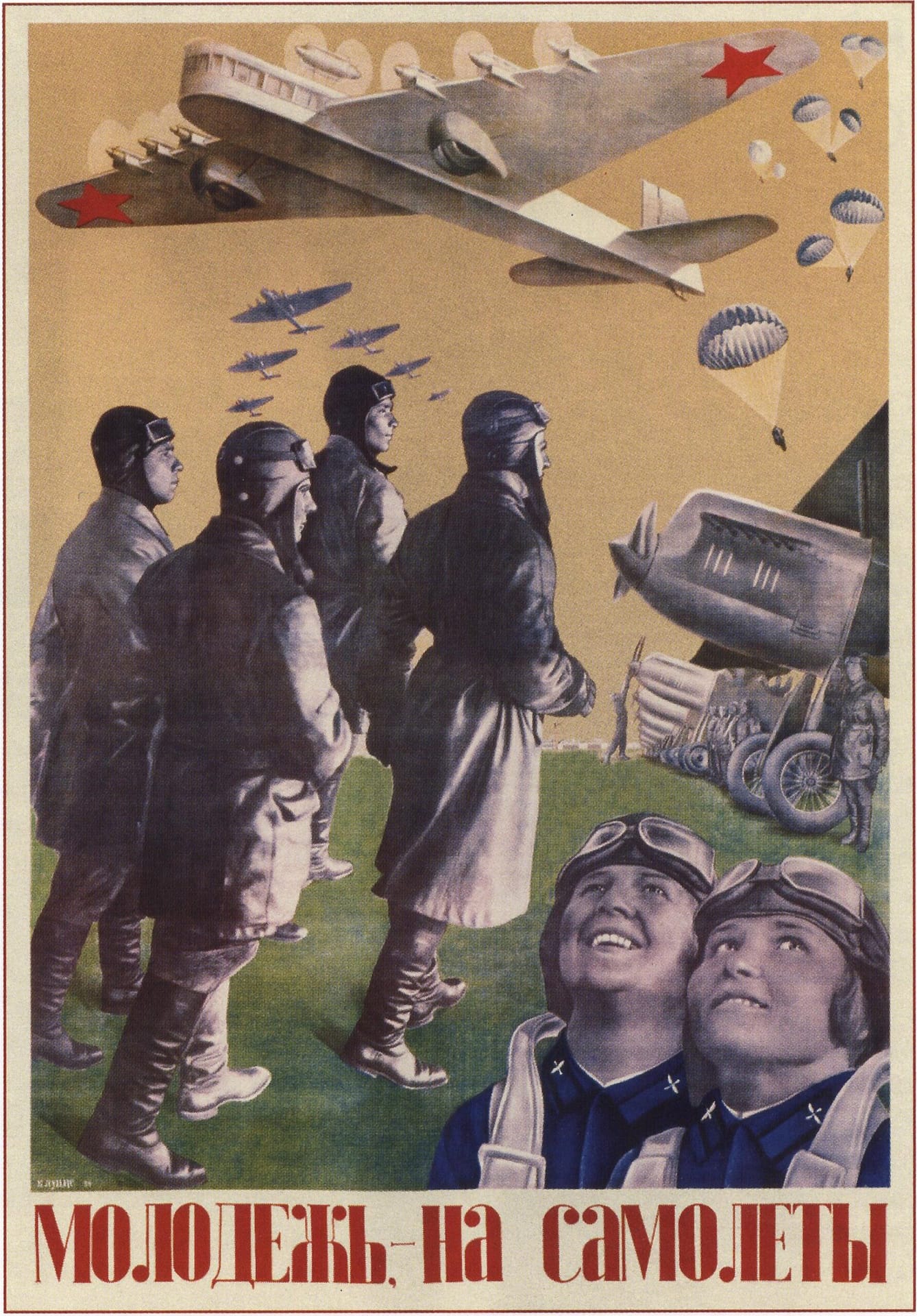
Theatrically, aviation made for great photographs. A Soviet pilot in a flying helmet, leaning against the prop hub of an ANT-25, was an icon that worked on every poster wall from Tashkent to East Berlin. A cosmonaut waving from the top of a Vostok capsule was the same icon updated for the 1960s. Both images were instantly readable. Both were also factually true: the country really had built those aircraft, those rockets, those records. The propaganda was selling something that genuinely existed.
The cult of the pilot — and then the cosmonaut
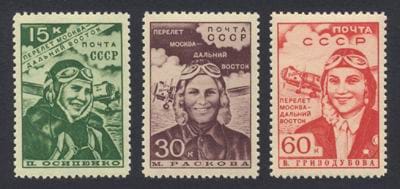
From the late 1920s through to the early 1960s, the most famous human beings in the Soviet Union were pilots. Valery Chkalov, who in 1937 flew the ANT-25 nonstop from Moscow over the North Pole to Vancouver, Washington, was a household name comparable to Lindbergh in the United States. Mikhail Gromov, who repeated the feat a month later and went further, was almost as famous. The three women — Polina Osipenko, Marina Raskova and Valentina Grizodubova — who in 1938 flew the Rodina from Moscow to the Far East had streets named after them in every Soviet city. The 588th Night Bomber Aviation Regiment — the “Night Witches” — became, after 1944, one of the central propaganda images of the entire Soviet Union.
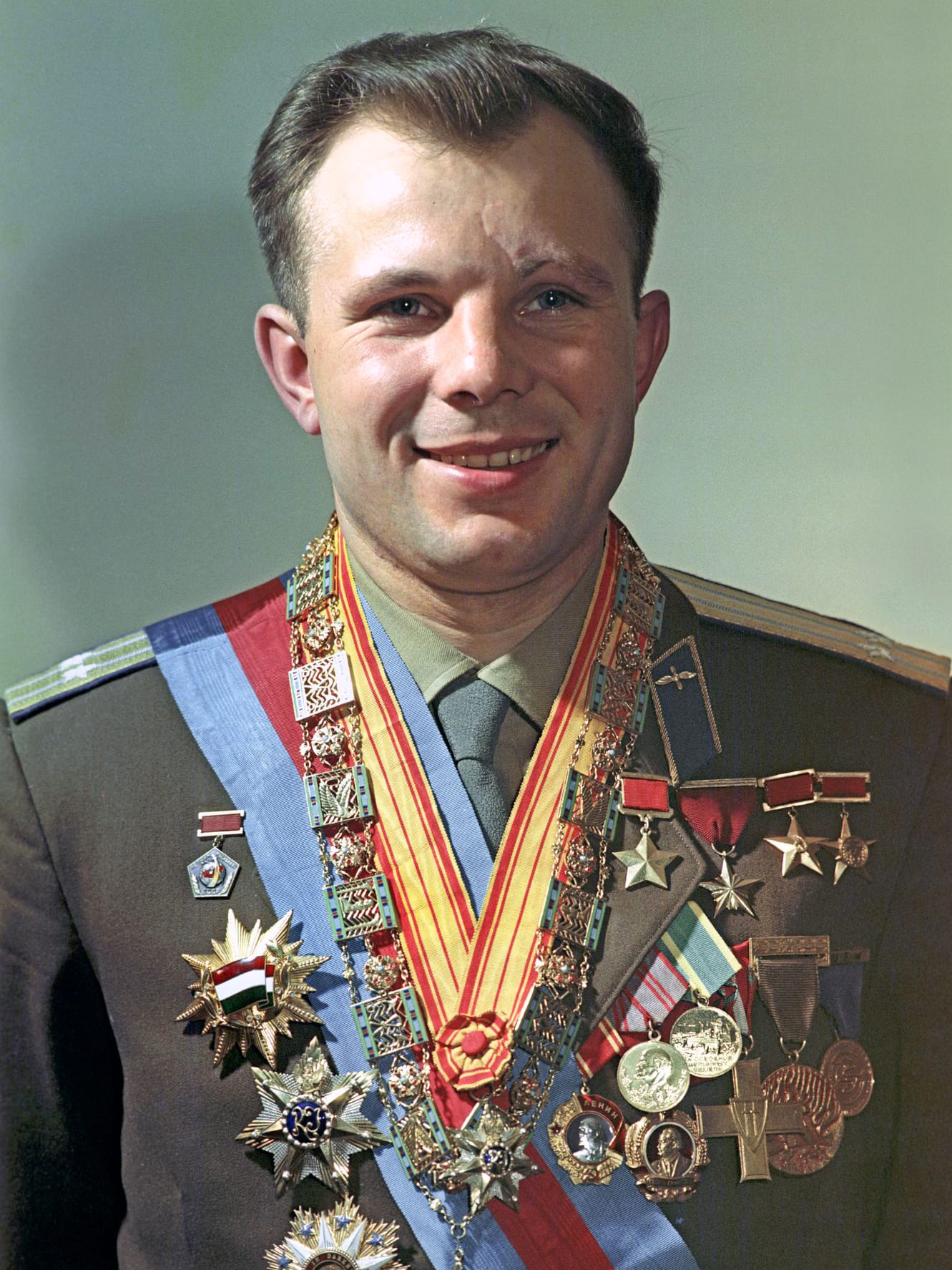
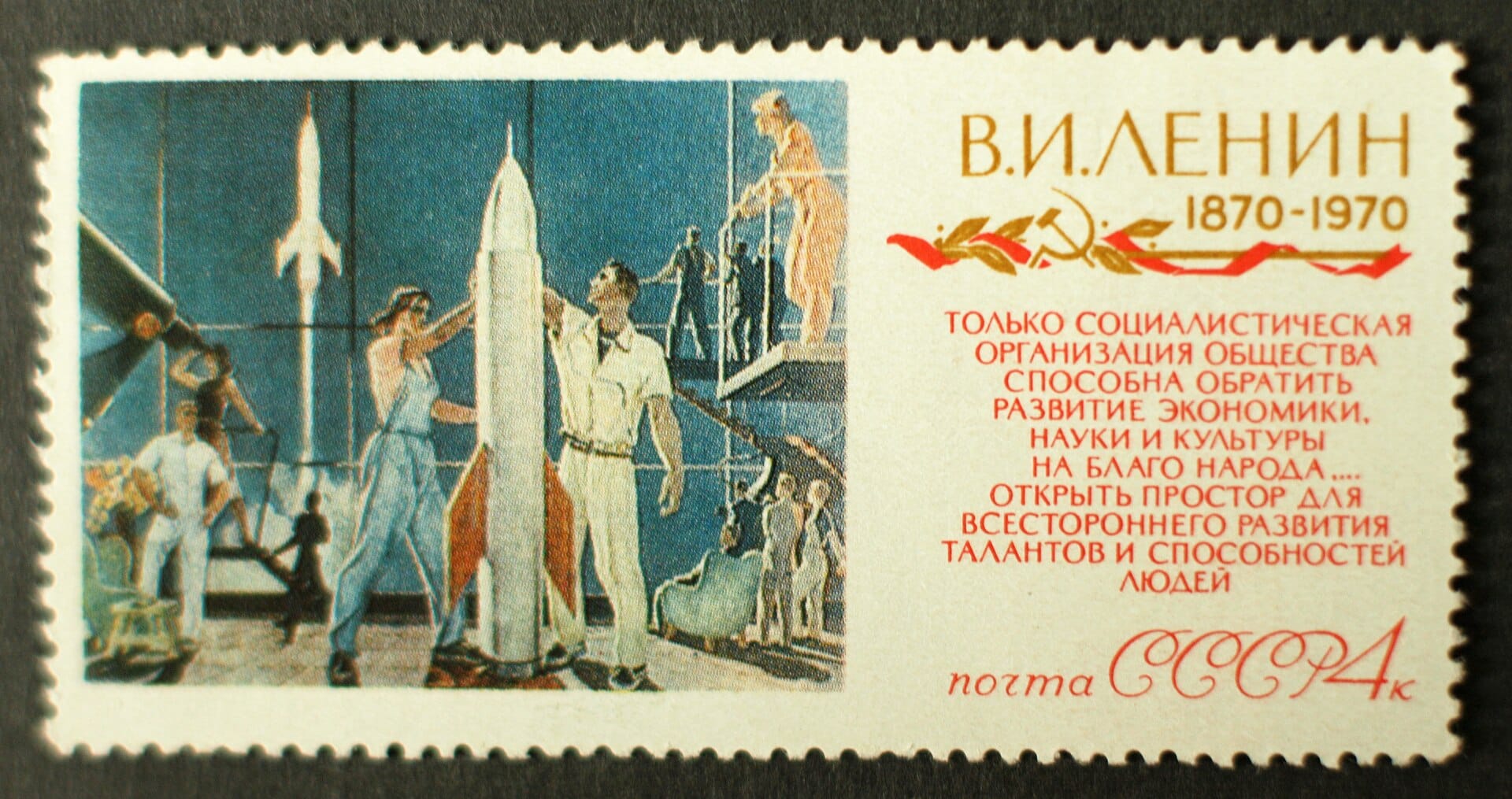
The cosmonaut cult that began on 12 April 1961 with Gagarin’s flight was, in structural terms, a direct continuation of the 1930s pilot cult. The poster designs were updated; the names changed; the technology was different. But the basic propaganda machinery was identical. Stalin had built it for his Falcons. Khrushchev inherited it. Brezhnev, Andropov, Chernenko and Gorbachev all used it. By the early 1980s the Soviet Union had launched close to fifty manned space missions, and every one of them was framed inside the same iconographic vocabulary: brass bands at takeoff, brass bands at landing, posters of the crew above every Soviet primary-school classroom for the next eighteen months.



Eight pieces, seven decades
This series breaks the seventy-year history of Soviet aviation propaganda into seven decade-length chapters. The 1920s — formation period, civil aviation, ROSTA windows, the Aviamarsh anthem, the Dobrolyot postal flights — are folded into the 1930s piece, where the genre fully matured. The series then runs:
- 1930s — Stalin’s Falcons, Chkalov, ANT-20 Maxim Gorky, Deyneka, the Rodina flight, the film Lyotchiki, OSOAVIAKhIM.
- 1940s — The Great Patriotic War. Pokryshkin and Kozhedub. The 588th Night Bomber Regiment. Aviamarsh as a battle song. The Il-2 Shturmovik in mass propaganda.
- 1950s — MiG-15 over Korea. The Soviet Union’s first jet airliner (Tu-104). Sputnik 1, October 1957. The propaganda apparatus discovers space.
- 1960s — 12 April 1961. Gagarin. “Poyekhali.” Tereshkova in 1963. Aleksey Leonov’s spacewalk 1965. The peak of the cult.
- 1970s — Salyut. Lunokhod. The routine cosmonaut. Apollo-Soyuz and the détente photograph. The propaganda begins to repeat itself.
- 1980s — Mir in orbit. Buran as the answer to the Space Shuttle. The propaganda machine is still running. The state itself is starting to fail.
- 1990s — The flag comes down. Sergei Krikalev orbits as the last Soviet citizen. NASA pays to fly its astronauts to Mir. The Aviamarsh outlives the state it was written for, surviving as ceremony and nostalgia.
Across all of it the Aviamarsh kept playing. It is, in a strange way, the unifying acoustic of the whole story — a 1923 march tune that survived Stalinism, the war, Khrushchev’s thaw, Brezhnev’s stagnation, Gorbachev’s perestroika and the dissolution of the Soviet Union itself. The lyric “higher, and higher, and higher” was played at the Red Square celebrations for Gagarin’s flight. It was played at Buran’s first and only flight in November 1988. It was played at Krikalev’s homecoming in March 1992 when he was no longer a Soviet citizen because there was no longer a Soviet Union to be a citizen of.
The Aviamarsh is still played today. Declared the official march of the Soviet Air Force in 1933, it remains the ceremonial anthem of Russia’s Aerospace Forces. It is the same tune Khayt wrote in 1923, with the same words Herman wrote in 1923. What follows over the next seven pieces is the story of what those words meant — and what aviation meant — across seven extraordinary decades of Soviet history.
Sources: Scott W. Palmer, “Dictatorship of the Air: Aviation Culture and the Fate of Modern Russia” (Cambridge University Press, 2006); Wikipedia entries on Aviamarsh, OSOAVIAKhIM, DOSAAF, Tupolev ANT-20; Russia Beyond; Open Culture; russiatrek.org propaganda poster archive.
Aviation in Soviet Propaganda — Series Index
→ Series Overview (you are here)
→ The 1940s: The Great Patriotic War
→ The 1960s: The Cult of the Cosmonaut

 English
0 Comments