
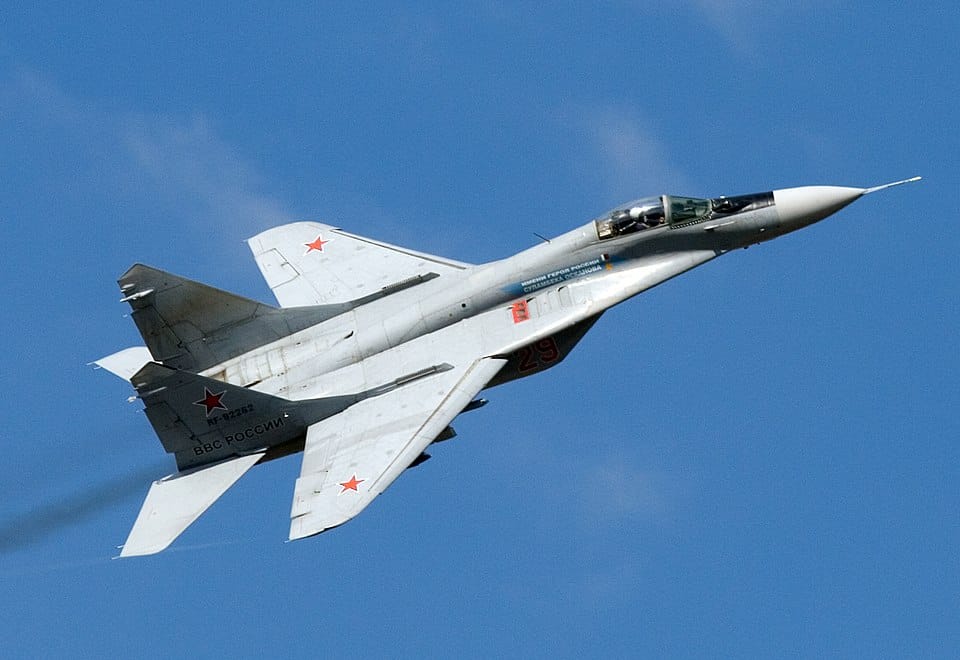
First Flight October 6, 1977
Operators 30+ nations across four continents — one of the most widely exported fighters in history
Role Air superiority fighter with secondary ground attack capability
Top Speed Mach 2.25 (2,400 km/h)
Combat Record Deployed in conflicts from the Gulf War to the Russo-Ukrainian War
MiGFlug Offered MiG-29 supersonic and Edge of Space flights for civilians from 2004 to 2017
Still Flying Active frontline service in Ukraine, India, Poland, and dozens more

The brief was simple: build a fighter that can beat the F-16. What Mikoyan delivered in 1977 was something more — an aircraft so versatile, so adaptable, and so relatively affordable that it would end up in the hands of more than 30 air forces across four continents, from the frozen bases of the Soviet Far East to the tropical airfields of Myanmar and Cuba.
The MiG-29 Fulcrum was designed for one thing: close-range air combat over the battlefields of central Europe, where NATO and Warsaw Pact fighters would meet in a war that never came. It got superbly powerful engines, a helmet-mounted sight that was decades ahead of anything in the West, and agility that stunned Western pilots who first encountered it after the fall of the Berlin Wall.
But the Cold War ended, the Soviet Union collapsed, and the MiG-29's story was only beginning. Because now, instead of facing the F-16, the Fulcrum would be sold to anyone who could afford one — and sometimes to both sides of the same conflict.
From Moscow to Everywhere
The Fulcrum's export career reads like a cold-war thriller crossed with an arms dealer's spreadsheet. East Germany operated 24 of them — and when reunification came in 1990, those jets became NATO property overnight. German Luftwaffe pilots flew the MiG-29 alongside F-4 Phantoms, and the evaluation that followed sent shockwaves through Western air forces: in close-range dogfights, the MiG-29's combination of thrust vectoring, the Archer infrared missile, and that revolutionary helmet-mounted sight made it a genuine threat to anything NATO flew.
India became the largest non-Soviet operator, buying over 60 aircraft and upgrading them repeatedly. Poland chose the Fulcrum as its first post-Warsaw Pact fighter. Bangladesh, Myanmar, Algeria, Syria, Iraq, Iran, North Korea, Eritrea, Sudan, Peru — the list goes on. By the mid-2000s, MiG-29s were patrolling airspace on every continent except Antarctica.
What made it so popular was not just performance — it was simplicity. The MiG-29 was designed to operate from rough strips with minimal ground equipment. Its intake doors close during taxiing to prevent foreign object ingestion, with auxiliary intakes on top of the wing root feeding the engines instead. It was a fighter built for austere conditions, and many of its operators had exactly that.

Combat Record: Mixed but Never Dull
The MiG-29's combat record is complicated. Iraqi Fulcrums were overwhelmed by coalition F-15s during the 1991 Gulf War — but they were outnumbered, poorly supported, and facing the most capable air force in the world. Serbian MiG-29s fought bravely in 1999 but were shot down by NATO's superior situational awareness and beyond-visual-range missiles. In both cases, the aircraft was let down by the system around it, not by its own capabilities.
The Fulcrum's most consequential combat deployment is happening right now. Ukrainian MiG-29s — upgraded with the ability to carry Western weapons, including HARM anti-radiation missiles and JDAM guided bombs — have been fighting Russian aircraft and air defences since February 2022. Ukrainian pilots have achieved air-to-air kills with the type, and the MiG-29 has proven adaptable enough to integrate weapons its designers never imagined.
It is a remarkable second act for a fighter designed nearly 50 years ago to fight a war that never happened — now fighting a very real one, with weapons from the other side of the Iron Curtain bolted under its wings.
Flying the Fulcrum as a Civilian
For most people, the MiG-29 is something seen in news footage or airshow displays. But for a select few civilians, it has been something far more visceral — an aircraft they have actually flown in.
MiGFlug offered MiG-29 flights for civilians from 2004 until 2017 — first at Zhukovsky airfield outside Moscow, later at Nizhny Novgorod. These were not gentle joyrides. Passengers flew in the rear seat of a two-seat MiG-29UB with a Russian military test pilot up front, experiencing supersonic flight, high-G manoeuvres, and — for those who chose the Edge of Space package — climbs to altitudes above 20 kilometres, where the curvature of the Earth becomes visible and the sky turns black.
It was the most extreme civilian aviation experience available anywhere in the world. No other programme offered supersonic flight and stratospheric climbs in a frontline fighter jet. When political and logistical changes ended the MiG-29 flights in 2017, nothing replaced them. For eight years, supersonic civilian flights simply did not exist.
Supersonic Flights Are Back
After a break from 2017 to the end of 2025, supersonic flights are available again for civilians for the first time in eight years — worldwide. MiGFlug has launched a new programme offering supersonic flights in the MiG-21, bringing back the experience of breaking the sound barrier in a fighter jet. It is a different aircraft with its own character — the MiG-21 is lighter, more agile at low altitudes, and carries its own legendary status as the most-produced supersonic fighter in history.
For anyone who dreamed of flying the Fulcrum but missed the window, the MiG-21 programme is the closest thing to a second chance. The sensation of supersonic acceleration in a fighter jet — the kick in the back, the Mach meter climbing past 1.0, the sonic boom trailing behind you — is back on the table.
The MiG-29 was built for a war between superpowers that never came. Instead, it became one of the most widely flown fighters in history — a Cold War warrior that found work on every continent, in every kind of conflict, and eventually carried civilians to the edge of space. Nearly 50 years after its first flight, the Fulcrum is still flying, still fighting, and still surprising everyone who underestimates it.
Sources: Air Force Technology, Military Watch Magazine, MiGFlug
Related Questions
What is the MiG-29?
The Mikoyan MiG-29 (NATO reporting name "Fulcrum") is a Soviet twin-engine air-superiority fighter that first flew on 6 October 1977. Designed to counter the American F-16, it became one of the most widely exported fighters ever, serving with more than 30 nations across four continents.
How fast is the MiG-29?
The MiG-29 has a top speed of about Mach 2.25, roughly 2,400 km/h. It is a highly agile air-superiority fighter with secondary ground-attack capability, and its raw performance made it a star of MiGFlug's civilian fighter-jet flight experiences.
Why was the MiG-29 built?
The MiG-29 was developed in the 1970s to counter new American fighters, especially the F-16, in a European dogfight. Mikoyan delivered an aircraft so versatile and affordable that it spread far beyond the Warsaw Pact to operators on nearly every continent.
How many countries operate the MiG-29?
More than 30 nations across four continents have operated the MiG-29, making it one of history's most widely exported fighters. It remains in frontline service in Ukraine, India and Poland, and its global spread is charted in MiGFlug's military aviation history.
Can civilians fly in a MiG-29?
Civilians could fly in a MiG-29 through MiGFlug, which offered supersonic and "Edge of Space" flights from 2004 to 2017. Passengers reached the stratosphere and experienced the curvature of the Earth aboard the same Fulcrum that still equips fleets like North Korea's air force.
Is the MiG-29 still in service?
Yes. Decades after its 1977 debut, the MiG-29 remains in active frontline service with Ukraine, India, Poland and many other nations, and has seen combat from the Gulf War to the Russo-Ukrainian War. Its enduring spread is traced in MiGFlug's aviation history overview.
 English
0 Comments