
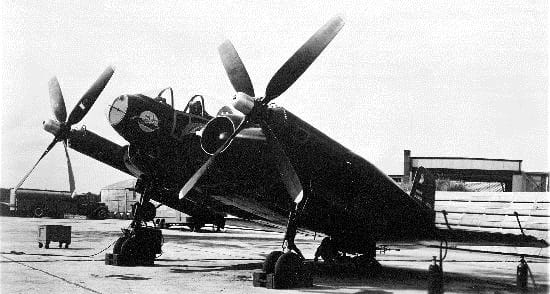
Picture a fighter shaped like a dinner plate. Not a sleek dart, not a graceful sweep of wings — a fat, near-circular disc with a bubble canopy stuck on top and two enormous propellers windmilling at the tips. It looks like something that should be hovering over a cornfield, abducting cattle. People who saw it fly in the 1940s genuinely reported UFOs.
This was the Vought Flying Pancake, and for a brief, strange moment the U.S. Navy thought it might be the future of carrier aviation. It could crawl through the air at bicycle speed without falling out of the sky, then — in theory — sprint past 400 mph. It was one of the most radical aircraft America ever built.
And the fighter version, the XF5U, never flew. Not once.
Quick Facts
- Type: Experimental US Navy fighter (XF5U-1); the V-173 was its wooden proof-of-concept
- Designer: Charles H. Zimmerman, Chance Vought
- V-173 first flight: 23 November 1942 (test pilot Boone Guyton)
- XF5U-1: two built; never achieved true flight
- Configuration: near-circular, very low-aspect-ratio "all-wing" lifting body with wingtip propellers
- Estimated top speed (XF5U): roughly 425-450 mph
- Fate: cancelled 17 March 1947; the XF5U scrapped ~1948; the V-173 survives, restored, in Dallas
A wing shaped like a plate
The brain behind the madness was Charles Zimmerman, an engineer who became obsessed with a heretical idea: what if the whole aircraft was the wing? A short, stubby, almost circular wing should have been an aerodynamic disaster, because tiny wings bleed away lift in swirling vortices at their tips. Zimmerman's fix was audacious. He bolted big propellers right at the wingtips and spun them against those vortices, cancelling the drag that normally punishes such a shape.
The payoff, on paper, was spectacular. A wing that refused to stall. An aircraft that could take off in almost no distance and mush along at a walking pace — perfect for a pitching carrier deck — yet still chase down enemy fighters. It was carrier aviation's holy grail wrapped in the silhouette of a flying saucer.
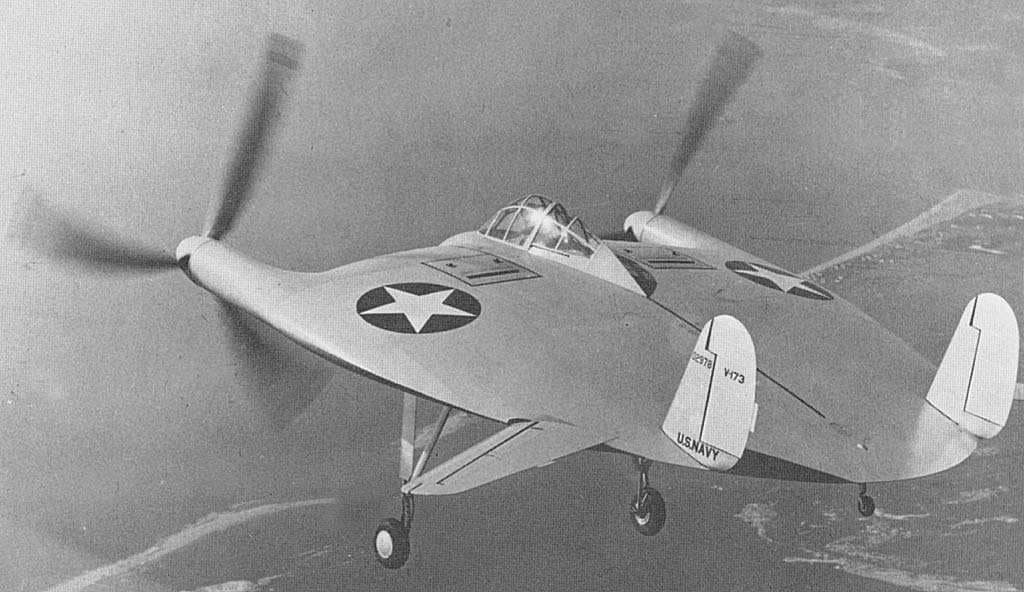
To prove the concept without betting the budget on it, Vought first built a featherweight testbed: the V-173, a wood-and-fabric contraption weighing barely a tonne and powered by two tiny 80-horsepower engines. On 23 November 1942, test pilot Boone Guyton coaxed it into the air over Connecticut.
The plane that wouldn't stall
The little Skimmer flew roughly 190 times over the next few years, and it did exactly what Zimmerman promised. Test pilots — including Charles Lindbergh himself — came away amazed that they simply could not make it stall. One forced landing flipped it upside down on a beach; the pilot walked away, and the aircraft was barely scratched.
It was also slow, noisy, and it looked like nothing else in the sky. Locals kept phoning in flying-saucer sightings. The Navy, delighted, ordered the real thing.
Metalite, and the jet that killed it
The fighter, the XF5U-1, was a very different beast: all metal, roughly five times heavier, and skinned in a curious aluminium-and-balsa sandwich called Metalite. Two big Pratt & Whitney radial engines buried in the body drove those tip propellers through a maze of gearboxes and shafts.
That maze was the problem. Persistent vibration in the drivetrain, and propellers that never arrived as promised, kept the XF5U pinned to the ground. It made a few brief taxi hops and nothing more. Meanwhile, the world had changed underneath it: the jet age had arrived, and a propeller-driven pancake — however clever — suddenly looked like yesterday's answer. The Navy cancelled the programme on 17 March 1947.
The end was almost comically brutal. The sole completed XF5U was so ruggedly built that when crews tried to scrap it, a wrecking ball reportedly bounced off the Metalite skin; they had to bring out blowtorches. The fighter that never flew was destroyed on the ground around 1948.
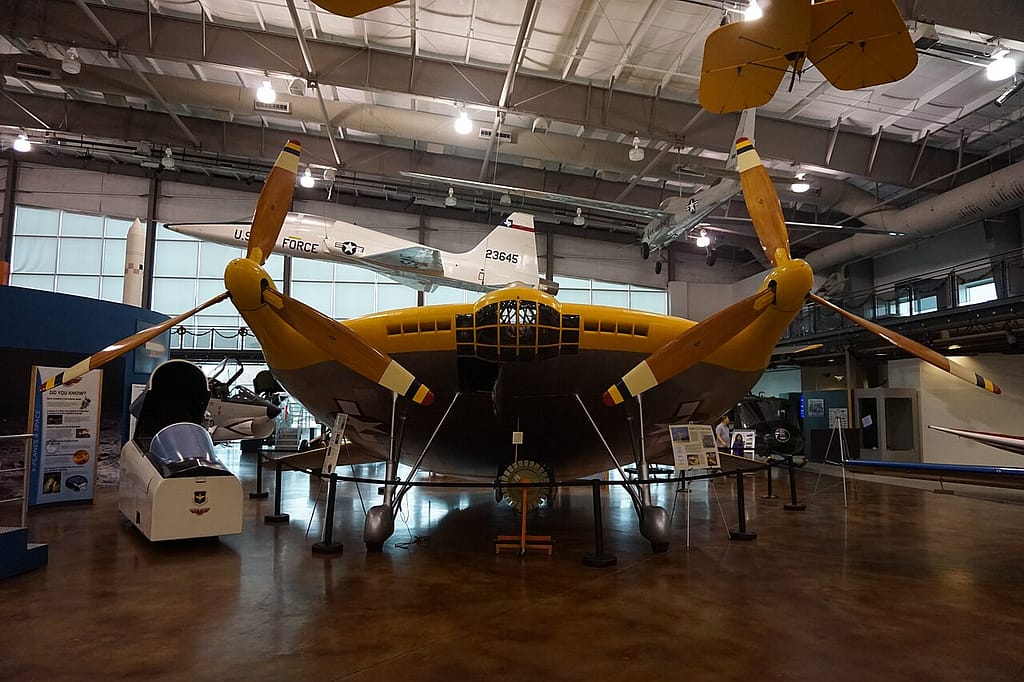
Its wooden ancestor fared better. Vought retirees lovingly restored the V-173 over eight years, and today it sits in a Dallas museum — a genuine flying saucer that turned out to be entirely, wonderfully real.
Sources: Wikipedia; PlaneHistoria; National Air and Space Museum; Frontiers of Flight Museum. Some figures (engine ratings, top speed) vary between sources and are given as ranges.
Related Posts

0 Comments