
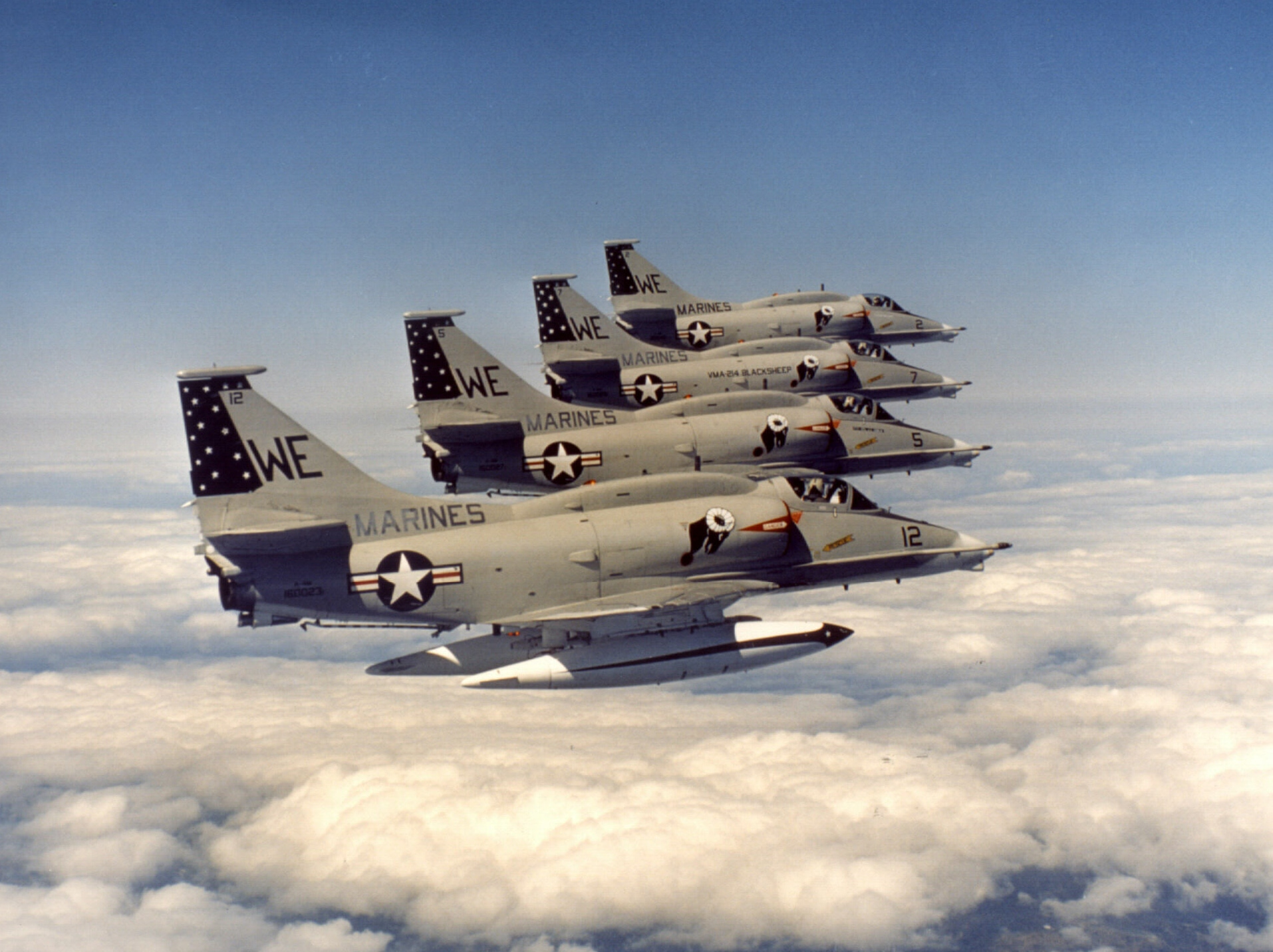
Douglas A-4 Skyhawk
“Heinemann’s Hot Rod”
The tiny carrier attack jet that came in at half the Navy’s weight limit — a delta-winged “Scooter” that flew for over half a century, from Vietnam to the Falklands, and never needed its wings to fold.
The little jet that beat its own spec
In the early 1950s the US Navy wanted a jet attack aircraft and set a ceiling: no more than 30,000 lb at takeoff. Douglas’s chief designer Ed Heinemann looked at the number and decided it was far too generous. He and his El Segundo team promised the Navy the range and payload it asked for in an aircraft weighing less than half the limit — and 90 knots faster. The prototype rolled out at an empty weight of just 7,896 lb.
The result, first flown on 22 June 1954 and in fleet service by 1956, was a masterpiece of ruthless simplicity. Its modified-delta wing was so compact (~27.5 ft span) that it did not need to fold for carrier stowage — a first for a US Navy jet and a saving of some 200 lb of hinges and hydraulics. Pilots nicknamed the nimble little machine the “Scooter,” and the press dubbed Heinemann’s creation the “Hot Rod.”
Small did not mean slight. The A-4 was designed from the start to loft-deliver a nuclear bomb, and it could haul a large conventional load on five hardpoints. It became the US Navy and Marine light-attack workhorse over Vietnam, equipped the Blue Angels, taught fighter pilots as a TOPGUN aggressor, and went to war for Israel, Argentina and Kuwait. Production ran an extraordinary 25 years to ~2,960 aircraft, and the type served on somewhere for more than 70 years.
01How Ed Heinemann built the A-4 Skyhawk at half the Navy’s weight limit
Heinemann treated every pound as the enemy. He deleted the wing-fold mechanism by making the wing small enough to fit carrier hangars as-is; he consolidated the avionics into a single package to save wiring and weight; he redesigned the ejection seat with roughly a third fewer parts; and he kept the structure and systems as simple as the mission allowed. The payoff was an attack jet that was cheap to build, easy to maintain, hard to break and delightful to fly.
The Navy’s specification had allowed 30,000 lb. The XA4D-1 prototype came in at an empty weight under 8,000 lb and a design gross weight far below the ceiling — while still meeting the range and payload the Navy demanded. It was one of the purest expressions of the idea that the best part is no part, and it defined a career that outlasted almost every contemporary.
What makes the A-4 Skyhawk special
Minimalism as a weapon
Heinemann’s philosophy was subtraction. By making the wing small enough to skip the fold, packaging the avionics tightly and simplifying every system, he produced an attack jet at roughly half the Navy’s 30,000 lb weight ceiling. Light meant cheap, rugged, agile and easy to maintain — the qualities that kept the “Scooter” in service for decades.
Delta wing, growing engine
The compact modified-delta wing gave good load-carrying and honest handling without needing to fold. Early A-4s (A/B/C) used the Wright J65 turbojet; from the A-4E onward the aircraft switched to the more powerful Pratt & Whitney J52, reaching about 11,200 lbf in the A-4M. Singapore later re-engined its fleet with a modern F404 turbofan.
A heavyweight punch for a featherweight
Despite its size the Skyhawk was built as a nuclear striker, designed to toss an early tactical bomb clear using LABS loft-bombing, and later cleared for weapons such as the B43/B57/B61. Conventionally it carried up to roughly 4,500 kg (~9,900 lb) of ordnance plus two 20 mm cannon — a remarkable load for so small an airframe.
02The A-4 Skyhawk’s wing: why it never needed to fold
Every other US Navy jet of its era folded its wings to fit the crowded carrier hangar deck. The Skyhawk did not. Heinemann sized the delta wing at about 27.5 ft span — small enough to strike below and park without any folding joint at all. Deleting that mechanism saved an estimated 200 lb of structure, hydraulics and maintenance, and removed a common source of failures. It became the aircraft’s signature trait and a neat symbol of the whole design: solve the problem by removing weight, not adding it.
03The A-4 Skyhawk as a nuclear bomber: LABS and the toss
Behind the modest “light attack” label, the A-4 was conceived as a carrier-based tactical nuclear delivery aircraft. Using the Low-Altitude Bombing System (LABS), a lone Skyhawk would sprint in at low level, pull up into a climbing arc and release its weapon so that it was “tossed” forward onto the target while the aircraft rolled and dived away to escape the blast. Early on it carried weapons such as the Mark 7 and Mark 12; later variants were cleared for the B43, B57 and B61. The mission shaped the airframe — small, fast at low level and long-legged for its size.
Full specifications — A-4M Skyhawk II
Airframe & Performance
- Bemanning
- 1 (two-seat trainers seat 2)
- Lengte
- ~12.3 m (40 ft 3 in)
- Spanwijdte
- ~8.4 m (27 ft 6 in) — non-folding
- Hoogte
- ~4.6 m (15 ft 0 in)
- Leeggewicht
- ~4,750 kg (~10,465 lb)
- Max takeoff weight
- ~11,100 kg (~24,500 lb)
- Max speed
- ~1,080 km/h (~670 mph) · sources vary ~1,040–1,105
- Gevechtsradius
- ~625 km (~340 nm) · load-dependent
- Serviceplafond
- ~12,900–13,500 m (~42,000–44,000 ft)
Propulsion & Armament
- Motor
- 1 × Pratt & Whitney J52-P-408
- Thrust
- ~11,200 lbf (~49.8 kN)
- Cannon
- 2 × 20 mm Colt Mk 12 (200 rpg)
- External load
- Up to ~4,500 kg (~9,900 lb) on 5 hardpoints
- Nuclear role
- LABS toss delivery (Mk 7/12, later B43/B57/B61)
- First flight
- 22 June 1954
- Built
- ~2,960 (1954–1979)
- Unit cost
- ~$860,000 (early A-4, 1960s) · estimate
- Cost per flight hour
- No reliable public figure
04The A-4 Skyhawk’s specifications: why the numbers vary
The A-4 was built in many variants over 25 years, so a single spec sheet never tells the whole story. Figures here are for the late A-4M Skyhawk II. Even for one variant, published maximum speeds range from about 645 to 688 mph and quoted bomb loads run from roughly 9,150 to 9,900 lb depending on the source and configuration — so treat those as ranges, not exact values. The A-4 was famously cheap for its day: early aircraft are commonly cited around $860,000, a fraction of the fighters around it. No reliable modern cost-per-flight-hour figure exists in open sources.
Seven decades of the Scooter
The under-weight bet
Douglas and Ed Heinemann win the Navy light-attack contract with a design at roughly half the 30,000 lb weight limit.
First flight
The XA4D-1 prototype flies on 22 June with Douglas test pilot Robert Rahn at the controls.
Enters the fleet
The A4D-1 reaches operational Navy squadrons, beginning a service life that would run for decades.
Vietnam workhorse
The A-4 becomes the Navy and Marines’ primary carrier light bomber, flying tens of thousands of Rolling Thunder sorties.
McCain and the Forrestal
Lt Cdr John McCain survives the 29 July Forrestal fire in his A-4, then is shot down in an A-4E over Hanoi on 26 October.
The Yom Kippur crucible
Israel’s Skyhawks carry the ground-attack load and take heavy losses to Egyptian and Syrian SAM belts.
The Blue Angels years
The US Navy flight-demonstration team flies the nimble, economical A-4F Skyhawk II for twelve seasons.
Falklands strikes
Argentine A-4s press home low-level attacks on the Royal Navy, sinking and damaging warships at heavy cost.
The last operators
Singapore retires in 2005 and Argentina in May 2026, leaving Brazil’s navy the world’s final military Skyhawk operator.
From the deck: twelve Skyhawk stories
Half the weight, all the punch
Heinemann bet he could beat the Navy’s 30,000 lb limit by 50% — and won.
Read the full story
The wing that never folded
Every carrier jet folds its wings — except the Scooter.
Read the full story
Why they called it the Scooter
Small, light and quick, the A-4 buzzed around the deck like a scooter in traffic.
Read the full story
A tiny jet built to carry the bomb
Behind the “light attack” label, the A-4 was a nuclear striker from day one.
Read the full story
McCain’s two brushes with death in 1967
Twice in three months, disaster found John McCain in an A-4.
Read the full story
The Zuni that burned the Forrestal
A single stray rocket caused the Navy’s worst carrier fire since WWII.
Read the full story
The Scooter goes show-business
From 1974 the Blue Angels traded the thirsty Phantom for the nimble A-4.
Read the full story
Red Air’s favourite little jet
The A-4’s size and agility made it a superb stand-in for enemy fighters.
Read the full story
Skyhawks against the Royal Navy
In 1982 Argentine A-4 pilots pressed suicidally low attacks on the British fleet.
Read the full story
The Ayit in the wall of SAMs
Israel’s Skyhawks carried the load in 1973 — and paid dearly.
Read the full story
Skyhawks off the highway
When Iraq invaded in 1990, Kuwaiti A-4 pilots fought from public roads.
Read the full story
The Super Skyhawk reborn
Singapore ripped out the old engine and gave the A-4 a modern turbofan.
Read the full story
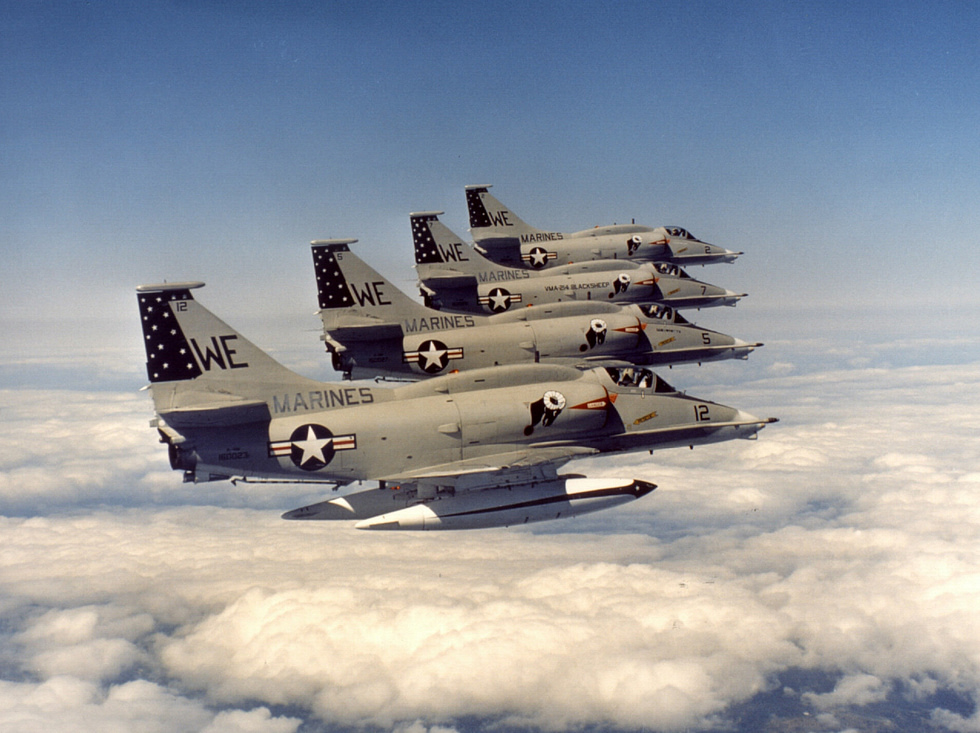
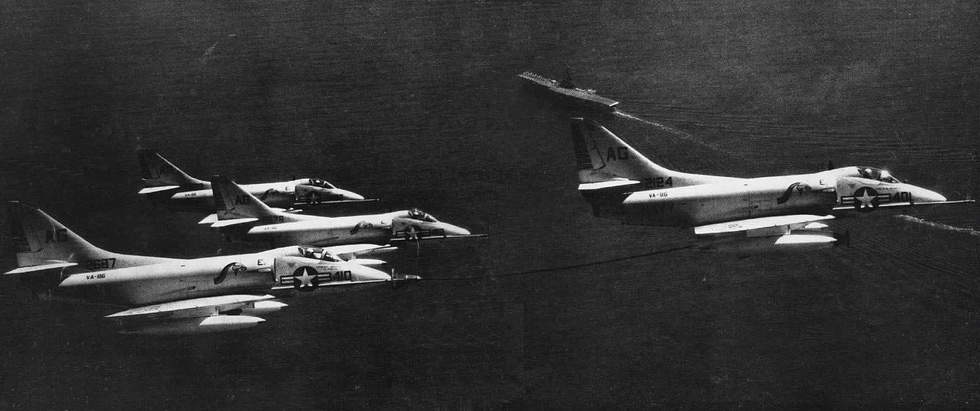
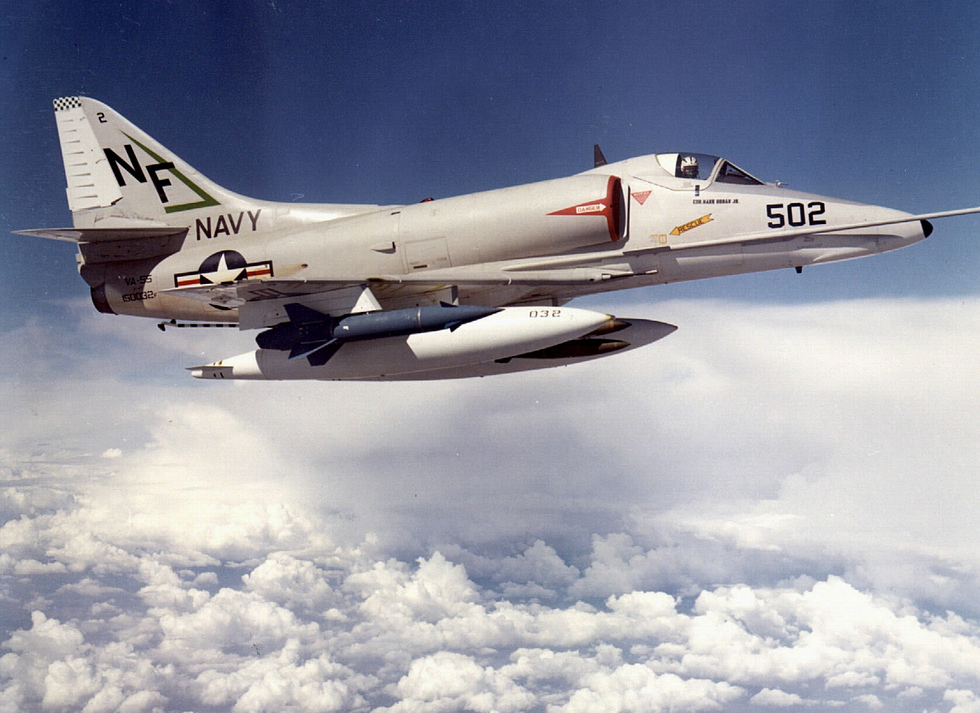
The Skyhawk in pictures
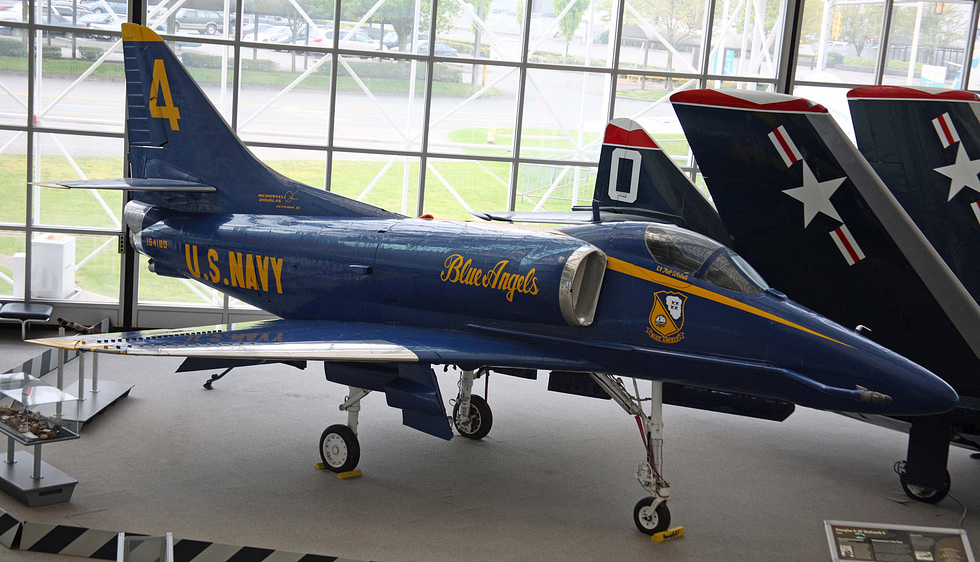
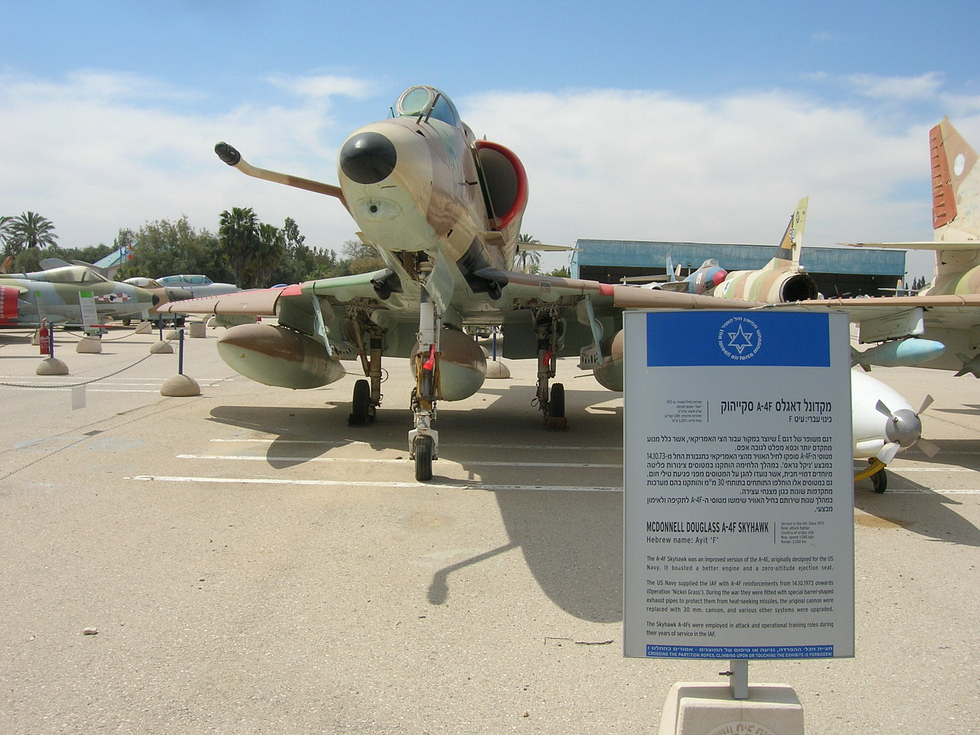
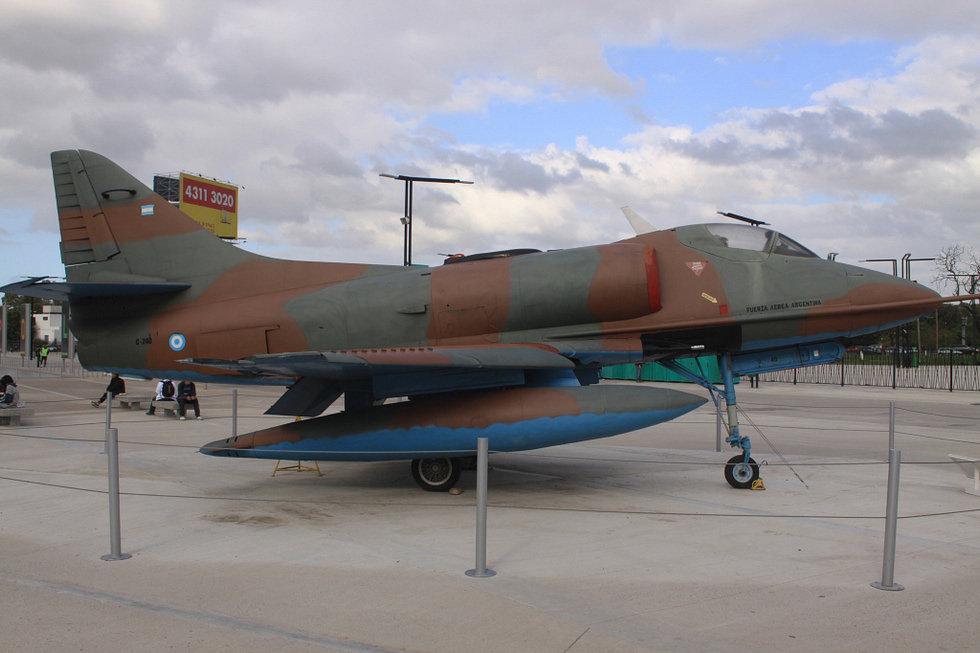
The A-4 Skyhawk in motion
Yarnhub — one of the most-watched A-4 Skyhawk films on YouTube.
Where the Skyhawk flew
The score that defines it
The A-4 was an attack jet, not a dogfighter, so its record is written in bombs delivered, ships hit and sorties survived rather than air-to-air kills. It was the US Navy’s light-attack backbone over Vietnam, Israel’s hardest-worked striker in 1973, and the jet that bloodied the Royal Navy in 1982 — often at a punishing cost to its own crews. Loss figures are contested and quoted here as ranges.
Compare the combat record of every military aircraft. Figures as of July 2026.
Everything people ask about the A-4 Skyhawk
Can I fly in an A-4 Skyhawk?
Why is it called “Heinemann’s Hot Rod”?
Why didn’t the wings fold?
How many A-4 Skyhawks were built?
Was John McCain flying an A-4?
What ships did Argentine Skyhawks sink?
Could the A-4 carry a nuclear bomb?
Is the A-4 Skyhawk still in service?
You can’t fly the A-4 Skyhawk.
These, you can.
Some legends only live in museums — others are fuelled and waiting. MiGFlug has put civilians in real military jet cockpits since 2004.
 Fly the L-39 AlbatrosThe world’s most-flown jet trainer — aerobatics included
 Fly the F-104 Starfighter“The missile with a man in it”
 Fly the MiG-21The Cold War’s most-produced jet
 Vlieg met de T-33 Shooting StarAmerica’s first jet trainer
 Fly the DH VampireA piece of early jet history
 Fly the S.211Agile Italian jet trainer
 Fly the MB-326The classic Aermacchi jet
 Fly the MiG-15The Soviet legend of the Korean War
Continue the tour
Every fact, checked
- HistoryNet — Heinemann’s Hot RodThe design story and the under-weight bet that produced the Skyhawk.
- The Skyhawk AssociationProduction history, and the Israeli, Argentine, Kuwaiti and Singaporean combat records.
- Naval History and Heritage CommandThe 1967 USS Forrestal fire and US Navy Skyhawk service.
- Military FactoryA-4M specifications, engine and armament data.
- Flying Leathernecks Aviation MuseumA-4M dimensions, weights and performance figures.
- FactCheck.orgJohn McCain’s 26 October 1967 shootdown in an A-4E.
- The AviationistArgentina’s 2026 A-4AR retirement and Falklands operations.
- Sea Power Centre (RAN)Australian A-4G Skyhawk carrier operations.