
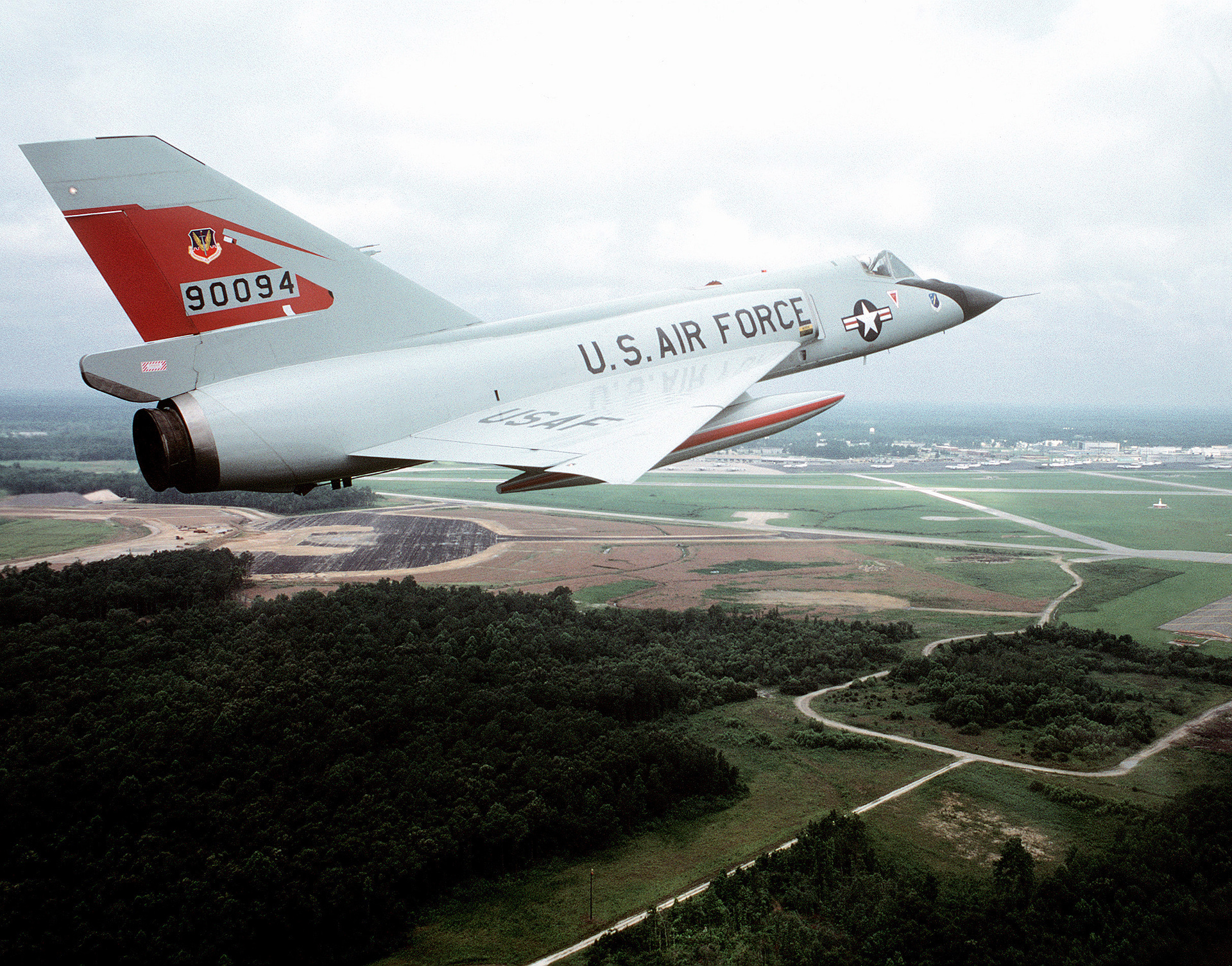
Convair F-106 Delta Dart
“The Ultimate Interceptor”
America’s last dedicated interceptor — a tailless delta built to catch Soviet bombers over the Arctic, flying nuclear-tipped rockets under the automated eye of the SAGE air-defence network, and the fastest single-engine jet the world has ever timed.
The USAF’s “Ultimate Interceptor”
In the 1950s the United States expected the next war to arrive over the North Pole — waves of Soviet bombers carrying nuclear weapons toward American cities. The answer was a continental shield of radar, computers and interceptors, and its sharpest point was meant to be the Convair F-106 Delta Dart. Developed from the earlier F-102 Delta Dagger — it began life as the F-102B before its changes proved so extensive that it was redesignated a new type in 1956 — the F-106 was, in the language of the day, the “Ultimate Interceptor.”
The recipe was single-minded: a tailless delta wing, one enormous Pratt & Whitney J75 turbojet, and a mission that was pure air defence. First flown on 26 December 1956 and operational from 1959, the Delta Dart was not built to dogfight or drop bombs. It was built to be vectored by ground computers onto a bomber at 40,000 feet, at twice the speed of sound, and to destroy it — if necessary with a nuclear rocket. Crews and fans alike simply called it “the Six.”
What made the Six remarkable was less the airframe than the system around it. It was a node in SAGE — the Semi-Automatic Ground Environment — a continent-spanning network of radars and computers that could fly the interception for the pilot, steering the aircraft by datalink through its Hughes MA-1 fire-control system. In an age before microchips, the MA-1 filled the jet with hundreds of black boxes. The F-106 never fired a shot in anger; instead it stood alert for nearly three decades, and its story is told in records, longevity and one of the strangest incidents in aviation history — the day a pilotless Delta Dart landed itself in a Montana field.
01The F-106 Delta Dart and the F-102: from Delta Dagger to Ultimate Interceptor
The F-106 grew directly out of the F-102 Delta Dagger, America’s first delta-wing interceptor. The F-102 had been troubled — it could not go supersonic in level flight until its fuselage was reshaped to the “area rule” — and the Air Force wanted far more performance. The improved aircraft, originally the F-102B, gained a much more powerful J75 engine, a redesigned intake and fuselage, and the advanced MA-1 fire-control system. The changes were so sweeping that in 1956 it was redesignated the F-106A, a new type in all but ancestry. The result roughly doubled the Dagger’s capability and gave Air Defense Command the interceptor it had wanted all along — even if it arrived years later and in far smaller numbers than first planned.
What makes it special
A tailless delta and the J75 — Mach 2 at the edge of the stratosphere
The F-106 pairs a clean tailless delta wing with a single Pratt & Whitney J75 turbojet of about 24,500 lbf (109 kN) in afterburner. The delta gives huge internal volume for fuel and a docile high-altitude ride; the J75 gives the thrust to reach roughly Mach 2.3 and to zoom-climb well above its ~57,000 ft service ceiling. It is optimised for one profile above all: a fast, high climb to meet a bomber head-on.
SAGE and the MA-1 — an interceptor flown by computer
The Six was designed to be steered by the ground. Plugged into the SAGE air-defence network, its Hughes MA-1 fire-control system received an interception by datalink and could fly the aircraft to the firing point almost hands-off, then trigger its weapons. The MA-1 was so complex — commonly cited at well over 2,000 pounds of electronics in some 200 “black boxes” — that it was reportedly never fully debugged, and was upgraded for years after the jet entered service.
The AIR-2 Genie — a nuclear air-to-air rocket
The F-106’s signature weapon was the unguided Douglas AIR-2 Genie, a rocket tipped with a roughly 1.5-kiloton nuclear warhead. The idea was brutal but logical: a single nuclear burst in the middle of a bomber stream would destroy anything nearby, no precision guidance required. The Genie sat in the internal weapons bay alongside guided AIM-4 Falcon missiles — the Six carried no gun at all when it entered service.
02The F-106 Delta Dart’s SAGE and MA-1 system: automated interception in the vacuum-tube age
SAGE was one of the largest computer projects of the early Cold War: a chain of blockhouses full of room-sized vacuum-tube computers that fused radar tracks into a single air picture and could hand an interception straight to a fighter. Aboard the F-106, the MA-1 fire-control system flew that interception. Ground controllers could uplink steering commands, and the aircraft could be guided to the firing solution automatically, the pilot largely monitoring rather than flying. It was a genuinely futuristic idea for the late 1950s — and a fragile one. The MA-1 was famously troublesome, receiving a long series of modifications over its service life. Read the automation claims of the era with some caution: the system worked, but never quite as seamlessly as the brochures suggested.
03The F-106 Delta Dart’s armament: the Genie nuclear rocket and the gun that came late
When it entered service the F-106 carried no gun — interceptor doctrine of the day held that missiles and a nuclear rocket had made cannon obsolete. Its internal bay held up to four AIM-4 Falcon guided missiles and a single AIR-2 Genie nuclear rocket. Combat over Vietnam soon exposed the limits of missile-only fighters, and from around 1972 many F-106s were retrofitted with an internal 20 mm M61 Vulcan cannon in a programme nicknamed the “Six Shooter,” which also added a clearer canopy. The Genie was only ever fired with a live warhead once, in the 1957 “John” test — and never in combat.
Full specifications
Airframe & Performance
- Bemanning
- 1 (two-seat F-106B trainer seats 2)
- Lengte
- ~21.6 m (70 ft 9 in)
- Spanwijdte
- ~11.7 m (38 ft 4 in)
- Hoogte
- ~6.2 m (20 ft 4 in)
- Max takeoff weight
- ~17,350 kg (~38,250 lb)
- Max speed
- ~Mach 2.3 · ~1,525 mph (2,455 km/h)
- Initial climb rate
- ~9,100 m/min (~30,000 ft/min)
- Serviceplafond
- ~17,000 m (~57,000 ft)
- Gevechtsradius
- ~925 km (~575 mi) on internal fuel
Propulsion & Systems
- Motor
- 1 × Pratt & Whitney J75-P-17 turbojet
- Thrust
- ~109 kN (24,500 lbf) with afterburner
- Fire control
- Hughes MA-1 (SAGE datalink)
- Bewapening
- 4 × AIM-4 Falcon + 1 × AIR-2 Genie; 20 mm M61 from ~1972
- First flight
- 26 December 1956
- In service
- 1959 (retired 1988)
- Built
- 340 (277 F-106A + 63 F-106B)
- Unit cost
- ~$4.7 million (early-1970s estimate)
- Cost per flight hour
- No reliable public figure
04The F-106 Delta Dart’s operating costs: what the numbers really tell us
Firm cost figures for the F-106 are scarce and inconsistent, as is usual for a 1950s–60s military aircraft. Contemporary sources place the flyaway unit cost very roughly in the region of $4–5 million in early-1970s dollars, but this should be read as an order-of-magnitude estimate rather than a precise, audited price. No reliable public cost-per-flight-hour figure exists for the type. What is better documented is the aircraft’s reputation for reliability: the F-106 is often cited as having one of the lowest accident rates of any Century-series fighter, which helped keep it economical enough to serve for almost thirty years. Treat any exact dollar figure attached to the Six with healthy scepticism.
Three decades on continental alert
Redesignated & first flight
The heavily revised F-102B is redesignated the F-106A; the first aircraft flies on 26 December 1956 at Edwards AFB.
Enters service & sets a record
The Six joins Air Defense Command; on 15 December Major Joe Rogers sets a world speed record of 1,525.695 mph — still unbeaten for single-engine jets.
The SAGE shield
F-106 squadrons stand nuclear-armed alert across the US and Iceland, plugged into the SAGE network against the Soviet bomber threat.
The Cornfield Bomber
On 2 February a pilotless F-106 recovers from a flat spin after its pilot ejects and belly-lands itself, engine running, in a Montana field.
The gun comes back
The “Six Shooter” upgrade adds an internal 20 mm M61 Vulcan cannon and a clearer canopy — missiles alone were no longer enough.
The Guard’s last interceptor
As newer fighters take over air defence, the F-106 soldiers on with the Air National Guard, the last of the pure interceptors.
Retirement
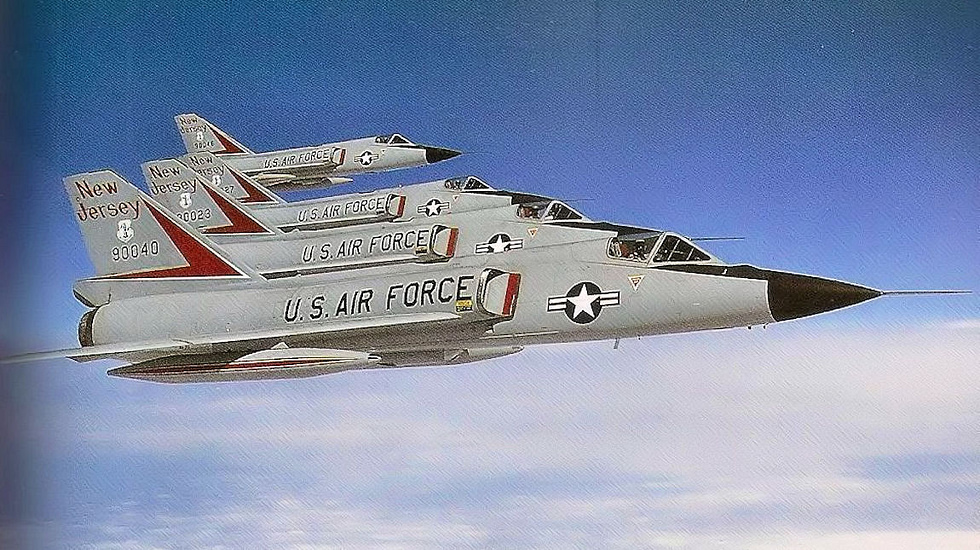
The last operational F-106s leave service with the 119th Fighter-Interceptor Squadron of the New Jersey Air National Guard.
A second life as a drone
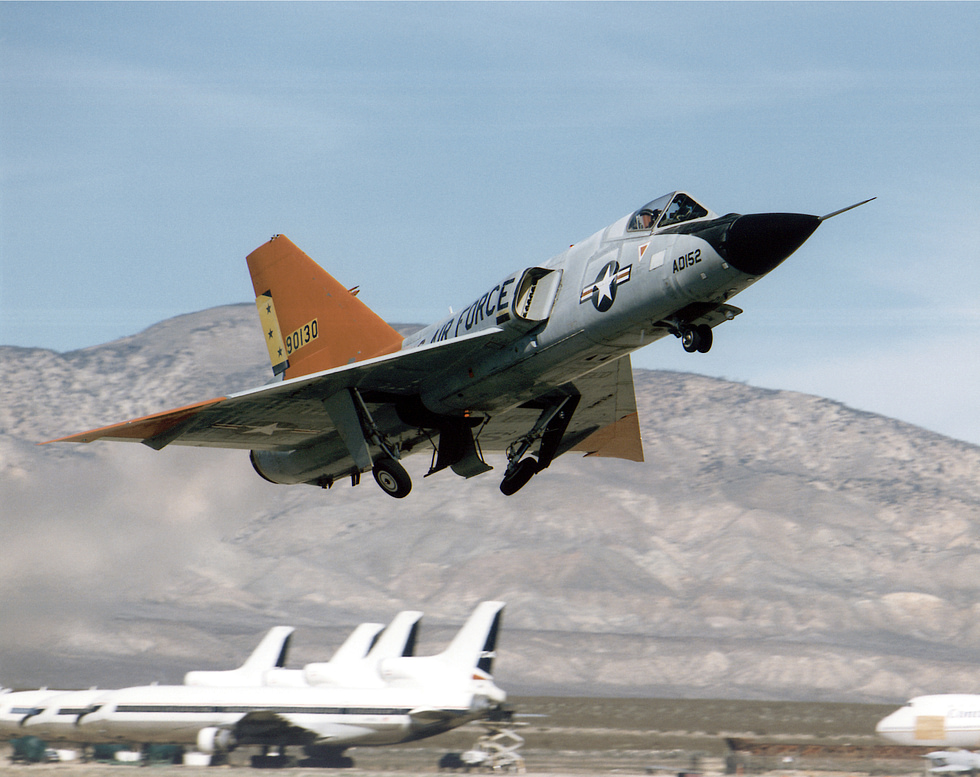
Under the Pacer Six programme, roughly 190 retired airframes are converted to QF-106 target drones, flying on into the late 1990s.
Twelve stories of the Six
From Delta Dagger to Delta Dart
The F-106 began as an improved F-102 before becoming a new type entirely.
Read the full story
Why crews called it “the Six”
Officially the Ultimate Interceptor, informally just the Six.
Read the full story
The interceptor flown by computer
Ground computers could steer the F-106 to its target by datalink.
Read the full story
A nuclear rocket for air combat
The AIR-2 Genie carried a nuclear warhead meant to destroy a whole bomber formation.
Read the full story
Two hundred black boxes
The F-106’s fire-control system was one of the most complex of its era.
Read the full story
The fastest single-engine jet ever timed
Major Joe Rogers set a world speed record that still stands for its class.
Read the full story
The Cornfield Bomber
A pilotless F-106 recovered from a spin and landed itself in a field.
Read the full story
The Six Shooter
Combat over Vietnam brought the cannon back to the missile-only interceptor.
Read the full story
Never fired in anger
For all its firepower, the F-106 never shot at an enemy.
Read the full story
The interceptor that outlasted its replacement plans
Repeated attempts to replace the F-106 kept falling through.
Read the full story
From interceptor to target
Retired F-106s were reborn as full-scale drones.
Read the full story
The last of its kind
No dedicated interceptor has followed the F-106 in US service.
Read the full story
The Delta Dart in pictures





The Delta Dart in motion
A verified, high-authority video feature for the F-106 is still being selected — video coming soon. In the meantime, the photo gallery above and the stories carousel cover the aircraft in depth.
Where the Delta Dart flew
The record that defines it
The F-106 never fired a shot in anger. Its entire three-decade career was spent on continental air defence — scrambling to meet Soviet aircraft, standing nuclear-armed alert, and deterring an attack that never came. Its story is written not in kills but in speed records, reliability and sheer longevity as the last of the pure interceptors.
Compare the combat record of every military aircraft. Figures as of July 2026.
Everything people ask about the F-106
Can I fly in an F-106?
How fast was the F-106?
Why is the F-106 called the “Ultimate Interceptor”?
What was the “Cornfield Bomber”?
Did the F-106 ever shoot down an enemy aircraft?
Was the F-106 really armed with a nuclear weapon?
Did the F-106 have a gun?
When did the F-106 retire?
You can’t fly the F-106.
These, you can.
Some legends only live in museums — others are fuelled and waiting. MiGFlug has put civilians in real military jet cockpits since 2004.
 Fly the L-39 AlbatrosThe world’s most-flown jet trainer — aerobatics included
 Fly the F-104 Starfighter“The missile with a man in it”
 Fly the MiG-21The Cold War’s most-produced jet
 Vlieg met de T-33 Shooting StarAmerica’s first jet trainer
 Fly the DH VampireA piece of early jet history
 Fly the S.211Agile Italian jet trainer
 Fly the MB-326The classic Aermacchi jet
 Fly the MiG-15The Soviet legend of the Korean War
Continue the tour
Every fact, checked
- National Museum of the U.S. Air Force — F-106A Delta DartOfficial specifications, development history and production figures.
- HistoryNet — Convair F-106: The Ultimate InterceptorDevelopment, the MA-1/SAGE system, armament and the 1959 speed record.
- F-106 Delta Dart (f-106deltadart.com)Dedicated enthusiast archive: service history, the MA-1 system and QF-106 conversions.
- The Cornfield Bomber 58-0787Detailed account of the 1970 pilotless landing and the aircraft’s recovery.
- Museum of Aviation — F-106 Delta DartCross-checked dimensions, engine and performance data.
- Avgeekery — The SixBackground on the interceptor mission, the Genie and the “Six Shooter” gun.
- The National InterestThe F-106 as America’s last dedicated bomber interceptor.
- FAI records databaseReference for the 1959 world absolute speed record.